
Fortress Group has launched a new in-line amplifier (ILA) module targeting fiber operators.
Fortress, a North American digital infrastructure company, recently announced the NextGen Smart ILA, a modular in-line amplifier platform designed to help network operators deploy faster.
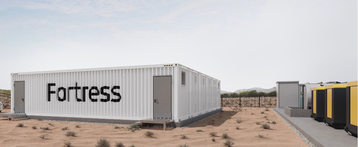
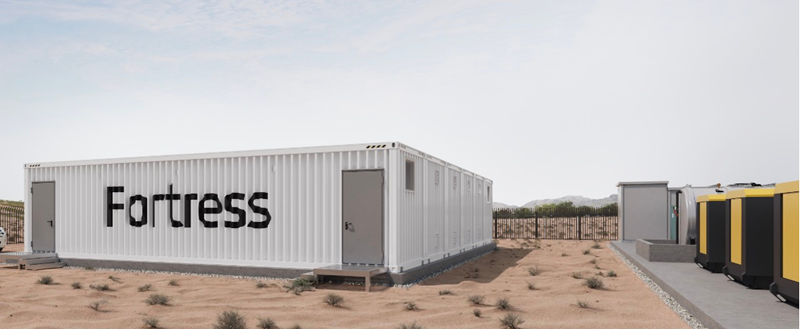
ILA sites are small network POPs located along long-haul fiber routes. These prefabricated modules provide space, power, and cooling infrastructure to support Inline amplifier hardware used within DWDM systems, repeating signals within fiber every 80- 100 km (50-62 miles).
Long-haul fiber companies each operate hundreds or even thousands of these modules across their networks. With many operators building out new fiber to serve AI data center needs, the number of ILAs is growing considerably.
The first model Fortress has launched is the low-density (LD) module, designed to support optical transport equipment such as the Ciena 6500 RLS.
The LD configuration supports 144–288 fibers, with each module delivering ten relay racks within an 8ft × 40ft (two meters x 12 meters) ISO container footprint with independent N+1 cooling. An LD-only cluster can offer approximately 83.5kW of facility load.
Fortress said it is also working on a high-density (HD) module designed to support up to 864 fibers, alongside six standard configurations that combine HD and LD modules based on site requirements.
The HD module will offer rear-door heat-exchanger cooling and a dedicated high-density fiber-management frame, which the company says will be able to host “dramatically more” fiber in the same on-site footprint.
Across the platform, configurations are designed to scale from approximately 83.5kW to 406kW of facility load, with two standard utility packages covering the full range.
Rack densities at ILAs are much lower than regular data centers, with all the networking gear often in the single-digit kilowatt range.
Early designs supported around 600–800W per rack, with today’s typically drawing around 2–4kW per rack. However, as we reach the upper limit of how much data can be transferred over a single fiber, companies are increasingly pushing more fiber pairs, pushing up rack densities into the low double-digit kilowatts. Future designs are expected to reach 5–6kW, and up to 12kW per cabinet for high‑density hyperscaler deployments.
While still lower than many compute racks, traditional ILA designs have remained largely unchanged for decades and were not intended to host such high densities. Many companies are now working to update their approach to ILAs to host more fibers in the same footprint.
Boston-based Fortress also develops Edge data center modules and satellite ground station sites.





Comments