
Whatever you are buying, no price is better than “free”. This is why free cooling has been a rising trend in the data center industry. Simply opening your air ducts to the outside world, however, can only go so far. Many companies install chillers to supplement outside-air cooling as necessary. But there’s a cheaper way to do this then buying and running a
chiller: fog.
Turn up the heat
Guidelines coming out of the American Society for Heating, Refrigerating and Air Conditioning Engineers (ASHRAE) have been the official standard IT manufacturers use to indicate environmental conditions in which their products are guaranteed to work. ASHRAE has consistently widened both temperature and humidity ranges in its guidelines, publishing the most recent version last year.
The horse powers of fog
Outside-air alone is not enough even in hotter rooms. Both temperature and humidity need to be adjusted to reach desired operating ranges. Still, the new ASHRAE guidelines make this a lot easier to do without running chillers. One way is to use fogging systems, which utilize the natural cooling effect of evaporation.
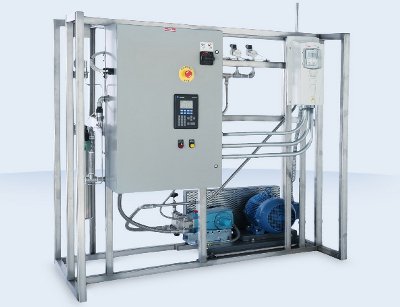
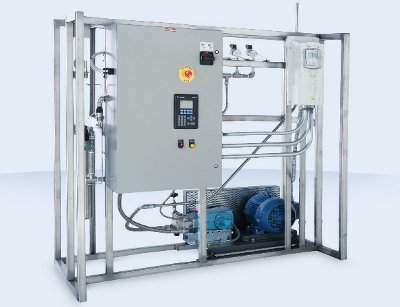
These systems use high-pressure pumps and specialized nozzles to convert water into a fine mist of sub-20-micron droplets that quickly evaporate in a stream of air, lowering the air’s temperature and raising its humidity. A system like this uses one horsepower to convert 600 pounds of water into fog every hour. Since evaporating one pound of water at room temperature removes about 1100 BTUs (British thermal units), each horsepower of pumping removes about 660,000 BTUs per hour – an equivalent of 55 tons of cooling. A fogging system with a 10-horse-power (hp) motor, therefore, could replace a 500-ton chiller and cost a lot less.
Three ways to use fog
Cooling the air: Fog’s primary application in the data center is cooling outside air. It can be implemented either as supplemental capacity to chillers or as the sole source of cooling.
In its data center in Prineville, Oregon, Facebook has chosen the latter. The 147,000 sq ft data center is located in the high desert, which gets 10.4 inches of rain a year, and whose air temperature on summer afternoons is well in the 80s and 90s Fahrenheit.
Facebook is using 28 7.5hp pumps and 6000 spray nozzles to cool the air it pulls from outside, getting average PUEs below 1.1. Effectiveness of the approach is not limited to data centers in hot and dry environments, such as Prineville’s. Facebook is also using fogging at its newer data center in North Carolina, where humidity is much higher.
Cooling the chillers: Fog can also be used to boost cooling capacity of existing air-cooled condensers. One major financial-services company has chosen to do just then when its data center was running out of cooling capacity and room for additional rooftop units. By installing fogging units on the roof, the company was able to cool 98F summertime air down to 80F to cool the condenser coils.
Humidifying: Dry air’s tendency to stimulate the build-up of static electricity is dangerous for data center equipment. Server heat can reduce humidity to dangerous levels, and fog can be used to prevent disaster.
Because Facebook’s latest data center in Sweden is about 60 miles away from the Arctic Circle, it has more free cooling than it needs. Still, the company chose to install a fogging system to maintain humidity. Free cooling is great, no doubt, but it’s not enough. When thinking about that supplemental cooling capacity or humidity control, consider fog.
About the author: Eric Adamson is national sales manager at Mee Industries.
Disclaimer: Views expressed above are those of the authors and do not necessarily reflect the views of DatacenterDynamics
This article originally appeared in the DatacenterDynamics FOCUS magazine special supplement FOCUS on Cooling