

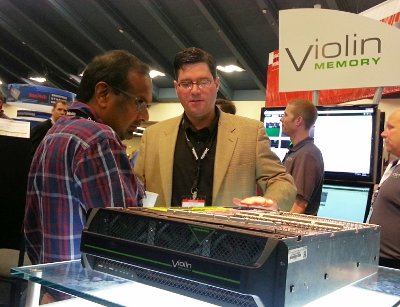
One could not help but notice a heavy presence of enterprise-grade Flash-array vendors at Oracle’s OpenWorld conference in San Francisco in October. Aside from storage-industry heavyweights (EMC and NetApp), smaller solid-state shops had reps on the floor showing off the wares. We spoke with three of them to get a sense of the direction of Flash-based storage in the data center.
Violin: sustained performance
Ashish Gupta, director of marketing at Violin Memory, says the biggest value proposition of Violin’s 2U all-Flash array is its ability to sustain high performance and low latency for long periods of time. “A sustained 1m-IOPS scenario, as well as microsecond latency,” he says about the product.
Violin buys Toshiba NAND Flash cards. Other than that, the system is designed in-house, including the company’s own controllers. It has 68 control points across the board. “Every part of the system is fully visible,” Gupta says.
Violin has put a lot of thought into reliability. Everything in the system is hot-swappable. There are four RAID controllers and each can be replaced mid-flight in case of failure. “There are no moving parts, outside of the fans, that are hot-swappable,” he says.
A common application is supporting a desktop virtualization environment, Gupta says, where one 2U box can support several thousand virtual desktops. It is also a popular solution for database deployments. “We can reduce the amount of compute you… need to run your database infrastructure,” he says. This means fewer Oracle licenses and fewer servers, which reduces energy consumption. Violin plans to add full data-management functionality to the array, including deduplication, compression and snapshot capabilities.
Kaminario’s value proposition
Israeli enterprise-Flash player Kaminario started in 2008 with funding from the famous venture-capital firm Sequoia Capital. Phil Williams, the company’s VP of business development, says the company’s founding team combines former employees of EMC, NetApp, IBM and other firms of similar caliber. “We bring a deep storage expertise to our company,” he says.
Kaminario’s all-Flash storage array for enterprises is a “pure-scale-out” one. “You can start small and grow in a linear fashion,” Williams says. Kaminario’s value proposition includes performance, availability and scalability, which it solution gets through Spear, the company’s own operating system.
The solution can take snapshots, and deduplication is in the pipeline. Most deployments have been within Oracle database environments, which don’t call for deduplication, Williams explains. Additional features can take away from the raw power that database customers want.
While Violin prides itself on in-house hardware design, Kaminario is the opposite, placing emphasis on its software chops instead. “We’re a software company,” Williams says. “We focus on the software stack. We take advantage of all the underlying hardware, including Fusion-io [Flash-memory vendor] and standard servers.”
TMS: raw power is everything
Compared with this next SSD company, both Violin and Kaminario are toddlers. “We’ve been around for 34 years,” David Mungenast, area director at Texas Memory Systems (TMS), says. Two days before OpenWorld kicked off, IBM closed its acquisition of TMS, testifying to the strength of its product.
The firm started with DRAM (like Violin did) and switched to Flash in 2007, Mungenast says. It uses the same Flash provider as Violin: Toshiba. But its strategy could not be more different from those of the young guns. While both Violin and Kaminario are hard at work trying to add data-management functionality to their arrays, TMS is all about raw performance.
“We can put 24TB of Flash memory in a 1U container and run it at less than 500 watts at half a million IOPS,” Mungenast says. He is referring to TMS’ all-Flash RamSan product line. “Its technical leadership is far beyond anything else, and the biggest reason is because we’re focused on speed,” he says, explaining the company’s differentiation strategy.
Storage IO is a data center performance bottleneck, and Flash-based storage arrays are offered as a solution. This is why the space is heating up. As EMC’s CEO Joe Tucci pointed out in his OpenWorld keynote, this does not mean Flash will replace spinning disk. It means Flash will replace spinning disk as a means to store data used by applications that need the highest performance. The future, he said, is fully automated storage tiering, where the type of data that needs to be stored determines the medium that will store it.
This article first appeared in DatacenterDynamics FOCUS magazine.