
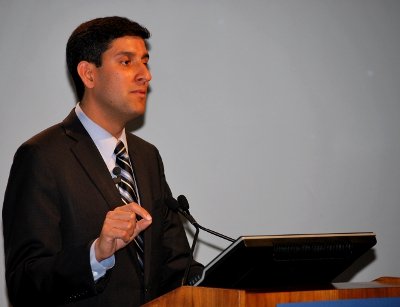

An analyst focusing on IT operations of the US federal government said White House CIO Vivek Kundra's 25-point action plan for federal IT reform contained too many action items and deadlines that were too ambitious.
Stephen O'Keeffe, founder of analyst house MeriTalk, said in a testimony before a US Senate subcommittee that his first review of the plan ended in confusion. "25 points ÔÇô really?" he said. "When I was a small boy in school, I had profound challenges remembering the 10 commandments ÔÇô and there were only 10 of them."
Both O'Keeffe and Kundra testified in front of a senate subcommittee tasked with evaluating the IT-reform plan on 12 April. As the federal government remained at an impasse on the next year's budget, the hearing's purpose was to weigh the Office of Management and Budget's request for US$25m to fund the plan's implementation.
O'Keefe's opinion was not based only on his childhood experience with the 10 commandments, however. MeriTalk recently conducted a survey of government IT professionals to gauge what the general impression of the plan was.
While the results gave general impression that the community found each of the 25 points desirable (some more and some less so), it did not think they were all doable.
Survey respondents rated data center consolidation ÔÇô the number-one item on Kundra's plan ÔÇô as doable but not as desirable as some of the other items, including creation of a platform for collaborating on and sharing best practices and case studies.
Other more desirable items were making IT budget models more flexible and creation of a formal career path for IT program managers, among others. Kundra addressed both of these items in his testimony.
Inflexibility of budgeting for technology procurement has been a major problem, he said. The federal budget process forces agencies to specify what solutions they are going to buy 24 months before they can start a project the solutions are for. There is usually also a 12-18-month acquisition process.
"This multiyear process locks agencies into specific technology solutions that are almost by definition out of date by the time the project starts," Kundra said.
For better IT deployment, agencies need to be able to decide on technology solutions at the point of execution, "so that the budget process is aligned with the technology cycle."
Another problematic area in federal IT is lack of process in hiring of program managers, Kundra said. This has resulted in high turnover and lack of expertise in this position in government agencies.
The government's personnel-management office has taken steps to address this issue, including a new career path to make the job more attractive for top qualified professionals and a new competency model.
Kundra began his testimony with expressing discontent with the current state of federal IT.
"Despite the vast promise of using information technology to improve how the federal government operates, we continue to see projects spiral out of control ÔÇô wasting tax-payer dollars, failing to deliver results and introducing security vulnerabilities," he said.
The aforementioned data center consolidation initiative would cut a lot of costs out of the budget.
Federal government spends US$24bn a year on IT infrastructure. That is 31% of its entire IT budget spent on assets Kundra says are "often redundant and inefficient."
Since 1998, the government has increased the number of data centers it operates from 432 to 2,094 ÔÇô growth Kundra calls unsustainable. "That is why we are actively shutting down 800 data centers by 2015," he said.
Download Kundra's 25-point implementation plan for federal IT reform by clicking here.