
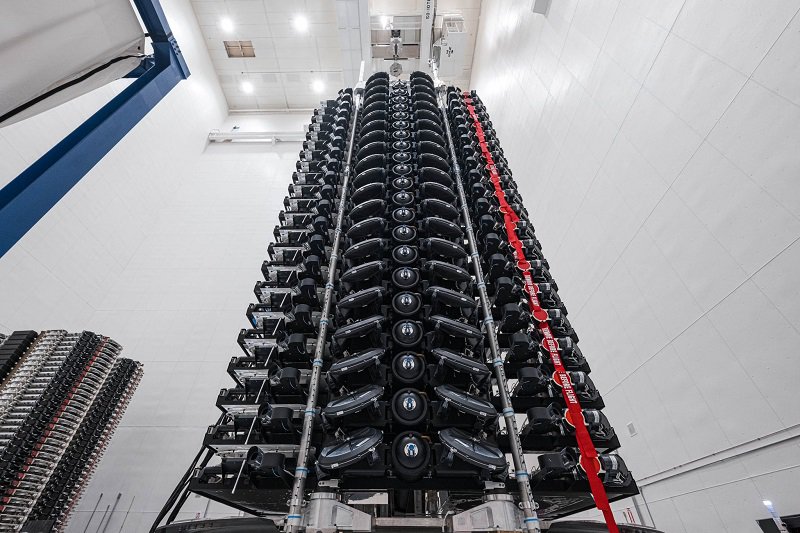
The US Federal Communications Commission (FCC) has approved Starlink's plans to deploy an additional 7,500 of its Gen2 satellites to comprise a 15,000-satellite constellation.
“President Trump is restoring America’s technology leadership,” explained FCC Chairman Brendan Carr in a statement. “This FCC authorization is a game-changer for enabling next-generation services. By authorizing 15,000 new and advanced satellites, the FCC has given SpaceX the green light to deliver unprecedented satellite broadband capabilities, strengthen competition, and help ensure that no community is left behind.”

SpaceX’s Starlink fleet is close approaching the milestone of 10,000 active satellites in its constellation, which today serves 9.2 million customers globally.
SpaceX had a potential plan for an eventual expansion to a total of 34,400 satellites in its giant low-Earth orbit constellation, and applied to the FCC for more than 22,000, which the FCC partially granted, doubling its existing cap on new Gen2 satellites from 7,500, granted in December 2022, to 15,000, which would represent a constellation of about 19,000.
The FCC has also allowed SpaceX to operate across Ku, Ka, V, E, and W-Band frequencies including direct-to-device services, and authorized the operation of its satellites about 200 kilometers closer to the Earth, including the deployment of “up to 144 satellites in up to 72 planes in each of the 340km, 345km, 350km, 355km, and 365km orbital shells, and deploying up to 120 satellites in up to 56 planes in the 480km and 485 orbital shells.”
Starlink has also received a “time-limited waiver” to operate its network at higher power levels to increase speeds, whilst the FCC updates its rules on limits to what it calls equivalent power flux density.
“We believe that while this rulemaking is ongoing, it is in the public interest to grant SpaceX’s request for waiver to allow it to exceed the equivalent power-flux density limits, given the benefits to SpaceX’s service and thus American consumers and the continued protection of geostationary operators,” the FCC said in its statement.
During the public comment period preceding the FCC’s decision, rivals such as Viasat, Globalstar, and Blue Origin voiced their concerns that the commission was empowering a monopoly.
“This proposed expansion of SpaceX's operating authority would give [SpaceX] an even greater ability and incentive to foreclose other operators from accessing and using limited orbital and spectrum resources on a competitive basis,” Viasat wrote in a letter to the FCC.
In its own letter to the commission, Globalstar wrote: “SpaceX’s failure in the September Application to provide a legitimate interference analysis is not surprising. As Globalstar has pointed out repeatedly, new operator entry into the Big LEO band is technically infeasible.”
In its 2025 report, Starlink announced that it had passed 600 terabits per second in network capacity. This will expand as the constellation launches its V3 satellites, promised to provide ten times the downlink and 24 times the uplink capacity compared to the V2 satellites. The report says it gained 4.6 million new customers in 2025 as part of activating more than 35 new markets, practically doubling its subscriber base from the year prior.
Rumors of Starlink’s IPO continue to abound, as they have for the duration of its existence, something Musk has occasionally invited. Previously, economists have been skeptical about a Starlink public offering, or its timing, believing the division would have spun off much earlier if it were a priority for SpaceX.




Comments