
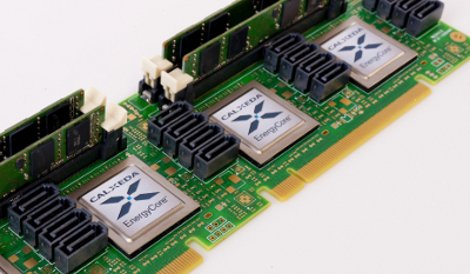

Facebook's hardware design and operations chief has taken a seat on the board of Calxeda, the Austin, Texas-based maker of ARM processors and SoC (System on Chip) cards for low-power servers.
In addition to his role as VP at Facebook, Frank Frankovsy is also chairman and president of the Open Compute Foundation, which oversees the open-source IT hardware and data center design community called the Open Compute Project. Calxeda joined OCP in January.
In a statement, Frankovsky said Calxeda had a “terrific vision for the role of ARM in the data center.” ARM Holdings is a UK company that licenses its low-power processor architecture to chip makers.
“I’m thrilled to have an opportunity to collaborate with their executive team and the rest of the board more deeply as they work toward 64-bit fabric and beyond,” Frankovsky said.
The 64-bit ARM SoC is what Calxeda and its competitors are racing to bring to the server market. Many of the cards, including ones by Calxeda, Applied Micro and AMD, are expected to become available in 2014.
Unavailability of 64-bit ARM chips has been considered a major barrier to adoption of the low-power processor in the data center space, since most data center applications are written for the 64-bit instruction set. Calxeda has had a 32-bit ARM product, which it has been marketing primarily for storage hardware.
The server market is a tiny portion of ARM's total revenue, almost all of which comes from licensing the architecture to companies making processors for mobile devices – companies like Qualcomm and Samsung. Lakshmi Mandyam, director of server systems and ecosystems at ARM, told us in a recent interview that only a few thousand of the 8.7bn ARM-based chips shipped in 2012 were “server-oriented” products.
Intel Corp. is a major competitor to all ARM vendors working to bring 64-bit server SoCs to the market. The giant announced general availability of Avoton, its Atom-based 64-bit server SoC, in September.
While execs from Calxeda and AMD told us they had tried and failed to buy Avoton, they conceded that the part would be available a few months ahead of any 64-bit ARM SoC.
Frankovsky's hardware and data center team at Facebook and OCP have not endorsed ARM over Intel or vice versa, saying that they try out all options.