
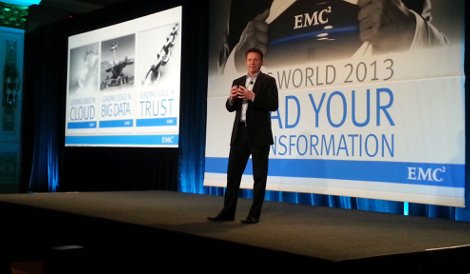

As its biggest announcement at this year's EMC World conference in Las Vegas, storage giant EMC unveiled ViPR, its software-defined-storage play, on Monday.
Simply put, ViPR does to storage what hypervisors by EMC's VMware, or Citrix and Microsoft, do to physical servers. It is a software control layer that abstracts physical storage underneath and creates virtual storage pools users can allocate to applications.
Initial ViPR products are slated for general availability in the second half of 2013.
It automates management of the underlying storage infrastructure (functions like provisioning or migration) and dynamically responds to new use cases. The platform supports storage arrays by EMC and by other vendors, as well as commodity hardware.
Through a ViPR self-service portal, customers can choose virtual storage resources from a catalog and provision them based on their applications' needs.
While enterprises are not excluded from EMC's go-to-market strategy for ViPR, the company designed the platform for service providers with cloud environments. It is built for globally distributed environments that scale out.
Amitabh Srivastava, president of the Advanced Software Division at EMC, said cloud was ViPR's “design point” was cloud, which meant it was designed with massive scale, high availability and geographic distribution.
Jeremy Burton, executive VP of product operations and marketing at EMC, said that one of the main challenges EMC was trying to address with ViPR was the mix of workloads in the modern data center. There are traditional workloads (which are not going anywhere) and the new-generation workloads, all of which have different storage-infrastructure requirements.
To accommodate this variety of requirements today, companies use different operators for different types of infrastructure, he said. EMC positions ViPR as sort of a “universal remote control” for all types of storage infrastructure.
By EMC's estimates, about 83m traditional business application instances are running today – a number the company expects to grow by 70%, reaching 141m in 2016. It considers applications like Java, Oracle database, SAP, Microsoft Dynamics to be in the “traditional” category.
The company estimates the number of “next-generation” workloads deployed to grow from about 6m instances today to 48m in 2016. Next-generation workloads are applications built on Node JS, Ruby on Rails, Spring, Python, Hadoop, etc.
To accommodate both traditional and next-gen workloads, ViPR separates the “data plane” from the “control plane”.
For traditional storage infrastructure, it will provide just the control plane, which discovers storage resources, creates virtual pools and provisions them to applications. It lets the underlying array to act as the data plane for these workloads that use file and block storage.
The new application workloads that are emerging often use enormous amounts of data, serving millions of users. They use object storage and new protocols, such as HDFS, for access.
ViPR provides object data services for these new application architectures. In addition, through its HDFS data service, it enables customers to perform analytics on data across heterogeneous storage environments without the need to move it.
The object data services include APIs (application programming interfaces) for Amazon's public-cloud-storage service S3 and the popular open-source cloud architecture OpenStack. EMC promises that existing software applications written to these APIs will run seamlessly.