
Distributed power delivery firm Scalvy has raised $13.9 million in its Series A funding round.
The round, which was oversubscribed, was led by investors including Climate Capital, Silicon Badia, and Skyriver Ventures.
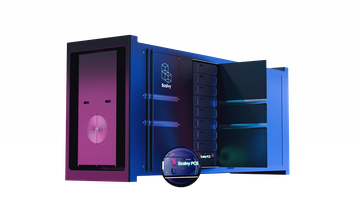
In a statement, Scalvy said that its total capital had now been raised to approximately $17 million, with the funds used to accelerate the field testing, deployment and certification of its modular power conversion units.
DCD has reached out to the firm for comment.
“Every conversation in tech right now is about AI compute — the chips, the models, the data centers being built at a staggering pace. What's getting far less attention is the power infrastructure that has to feed all of it,” said Namek Zu’bi, managing partner at Silicon Badia. “And it's not just data centers — this bottleneck shows up across industries, well beyond AI. Scalvy is tackling this at the architectural level, not patching around it, which is why we're proud to back them.”
Most power systems use a centralized conversion mechanism, wherein one power manager feeds multiple energy nodes. When a power system scales, so does the mechanism, increasing the chance of failure.
Scalvy has designed an alternative framework for power conversion using a modular architecture, cascading the conversion process across the power system using smaller units, which it calls ‘power neurons’. On its website, the startup claims that this results in 30 percent more usable energy and a 99 percent boost in the efficiency of the power system in which these units are deployed.
Scalvy argues for the widespread integration of its modular power conversion architecture into data centers to replace power shelves or be dropped into server trays.
According to the startup, the deployment of its power neurons can avoid the need for an HVDC sidecar and bus, and reduce a facility’s overall power shelf footprint by 60 percent. Scalvy sees immediate expansion opportunities in the AI data center niche, where demand for solutions that find power savings and expand opportunities to install more server racks is particularly high.
For the moment, however, Scalvy is primarily known for applying its modular power conversion architecture to electric vehicle (EV) drivetrains.
Earlier this week, the startup announced a successful test of its technology in an automotive battery system developed by Valeo. Scalvy also announced that it is currently field testing its Power Neuron architecture among select customers, and expects to begin commercial production of its system following the completion of requisite certification procedures next year.




More in Investment / M&A / Financing
-

-

-

Episode 2027 Trends and Outlooks: Europe
Comments