
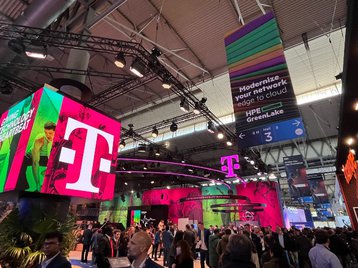
Deutsche Telekom CEO Tim Höttges has said the company is taking SpaceX's plans to launch a terrestrial network seriously.
His comments came after SpaceX founder Elon Musk stated last month that he wants to compete with the "Big Three" US carriers - AT&T, T-Mobile, and Verizon.
SpaceX is currently building its satellite network, focusing heavily on direct-to-device (D2D) connectivity that extends to some of the hard-to-reach spots that traditional telecoms infrastructure doesn't or can't.
Just this week, SpaceX announced it has signed a multi-year 5G infrastructure agreement with Qualcomm that will see the chip designer provide SpaceX with its radio equipment, baseband units, and software. This came a fortnight after reports that SpaceX was in talks to access 80,000 cell sites across the US to build out its network.
Musk's vision to offer carrier services has got the big telecom operators talking, with all of the US MNOs making reference to SpaceX's ambitions in recent weeks. T-Mobile CTO John Saw has previously warned Musk and SpaceX that it takes more than just spectrum to build a network, after SpaceX struck a deal to snap up Grain Management's nationwide 800MHz spectrum portfolio.
This time, it was the turn of Höttges, the leader of Deutsche Telekom, a company that is the majority investor in T-Mobile US.
Speaking on the company's earnings call, Höttges said: "If he wants to play in the telecommunication business or in the connectivity business, he needs terrestrial service, no question. And by the way, I take his attempt seriously."
The CEO also reiterated a viewpoint that has been shared by many within the telecoms industry that satellite connectivity is not a substitute for terrestrial service, particularly indoors.
"He has now bought 76MHz of spectrum. By the way, we have 400. So if you now say, okay, he can buy the spectrum prospectively, do your math. These are kind of triple-digit millions, or billions, which are needed to gain the spectrum position," said Höttges. "Okay. If he has the money, go for it. Then he has to build a network."
This network, he suggests, will require towers and a lot of them, plus tower rental costs, and the cost of antennas and the deployment of this equipment.
"My assessment is that SpaceX, if they want to play in that industry, needs at least a minimum of €200 billion ($223bn), or even beyond that to play in an industry which we have professionalized over the last 20 years. Okay. Welcome to the party."
Deutsche Telekom reported revenue of €31.1bn ($34.9bn) during the third quarter, an increase of 7.5 percent, with service revenue up 6.1 percent Year-over-Year to €26bn ($29.2bn).
Across the company's European units, DT increased its mobile subscriber base to 126.2 million, though fixed network lines across its European markets dropped 0.2 percent to 25.6 million.
Beyond this, adjusted net profit increased 12.7 percent to €3bn ($3.4bn) in the period.



More in Investment / M&A / Financing
-

-

-

Episode 2027 Trends and Outlooks: Europe
Comments