
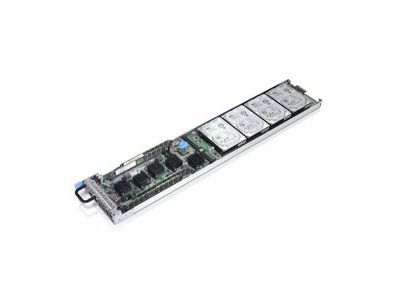

Dell has started shipping servers built on the small low-power ARM processors typically used in mobile devices to a select few customers and partners, the company announced Tuesday.
The idea is to give key developers access to the new machines so they can start testing operating systems and applications on them. ARM licenses its processor design – which has been attractive in the data center space because of its low energy use – to many processor makers.
Codenamed “Copper”, the ARM-based Dell machines have been shipped to companies like Canonical, a provider of products and services built around the open-source operating system Ubuntu, and Cloudera, which provides services based on the open-source distributed-computing framework Apache Hadoop.
Dell is also providing access to Copper clusters at several of its Solution Centers and through a partnership with the Texas Advanced Computing Center (TACC) at the University of Texas at Austin. TACC is famous for building and operating some of the world’s most powerful supercomputers used by scientists.
Forrest Norrod, VP and general manager of server solutions at Dell, said the idea was to enable development and testing of workloads on ARM for leading-edge hyper-scale environments.
“We recognize the market potential for ARM servers, and with our experience and understanding of the market, are enabling developers with the right systems and access for the current state of the ARM server market maturity,” Norrod said.
Dell said it began testing ARM server technology internally in 2010, responding to customers’ need for higher density and energy efficiency. The company has worked with its hyper-scale customers to understand how interested they really were in ARM and what they had expected.
Dell’s arch nemesis in the hardware space HP announced it was developing a server development platform called Redstone, based on EnergyCore ARM Cortex processors by Calxeda. Designed as a proof of concept, Redstone is a cluster that consists of 2,800 servers in one rack.