
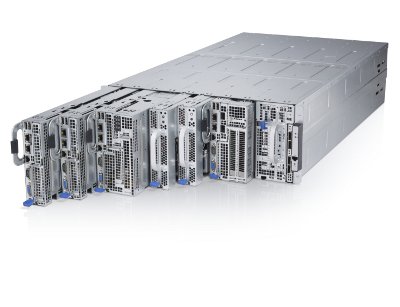
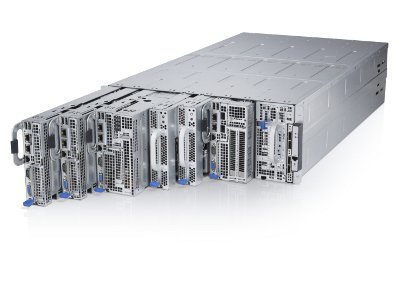
Dell announced a new series of server chassis and “sleds” that enable users to mix and match different compute, GPU and storage components within one 4U chassis.
The PowerEdge C8000 series is optimized for shared resource use and is best suited for high-performance computing, Big Data analytics or hosting, according to the vendor. A key benefit of swappable sleds is being able to upgrade separate components instead of replacing the entire chassis.
While C8000 products begin shipping this month, Texas Advanced Computing Center (TACC) is already incorporating them into the new supercomputer it is building called Stampede.
Dan Stanzione, deputy director at TACC, said Stampede consisted of several thousand PowerEdge C8000 servers with GPUs. “Dell’s infrastructure is invaluable in our mission of supporting data-intensive computing and visualization in complex computational science and engineering research.”
There are three C8000 sleds available: compute, compute/GPU and storage. Here are the details for each:
- PowerEdge C8220 compute sled: Up to eight C8220 nodes can slide into the C8000 chassis mounted on specially-designed single-width sleds.
- PowerEdge C8220X compute/GPU sled: further increases the performance and compute/memory density per rack, as well as allowing the use of GPUs and other accelerators. Customers can run multiple workloads in a single chassis in scientific visualizations and other resource-intensive workloads.
- PowerEdge C8000XD storage sled: This sled is ideal for workloads requiring flexible storage expansion, such as HPC, Hadoop and hosting environments.
- Building servers so that users can easily swap individual components instead of the entire box is not a novel idea.
Facebook, for example, through its Open Compute Project, is working on rack and server designs that will allow it to easily replace just the CPUs.
Frank Frankovsky, director of hardware design and supply chain at Facebook, told us incremental performance improvements in servers were driven primarily by CPU performance. Other components in a server, such as Ethernet cards and memory, can perform over multiple generations of CPUs.