
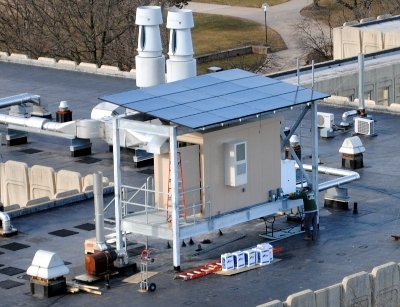
Rutgers University’s computer scientists have launched a test-bed data center for GreenHadoop, a framework that aims to ensure big-data workloads use solar energy to the maximum.
A major obstacle to using solar energy in data centers is solar panels' power output depends on the weather. GreenHadoop predicts how much solar energy is going to be available in the near future and times MapReduce (Hadoop basis) jobs when they can use most solar energy, according to a Rutgers paper on the subject.
When not enough solar energy is available but processing is a must, GreenHadoop finds times when grid energy is cheapest. It also manages peak grid power cost.
“Our experimental results demonstrate that GreenHadoop can significantly increase green energy consumption and decrease electricity cost,” the paper’s authors wrote.
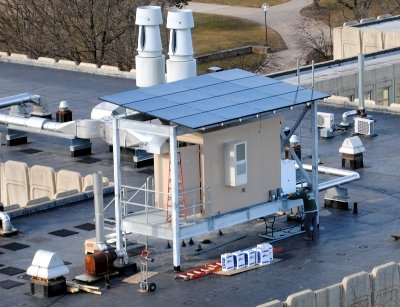
Parasol, the newly launched data center that will help test GreenHadoop and other tools, is a small metal container, complete with a set of solar panels and batteries. It houses up to 160 servers and networking gear.
Parasol uses a combination of free cooling and direct-exchange air-conditioning for cooling.
It can be configured to work completely off the electrical grid, using only solar and battery power.
GreenHadoop is related to the researcher team’s energy-aware scheduler for scientific computing jobs called GreenSlot. Where the two differ is in the amount of information about the workload available before scheduling is done.
GreenSlot relies on extensive information about the computing job required before it is scheduled. GreenHadoop does not need any information about job behavior, managing only data availability and peak grid-power costs.
Another project in the works at Rutgers’ computer-science department is GreenNebula, a combination of energy-aware job scheduling and the open-source cloud management system OpenNebula.
Not only will GreenNebula be aware of available green energy at a data center, it will also migrate virtual machines across multiple data centers to take advantage of dynamic supply.