
Neocloud Crusoe has developed a liquid-cooled version of its modular data center offering, Crusoe Spark.
Crusoe Spark Liquid supports up to 3.5MW of compute per system, but can be deployed in multiple units up to 100MW, cofounder Cully Cavness told DCD. Production is expected to begin next year, from the company's existing factory in Brighton, Colorado.
"It's a five-fold increase in computing density, going from 500kW IT in the [existing] air-cooled Spark version to now 3.5MW IT in the liquid-cooled Spark," Cavness, company president and chief strategy officer, said.
The Spark uses closed-loop cooling, so will not consume any additional water beyond the initial filling phase.
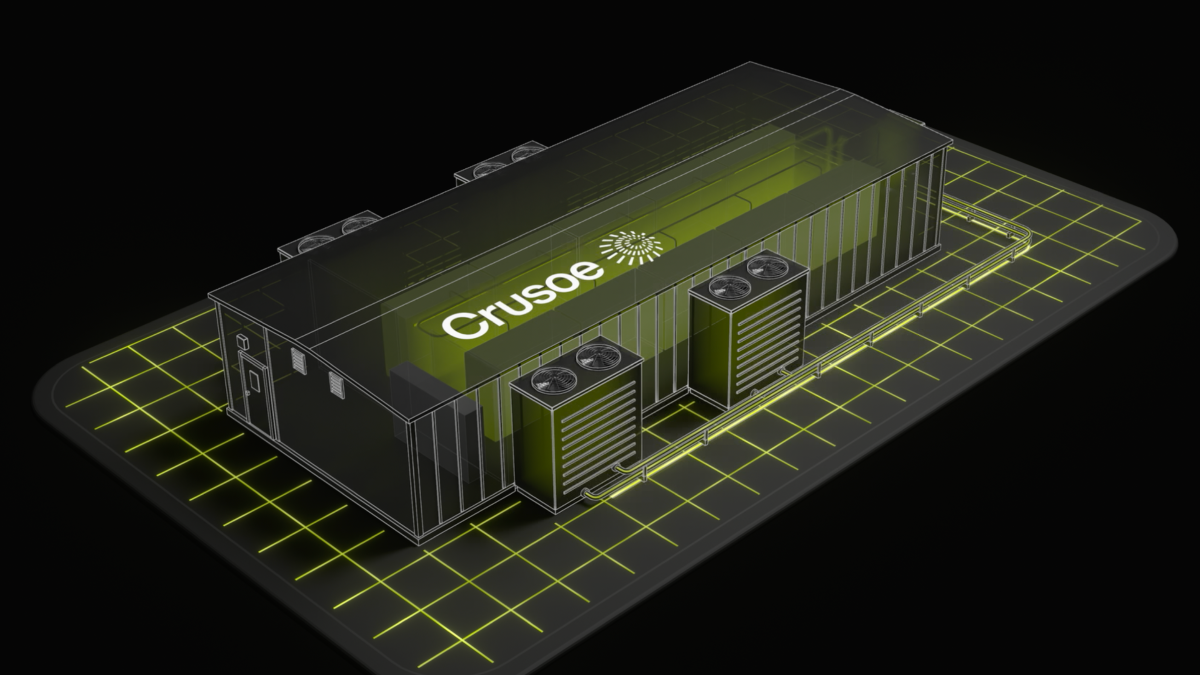
Each Spark consists of three shipping-container-sized modules "snapped together," Cavness said. "You can think of it in that form factor at roughly 60 feet long by 50 feet wide," he said, "that's a significant amount of space for things like compute, storage, networking, and we've designed it in a way that there's some flexibility so that over time, you can mix in next generations of chips and what might happen with storage and compute densities."
Currently, the product is firmly aimed at Nvidia's latest GPUs - supporting Nvidia GB300 NVL72 and Vera Rubin NVL72 racks - with all the Spark Liquids set to be produced in 2027 expected to use Nvidia hardware.
"Spark Liquid is one of the first designs that's compliant with DSX Modular," Cavness said, referring to Nvidia's new reference design for modular data centers. "They're also announcing that Spark is the first and only modular data center platform to achieve what they call Nvidia Exemplar status for cloud reliability.
"They've done a bunch of testing on the way we interconnect different Sparks, and they've said that B300s perform in that deployment to the same level of speed and reliability as they do in a large stick-built traditional data center market."
While the company believes that the performance is comparable, it still expects to take the traditional approach for larger-scale builds. "Ultimately, if you're going to go train a frontier model, we think still the large interconnected campus, like our flagship project in Abilene, probably makes sense if you're going toward gigawatt scale.
"[For Spark,] we're mostly looking at you know 10MW plus deployments. I think 20-50MW is probably a sweet spot."
All of the modular liquid deployments for next year are currently set to go to Crusoe Cloud, the company's cloud platform. "As you build data center capacity, being able to deliver on time is really important to our customers. A lot of customers tend to do reservations even ahead of deployments, given the supply-demand situation today," Erwan Menard, SVP of product, told DCD.
"I expect that over the years to come, we'll understand better where inference happens and how to bring inference closer to the user," he added.
"Not to mention that certain verticals like physical AI are always looking at improving latency, and so if I can scrap a little bit of latency by inferencing closer to, let's say, a fleet of robots in a facility, Spark is perfect for that. We also have demand for sovereign-type deployments, giving you a commitment of resiliency of compute and storage of any data related to the use of the model. I can give you an exclusive region, Edge zone, and you're the only tenant in there, which can be very helpful in certain countries."
In this current era of compute scarcity in a world of overwhelming demand, speed and trust are key to winning business, Menard said.
"If you go to the factory in Brighton, we build the shell, the container, but we also are able to pre-stage networking, which saves us a ton of time once we show up on site. We're looking with our storage vendors on how they can pre-integrate as well, and so everything is really designed for this predictability of ramping the capacity, and that's only because we're vertically integrated."
The company has also increasingly begun building its own gear, Cavness said. "So we go down to making our own switchgear at a factory in Tulsa, Oklahoma. We'll buy breakers and those kinds of components, but we do all of our own sheet metal work all the way through production of the switchgear board itself, including low voltage and medium voltage."
This helps the company deal with some of the supply chain constraints currently slowing the industry's growth, but it still faces others. "The supply chain is something that I think everybody's managing," Cavness said. "There are long leads across mechanical equipment and electrical equipment. You would have heard of a lot of these, but from chillers, CDUs, and transformers, just to name a few."
The other blocker the industry faces is increasingly strong local opposition. Here, Menard is hopeful that the smaller modular approach can avoid some of the pushback faced by megaprojects.
"If I'm able to build a 20-40MW site with similar per megawatt economics [as a large data center], it can be a fantastic project from a community view," he said. "We're bringing good tax money into a given community, and we're able to dial how much energy we are going to consume.
"And if I couple it with, in the near future, software feature capabilities around power management, I'm getting a really powerful AI factory that I can put in many communities with a good understanding of the impact on the grid, alongside positive taxes. And, obviously, no impact on water."


Comments