
Researchers from Loughborough University in the UK developed a chip capable of producing a “rainbow” spectrum of light that could unlock faster 6G communications and precision timing for quantum technologies.
The chip is about the size of a grain of rice and contains a microresonator producing precisely organized frequencies of light to form a microcomb. Where previous studies into these miniature chips have focused on generating a single, precise millimeter-wave frequency, the researchers sought to use a single microcomb capable of producing multiple frequencies at once.
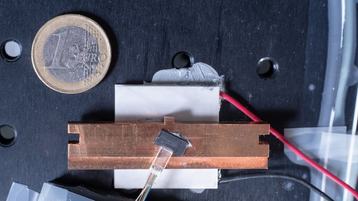
The research team included experts from the University of Sussex, City University of Hong Kong, and photonics vendor QXP Technologies. They were able to use the microcomb’s “rainbow” to produce variable strength frequencies that showcased precision and stability across millimeter-wave signals from a device smaller than a one-euro coin.
Millimeter waves offer far more bandwidth than lower-frequency radio bands and standard microwave frequencies, which makes them ideal for next-generation high-capacity technologies like 6G.
“The world is becoming increasingly data hungry. We want to send and receive more information, faster and in higher resolution, and millimeter waves could help provide the capacity to do that,” Luke Peters of Loughborough University’s Emergent Photonics Research Center explained.
The rainbow reference comes from the fact that both a rainbow and a microcomb are composed of many different light frequencies, but the difference is how those frequencies are arranged. Light produced by a microcomb is a precisely structured grid, whereas a rainbow blends them together.
“We’ve essentially created an incredibly precise and stable ‘rainbow on a chip,' where the loop keeps feeding the light back through the chip, allowing these states to build up efficiently, start on their own, and remain stable even when the system is disturbed," Peters noted. “It’s remarkably robust too. We’ve even had people jumping up and down next to the system, and the microcomb remains stable.”
The research team plans to take their microcomb technology out of the lab.
The microcomb chip might be minuscule, but the complete system is currently a tabletop laboratory set-up, suggesting that future versions could be even more compact and energy efficient. The miniaturization focus comes as they look to whether the technology could be used on satellites, where size, power, and weight are essential.
“They could ultimately contribute to faster, higher-capacity 6G networks, but the potential goes far beyond communications,” Peters added. These frequencies could also be used in radar systems as well as spectroscopy and astronomical instruments, helping scientists study materials and make extremely precise measurements of the universe.
“These applications are still some way off, and there are challenges to overcome before the technology can be used in real-world systems – but our latest work has tackled a major one," Peters noted.


Comments