
Corning has unveiled a slew of offerings aimed at optimizing networks for AI data centers, including a multicore fiber solution designed to boost network density.
The vendor’s new multicore fiber offering is an integrated cable that packs multiple cores into a single strand, with Corning claiming it offers four times the capacity per fiber.
Corning’s launch comes after it joined other vendors to commit to an industry standard design for multicore units. The demand for scale-out networks amid AI data center build-out led to the recent formation of the SDM4 MCF multi-source agreement (MSA), where Corning joined America Fujikura, Sumitomo, and TeraHop, signing onto a specification covering deployments such as intra-campus networks and other interconnect applications.
While the initial SDM4 MCF Specification will be finalized in the coming months, Corning used its presence at this week's OFC event to showcase its own multicore offering, which it claims can simplify data center installations, given its dense capacity would result in up to 75 percent fewer connectors and up to 70 percent less cable mass.
Corning also unveiled Contour Flow, a high-density microcable it claims “drastically” reduces cable diameter to maximize duct space to boost campus interconnectivity.
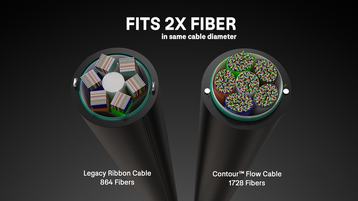
The product leverages Corning’s SMF-28 all-glass optical fiber technology, providing reach but with half the diameter of legacy ribbon cables, and providing double the fiber (1,728 fibers) in the same space.
Also showcased at OFC was a new 32-fiber Miniature Multi-fiber (MMC) Connector. Having already offered 12-, 16-, and 24-fiber configurations, Corning said the new offering further boosts fiber density and scalability for high-performance network environments.
Corning also revealed an unnamed copackaged optics (CPO) platform it said was developed alongside leading CPO system integrators and AI switch providers. The platform showed the potential for faster data transmissions and even higher bandwidth density, all while using much less energy.
“As AI capabilities continue to grow at an unprecedented rate, operators must build networks for today while planning for future demands,” Mike O’Day, SVP and GM of Corning Optical Communications, explained. “Across every segment of the network – from silicon and subsea to rural broadband and data centers – Corning’s innovations are shaping the future of connectivity.”




Comments