
Cisco unveiled Wednesday the fruit of its “spin-in” Insieme Networks founded to develop the Silicon Valley networking giant's answer to the software defined networking (SDN) trend.
In what looks like an attempt to differentiate and set itself apart from SDN hype, Cisco took the approach of automating the management of network requirements of specific applications directly, doing away with the concept of separating packet forwarding and control planes typical SDN applications require. Instead of abstracting the physical network that actually moves data packets by creating a virtual network layer on top, Cisco's model is complete transparency and awareness throughout the layers.
Jacob Jensen, an Insieme product management director, said the current SDN model created a virtual network within a physical network, and the resulting two networks presented a scaling and management challenge. “We didn't want those kind of models so we built a new kind of infrastructure,” he said.
The architecture is designed to use existing automation tools an IT shop may have, such as Chef, Puppet, or OpenStack. It will also support tools built in Python, Jensen said. It will do so through a set of open APIs (application programming interfaces).
While the physical network switches that are part of this architecture support the open SDN standard OpenFlow, the architecture as a whole does not use it.
Automate hardware management, not software
The idea is to give each application a network profile, which includes things like its connectivity, security, quality of service, storage and compute requirements. Using this profile, the network is automatically configured, wherever the application itself may reside at any given moment.
Instead of creating a virtual network and configuring it for each application's needs, Cisco's approach is to configure the physical network itself, decoupling only policy from the IP infrastructure.
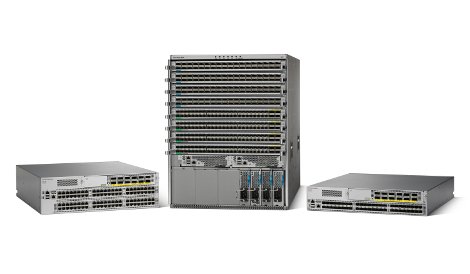
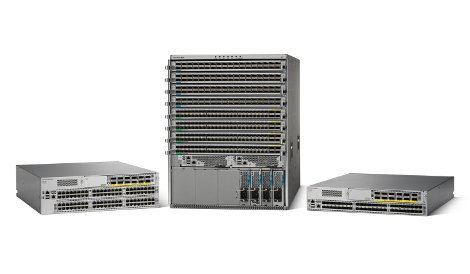
The approach, called Application Centric Infrastructure, has three pillars: hardware Nexus 9000 switches, the policy model and the application policy infrastructure controller (APIC). Cisco expects to ship the switches in the fourth quarter of this year and make the ACI mode available in he second quarter of 2014, Jensen said.
Until then, customers can simply run Cisco's NX-OS on the hardware. Once switched to ACI mode, the company is promising capital expenses of about US$15 per port per month and operating expenses of $25 per port per month.
The system scales from about 290 ports to about 55,300 ports, Jensen said. It can support one million unique IP end points and 64,000 tenants.
To give it scalability, Cisco did away with the spanning-tree architecture, replacing it with the spine-leaf approach.
Late to the party?
Some competitors framed the announcement as a catch-up game for Cisco. Kash Shaikh, senior director of product and technical marketing for HP's networking division, said Cisco was trying to deny the gravity of the SDN movement.
“They delayed SDN for as long as they could,” he said. HP, which has a big SDN play of its own, already has an SDN controller generally available on the market, Shaikh said.
Integrated-stack play, designed to sell hardware
Jeff Paine, VP of marketing at Vello Systems, a Menlo Park, California-based SDN vendor, said that while Cisco's solution was interesting, it was “all about hardware-based value.”
To him, the ACI announcement looked like a response to an encroachment onto Cisco's territory from the combination of VMware, which has a network virtualization platform, and Cumulus Networks, a start-up that sells cheap bare-metal switches with its own Linux-based operating system.
“It's very core-focused, which again is classic Cisco,” Paine said. It is all about the core of the data center.
While there is programmability in the ACI software, the solution is an integrated stack, which is "anti-SDN." One of the key ideas with SDN is to decouple the R&D cycle of hardware and software so solutions do not have to wait for each other, Paine said.
Addressing Jensen's assertion that creating an overlay network on top of a physical network infrastructure creates more complexity in management, Paine said it “flew in the face” of where the SDN movement was planning to go. The plan is to be able to configure any port, be it optical, Ethernet or virtual, from the same interface.
Cisco's “complexity” argument assumes nothing changes in the SDN space, which is still in its early stages. At the end of the day, the SDN movement is going toward a completely unified approach, where the underlying hardware really does not matter “and there will be interworking among different controllers,” Paine said.
Insieme dissolved in Cisco
Cisco announced to its employees in 2012 that it had started Insieme and funded it with US$100m, leaving itself the option to buy it later for $750m, according to a report on the New York Times' Bits blog. This is what gave it the “spin-in” status, which means a company established to be bought later by the founding entity.
Cisco has owned 85% of Insieme and on Wednesday said it would buy the remaining 15%. It will not keep the Insieme brand.