
AI chip company Cerebras has unveiled the CS-4, a rack-scale solution comprising three of the company’s newly launched Wafer Scale Engine 3 Turbo (WSE-3T).
The first member of Cerebras’ Nexus rack-scale platform architecture, the company claimed the CS-4 is twice as fast as the previous-generation CS-3 and has a 30x tokens-per-second-per-user advantage over GPU-based offerings.
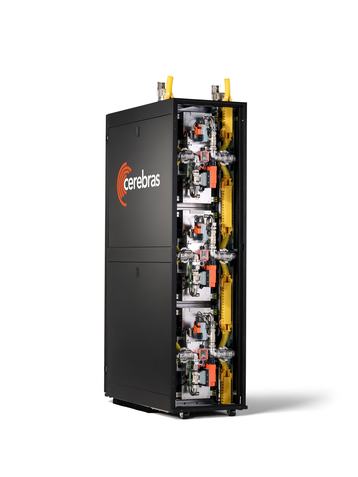
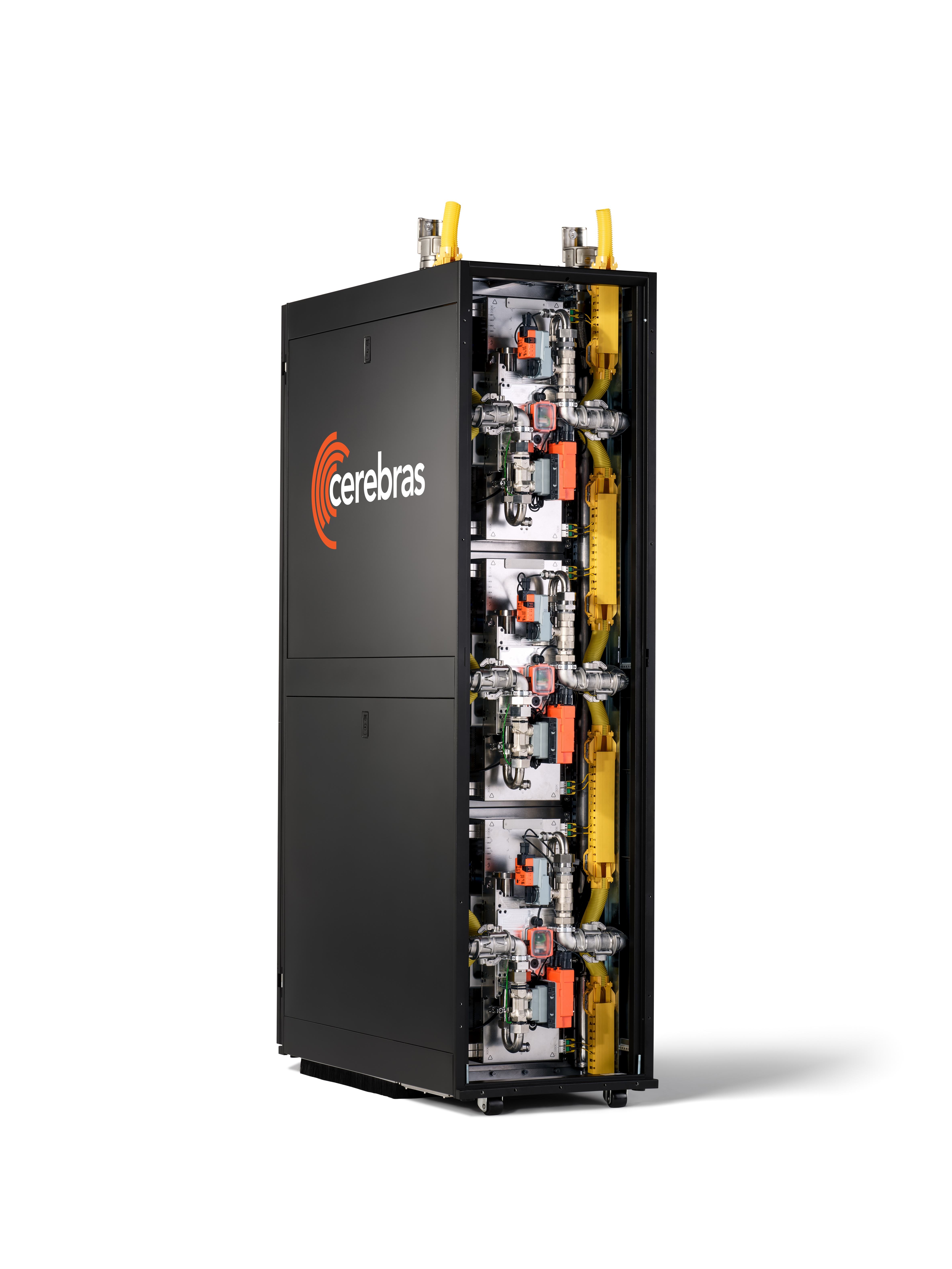
CS-4 has a modular design focused on compute, power, and I/O (input/output). It has a “rear-mounted backpack” that attaches vertically to the power array and supports power conversion, direct liquid cooling, and high-speed I/O in a single package built directly around the wafer.
According to Cerebras, by decoupling compute from the power supplies, the manufacturing process can be simplified, while deployment time is reduced from days to hours.
The CS-4 delivers 750 petaflops of AI compute, 7.2 terabits per second of I/O bandwidth, and 129.6 petabytes per second of memory bandwidth. Cerebras said the rack-scale solution can support “the creation of very large clusters” alongside models with more than 50 trillion parameters.
Meanwhile, the WSE-3T chip, which powers the offering, provides 250 petaflops of AI compute per wafer, 43.2 petabytes per second of memory bandwidth, and 44GB of SRAM. Containing 4 trillion transistors and 900,000 AI-optimized cores sitting on 46,225 square millimeters (71.6 square inches) of silicon, Cerebras said that, like its WSE-3 predecessor, the WSE-3T is the “largest AI processor ever built.”
“In AI, speed is productivity,” said Andrew Feldman, CEO and co-founder of Cerebras. “Historically, fast inference meant using smaller and less capable models. Cerebras CS-4 delivers industry-leading speeds on the largest frontier models, fundamentally changing the paradigm. Every aspect of the design has been optimized to deliver the highest speeds with massive throughput. With the CS-4, AI is so fast that it fundamentally reshapes product experiences.”
The first shipments of the CS-4 are expected to begin this quarter.





Comments