
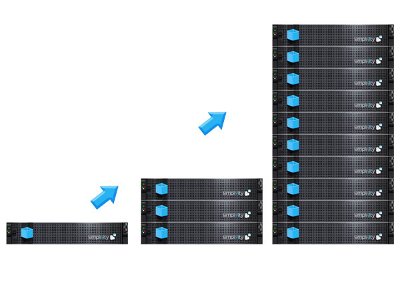

While George Slessman, the CEO of IO, is predicting the end of custom-designed – or what he calls “snowflake” - data centers (albeit putting a rather aggressive sunset date on them), standardization and commoditization is also happening in another layer of infrastructure: IT hardware. Just as data center companies such as IO are trying to stick all the different components of a data center (power, cooling, IT) into a standardized box, IT vendors, established players and startups, are doing the same with compute, storage and network.
In a recent example, a startup emerged from stealth mode in August with an end-to-end IT infrastructure solution with a basic building block that is one 2U box (although the minimum deployment size is two of them). The box, called OmniCube, produced by a company called SimpliVity, has compute, storage and 10GbE interconnect components. Want to expand capacity? Simply add more boxes. Whether you add them locally or remotely, SimpliVity’s technology OmniStack treats them all as one shared environment, which does everything from automatic replication for reliability, to server virtualization, deduplication and compression. The solution is optimized for VMware’s vSphere and enables VMs to move seamlessly within a data center, between data centers or between data centers and a public cloud.
So far this seems to be the ultimate in plug-and-play modular scalability and the same thing companies like IO are doing at the data center level.
SimpliVity’s founder, chairman and CEO is Doron Kempel. This is Kempel’s second startup after Diligent, a deduplication outfit he founded and eventually sold to IBM. The man in charge of engineering and product quality is Brian Nadeau, former executive director at Dell, where he managed the engineering team behind EqualLogic, Dell’s storage subsidiary.
With OmniCube, Kempel and Nadeau are going directly against their respective former employers, each of which has been playing in the emerging all-in-one-IT-infrastructure solution market. The key difference, however, is IBM and Dell (as well as Cisco, HP, EMC, Microsoft, NetApp and VMware) sell solutions that are basically pre-integrated packages of existing servers, storage arrays, network switches and virtualization software. SimpliVity just sells its cube – one box that does everything the big vendors’ packages of standard hardware do.
SimpliVity is not the only one. A startup called Scale Computing came out of the woodwork at VMworld in San Francisco in August with HC³, an integrated server/storage box that includes its own hypervisor. The idea is similar to SimpliVity’s: provide an all-inclusive solution that offers easy scaling and seamless VM mobility. A little more than one year ago, another startup called Nutanix launched its version of the all-in-one IT box. Its solution is called Complete Cluster – a 2U appliance that combines compute and storage capacity optimized for VMware.
Automated everything
All these products, fundamentally, are about the simplification of IT infrastructure management, which to a large extent means automation. When companies say they are simplifying infrastructure management, they mean they are automating the management functions that were done manually until things such as virtualization and cloud computing came about and turned IT-infrastructure management into a nightmare. To quote VMware’s recently departed CEO Paul Maritz, “at the end of the day, we are in the data center automation business”.
To avoid putting the quote out of context, he was commenting on the company’s recent acquisition of Nicira, a company with Software Defined Networking (SDN) technology that abstracts physical network infrastructure and enables users to provision virtual network resources and services. The quote also goes beyond SDN. It can be applied to the software-defined data center, or abstracting individual components of the IT infrastructure and automating back-end management functions via software.
The more standardized the individual physical building blocks, the easier it is to automate their management. Therefore, all-in-one appliances are a big step towards this vision of a powerful, yet easy-to-manage infrastructure.
Gateway to more efficiency?
Another potential benefit of extremely uniform IT is better management and resource utilization of the supporting data center infrastructure. If instead of having a data center filled with a patchwork of different types of servers, storage arrays, network switches and routers you have racks full of uniform 2U appliances, it is easier to predict exactly how much power you will need and determine an optimal cooling capacity that can be delivered uniformly across the floor. Given that the SimpliVities of the world have the resource-utilization bit worked out nicely for their boxes, this trend has the potential of making the data center manager’s life much easier.
If these standardized all-in-one packages do gain traction (on the face of it, it is hard to see why they wouldn’t) it will be a while before we see entire data centers filled with them. Like with the early generations of virtualization and cloud infrastructure, legacy applications and established organizational structures and processes will get in the way of a quick and complete transformation. If the industry does eventually start moving in that direction it will be interesting to see what effects a transformation like that will have on the underlying data center infrastructure as we know it today. What kinds of cooling systems will we see? And will increasingly complex data center infrastructure management (DCIM) solutions need to be so complex and all-encompassing?
This article first ran in the 24th edition of DatacenterDynamics FOCUS magazine (follow link for free subscription).