
Amazon Web Services (AWS) brought in $29.3 billion in Q1 2025, up 17 percent year over year (YoY).
While more than the previous quarter's $28.8 billion, this was the slowest growth seen by the company in the past year.
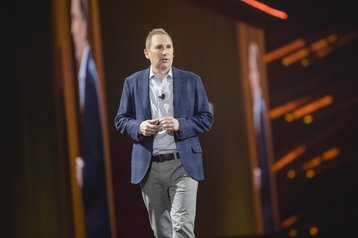
Revealed by the company during its recent earnings call, Amazon CEO Andy Jassy and CFO Brian Olsavsky remain positive with the cloud business segment's performance, noting that it is currently on track for a $117bn annualized revenue run rate.
Operating income for AWS was $11.5bn, compared with $9.4bn in the first quarter of 2024.
Similarly to the company's previous earnings call, CEO Jassy noted that capacity constraints were limiting revenue potential.
Jassy acknowledged that AWS has been bringing a lot of "P5" Instances live in the last quarter, which feature Nvidia GPUs, as well as instances with its own Trainium2 chips "as fast as we can," adding that "as fast as we actually put the capacity in, its being consumed."
"I think we could be helping more customers and driving more revenue for the business if we had more capacity. We have a lot more Trainium2 instances and the next generation of Nvidia’s instances landing in the coming months," he continued, though noted that some elements of the supply chain are a bit "jammed up." Jassy said that he believes this will improve as the year proceeds.
The quarter saw AWS signing new agreements with customers including Adobe, Uber, Nasdaq, Ericsson, Fujitsu, Cisco, Cargill, Mitsubishi Electric Corporation, General Dynamics Information Technology, GE Vernova, Booz Allen Hamilton, NextEra Energy, Publicis Sapient, Elastic, KPN, and Netsmart.
Jassy was keen to emphasize that "more than 85 percent of the global IT spend is still on premises."
"It seems pretty straightforward to me that this equation will flip in the next ten to twenty years."
He drew attention to the opportunity AWS believes AI provides - stating that prior to this "generation of AI" they thought AWS could have a multi-hundred-billion-dollar revenue run rate. "We now think it could be even larger."
Outside of AI, however, Jassy believes that enterprises will see the need to migrate to the cloud.
"Infrastructure modernization is much less sexy to talk about than AI, but fundamental to any company’s technology and invention capabilities, developer productivity, speed, and cost structure. And for companies to realize the full potential of AI, they’re going to need their infrastructure and data in the cloud," he told analysts on the call.
Speaking on AWS' "lumpy revenue," Jassy put this down to the sales cycle. He noted that while the company has a lot of start-ups that run on top of AWS, it is hard to predict when those start-ups are going to "find product market fit and grow substantially," while migration efforts by enterprises take time, and "it’s very hard for us to predict because it really is contingent on what enterprises how they wanna sequence it and resource it."
Capex for the quarter was $24.3bn, lower than the $26.3bn in the previous quarter. CFO Olsavsky said: "The majority of this spend is to support the growing need for technology infrastructure. This primarily relates to AWS as we invest to support demand for our AI services and increasingly in custom silicon like Trainium, as well as tech infrastructure to support our North America and international segments."
AWS, like Microsoft, was reported to be pulling back on data center leases. Analysts at Wells Fargo said in April that the company had pulled back from commitments at some colocation facilities.
However, while it was a key focus during Microsoft's earnings call, the topic went undiscussed by Jassy and Olsavsky.
Kevin Miller addressed the subject on LinkedIn last month, explaining themove as "routine capacity management."
He added: "There haven’t been any recent fundamental changes in our expansion plans. Fortunately for our customers, they’re able to focus on their business and leave these details to us."
The company has previously stated that it expects capex for the year to reach $100bn, though this includes its other segments and is not solely related to AWS.
Regardless, it seems that we can expect capex to increase later in the year.
When speaking on AWS' margins - which are approaching 40 percent for this quarter - Olsavsky put the quarter's performance down to AWS' "strong growth" and the company's "continued investment we're making in innovation and technology."
He explained that some of that investment has enabled AWS to optimize its server capacity and reduce its infrastructure cost. AWS has, according to Olsavsky, been developing more efficient and low-cost networking gear, and is also working to maximize power usage in its existing data centers.
While margins have been high for this quarter, Olsavsky noted that the company has "a lot of investment in infrastructure going on and planned for the second half of the year," which will have an impact.
Highlights for the quarter noted by CEO Jassy included AWS' new Outposts rack offerings and its announcement of the "Ocelot" quantum computing chip.
While the looming shadow of tariffs was mentioned during the earnings call, the impact of this was limited to discussions about Amazon's retail business
Overall for the company, Amazon posted sales of $155.7bn and an operating income of $18.4bn. Shares in Amazon declined around two percent in extended trading hours.


More in The Investment & Markets Channel
-

-

-

Episode DCD>Inside Virginia
Comments