
Immersion cooling firm Asperitas is developing a wall-mounted immersion cooling tank for Edge use cases.
Horizon is described as a compact single-phase immersion cooling system that integrates power and cooling into one compact, modular system for space-constrained environments.
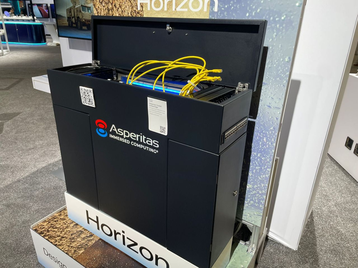
Each unit has a cooling capacity of up to 18.4kW in a 5U unit, with a 32°C ( 89.6°F) facility water system. The unit measures 103 cm by 28 cm by 82 cm (40 inches by 11 inches by 32 inches) and weighs 100 kg (220 lbs) ‘dry’ (i.e., not filled with fluid).
The company is pitching Horizon for use cases such as mining, manufacturing, retail, and healthcare.
The unit is designed with separate and independent cooling and power modules for easier servicing and upgrades. Able to be floor- or wall-mounted, multiple tanks can be connected to a single heat rejection unit.
The Horizon tank was quietly announced last month and recently showcased at Cisco’s CiscoLive event in Las Vegas.
“Over the past months, our team has been working on a system designed for demanding operating conditions where traditional IT assumptions no longer apply,” the company said on LinkedIn. “Horizon is still evolving. Learn more about the project and sign up for updates as we continue working on the next prototype.”
At the Las Vegas event, Asperitas was pitching Horizon as a potential hosting unit for Cisco’s Unified Edge hardware, which combines storage, networking, and security into a single cloud-managed offering designed for Edge use cases.
The Cisco UCS XE9305 offering totals 3U and is traditionally air-cooled, but the company has partnered with Asperitas and GRC to test immersion cooling.
The XE9305 unit generally requires around 3kW to operate. While Cisco has noted that its XE units’ “moderate thermal load” don’t require immersion to stay within operating temperatures, it said immersion “excels at isolating the system from harsh environments and mitigating noise.”
“Seeing Cisco Unified Edge operating fully immersed challenges the conventional way of thinking about Edge infrastructure,” Asperitas said. “More importantly, it shows how rethinking thermal management can unlock new possibilities as AI moves closer to where data is created.”







Comments