
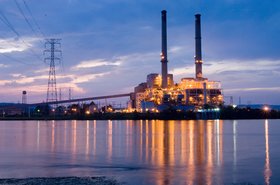
Arizona’s largest electrical utility, Arizona Public Service (APS), is looking to build a new 2GW natural gas power plant in Gila Bend, southwest of Phoenix, designed in part to supply Arizona’s fast-growing data center market.
First reported by Az Central, the Desert Sun Power Plant will be built in two phases. The first will add capacity to the grid, and the second phase will exclusively serve high-consumption customers, such as data centers, under a new subscription model.

The plant’s first phase is expected to come online around 2030, following completion of the Transwestern Pipeline in 2029. The timeline for the data center–focused second phase will depend on customer agreements, likely between 2031 and 2033.
The subscription model would permit large load users to finance and contract directly for the second phase, covering capital costs in exchange for long-term power rates. APS currently has about 30 data centers in its interconnection queue, requesting a combined 18GW of power. The utility claims that the approach could deliver power faster to hyperscale customers without burdening residential ratepayers.
Large users would have to pay for the second phase of the project in full, sign long-term contracts covering construction costs, and absorb the financial risks associated with building new power generation.
The utility recently adjusted its clean energy roadmap but plans to add 3GW of new gas generation and 7GW of solar, wind, and storage capacity over the coming years. Executives say the new plant will help maintain reliability during peak summer demand.
Jacob Tetlow, executive vice president and chief operating officer at APS, said the new plant is crucial to ensuring a reliable energy supply for its customers.
"Everything we're doing, we do it with a lens of reliability," Tetlow said.
At present, APS has almost 4.5GW of committed, high-load customer demand in its interconnection queue, mostly from the data center sector. In addition, it has more than 20GW of uncommitted large load customers.
APS provides energy to around 1.4 million customers across 11 of Arizona’s 15 counties.
In August, APS, alongside the Salt River Project, announced that it would acquire capacity from Energy Transfer’s Transwestern Pipeline Desert Southwest expansion project. The pipeline currently spans 2,590 miles, delivering 0.9 billion cubic feet a day (Bcf/day) of gas from the Permian Basin in southwest Texas to Arizona. The expansion - expected to cost around $5.3 billion - will expand the system by 516 miles and add 1.5 Bcf per day of capacity to the system.
Arizona is fast becoming a regional hub for data centers, with upwards of 129 data centers currently operating in the state. Hyperscalers, Meta, AWS, Google, and Microsoft all have a presence in the state.
The state is highly reliant on natural gas for its electricity. According to the US Energy Information Administration, gas-fired power plants accounted for 45 percent of the state's energy, nuclear for 27 percent, solar for 13 percent, and coal for eight percent.





Comments