
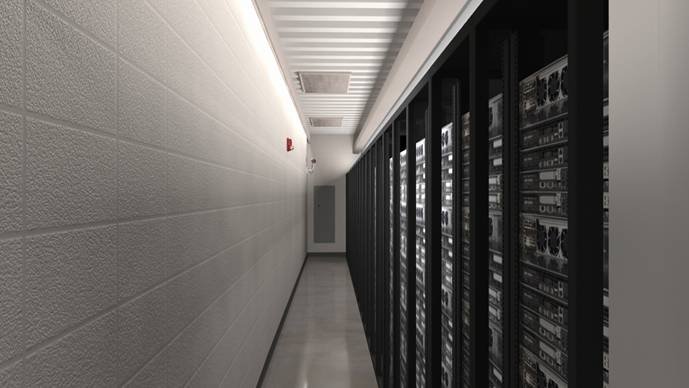

There is a new colocation provider in the Phoenix market with a modular offering unlike any others’. NextFort is leasing out 20-rack concrete-and-steel modules, each with its own scalable cooling infrastructure.
Mark Towfiq, the company’s founder and CEO, said the offering was something between retail-colo and wholesale data center space. “It’s priced like wholesale,” he said.
“We price it based on kilowatts,” but the minimum deployment size is smaller than in a typical wholesale deal. “We’re kind of in the middle.”
NextFort is finishing up its first data center in Chandler, Arizona, a Phoenix suburb that has become the region’s data center hotspot. Market heavyweights like IO and Digital Realty Trust have data centers in Chandler, and Cincinnati Bell-owned CyrusOne is building what will be one of the world’s largest data centers right next to NextFort’s building.
Towfiq said he was not worried about the competition because there was plenty of demand for data center space in the area. He was also confident a NextFort module would be much cheaper to lease than an IO module, for example.
Modularity and a straight-forward, highly standardized design give the company the ability to achieve economies of scale, enabling it to offer data center capacity at competitive rates.
First 25 modules are only the beginning
A single NextFort module supports up to 20 IT racks and up to 225kW of total IT power. The minimum deployment is one whole module and 75kW of power.
The first phase, expected to come online in the first quarter of 2013, has 25 modules, which is sort of a sweet spot for their deployment model, Towfiq said. “We build as we go,” avoiding a huge capital expenditure upfront.
There is a central generator yard and an uninterruptible power supply (UPS) room.
The property, which NextFort owns, can eventually fit as many as 200 modules.
The company is 100% privately funded by Towfiq and several others. Towfiq founded a colocation company called InteleNet Communications and sold it to a private-equity firm in the second half of last decade.
The private-equity firm used InteleNet’s assets to start a data center company called Latisys.
NextFort has no debt whatsoever, Towfiq said, and enough capital to build the property out to capacity and operate it into the forseeable future.
He and his partners are already looking at other US locations, namely in the Dallas market and on the East Coast.
Scalable and flexible cooling
Besides a unique approach to capacity build-out, NextFort has an unusual approach to cooling, which gives their customers a lot of flexibility in how they cool their equipment and full control of their cooling-power bill.
A tenant can start with one air-conditioning unit on the roof of the module and add more (up to four) as they increase power density inside. It will take only a few days for the provider to add a cooling unit, Towfiq says.
The module separates hot and cold aisles completely. There is no raised floor, so cold air fills the cold aisle, creating enough pressure to push it through the servers, which exhaust hot air on the other side for it to be sucked back into the cooling system.
The direct-expansion air conditioners, designed by Milwaukee, Wisconsin-based Johnson Controls, can use varying amounts of outside air to supplement cooling capacity and save energy. The units have variable-speed fans and variable-speed compressors.
If the temperature outside is cold enough, the modules can run on 100% free cooling. The system can also mix outside air with conditioned air to achieve the desired temperature.
Unlike in traditional colocation, tenants at NextFort will pay exactly for the amount of power their cooling system uses. This gives tenants the flexibility to choose the temperature they are running their data center at and to run different modules at different temperatures.
Since tenants usually share a central cooling system in traditional colo, their cooling-power cost is a factor above IT load. At NextFort, they have a dedicated cooling system, whose power is metered separately.
Controls for the cooling system were also designed by Johnson. Tenants can monitor and operate the system remotely, and since NextFort will also provide remote-hands services, a tenant does not necessarily have to have any permanent staff close by.
“They don’t really need to have any operations locally,” Towfiq says. “They can do it all remotely.”