
Power companies are increasingly incentivizing better power quality – a shift that is having a significant impact on the data center industry today.

Sponsored The hidden disruptor of data center harmony: Vol 1
Managing electrical harmonics so you don’t waste your energy on energy waste
Central to this is power factor, a key performance metric that measures how efficiently electrical power is being used. Maximized at unity (1.0), the closer a facility’s power factor is to one, the more effectively it utilizes electricity, reducing energy losses and boosting overall system efficiency.
By contrast, a fair to poor power factor – typically considered anything below 0.90 – requires more current to deliver the same amount of work, leading to increased energy waste and higher operational costs. Thomas Shircel, data center application manager at ABB, explains:
“If a system has any inductive loads, rather than purely resistive ones, the power factor drops below one. Inductive loads include things like motors, transformers, and fluorescent lighting, of which data centers have plenty.”
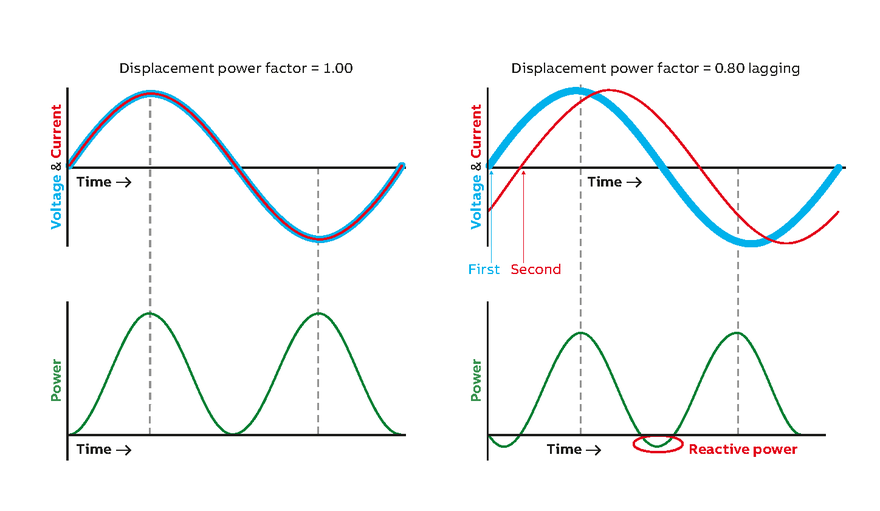
Electrical harmonics, which distort the ideal sinusoidal waveform of power, can also worsen power factor by misaligning voltage and current and increasing reactive power.
Lagging in the energy department
Power factor, just like harmonics, can create long-term challenges for electrical equipment. This may materialize in either a leading or lagging power factor for a facility, where a leading power factor occurs when the current waveform moves ahead of the voltage due to capacitive loads, while a lagging power factor arises when the current falls behind the voltage because of inductive loads.
In data centers, capacitive behavior often comes from equipment that uses capacitors for power conditioning, filtering, or energy storage (such as UPS systems and server power supplies), whereas inductive characteristics typically stem from devices like motors and transformers.
Expressed numerically, leading power factor is represented by negative values less than one, and lagging by positive values less than one. In either case, a power factor below one not only wastes energy but also places additional stress on electrical components, accelerating wear and degradation over time.
“A poor power factor can increase heating by up to 60 percent in cables, transformers, circuit breakers, and other devices. It can also reduce UPS capacity, shorten battery life, and compromise overall system efficiency,” clarifies Shircel.
This increased heat drives higher cooling demands, and because cooling equipment – such as fans and pumps – contains motors, it can further exacerbate power factor issues. For example, if multiple motors are causing lagging power, adding drives for cooling control upstream can improve efficiency, raise overall power factor, and ultimately reduce energy costs while enhancing system reliability.
Power factor to the people
The impact of power factor extends beyond individual devices to the wider electrical infrastructure, affecting all consumers – but especially large, mission-critical operations. As Shircel notes:
“Grid infrastructure can only be expanded so quickly, and the large amount of consumption occurring in such a short period directly affects not just new and existing facilities, but the power usage of individual users as well.”
Power factor also plays a critical role in the efficiency, capacity, and performance of standby generators, such as those used in hospitals or other facilities that require uninterrupted power. A low or lagging power factor increases losses in generator windings, reducing efficiency and often necessitating larger generators to handle the load. Beyond higher costs, it can also cause instability and tripping, which can have serious consequences in critical environments.
Every watt counts
Poor power factor can also be costly. Facilities with a low power factor rating are increasingly at risk of penalties from utilities. Because electricity is a premium resource, wasted power translates directly into higher costs, so operators may pay more per kilowatt for the same amount of usable energy. They may also need to purchase additional power to meet demand.
“Today, a lot of utilities are monitoring both displacement and distortion power factor – distortion being driven by harmonics – since together they form the true power factor.
"True power factor accounts for both forms of inefficiency, and while many facilities aren’t yet being billed for distortion-related issues, it’s likely that they will in the near future. Utilities have been planning for this shift for years, and as the supporting technology matures, they’ll be able to apply these charges far more broadly,” says Shircel.
In other words, whether through higher rates or increased consumption, energy waste always comes at a price. Even small inefficiencies matter, and treating equipment carefully contributes to broader energy stewardship and sustainability.
Industry trends affecting power factor
AC to DC
Power is still generated as alternating current (AC) at the plant and stepped up to very high voltages to minimize energy losses during transmission. Upon reaching a data center, the power is stepped down via transformers to voltages suitable for facility distribution. Even then, it arrives as AC, requiring conversion to direct current (DC) for virtually all modern IT equipment, which runs natively on DC.
Many data centers also use uninterruptible power supplies (UPS) that further convert AC to DC and back to AC to maintain reliability. Each AC-to-DC conversion contributes to harmonics and power factor challenges by introducing energy losses and heat, making repeated conversions inefficient – especially as servers, GPUs, batteries, and renewable energy sources are inherently DC-based. Shircel says:
“Data centers are increasingly exploring DC power at the chip level, reducing the need for multiple small converters to transform incoming AC into DC. Though, the fact remains that somewhere along the line, power still arrives as AC and must be converted.”
Meanwhile, much of the supporting infrastructure – motors, cooling systems, and other ancillary equipment – still runs on AC because AC motors remain more cost-effective. As Shircel notes:
“Even in the white space for processors, data centers still have large amounts of cooling and other equipment that run on AC, which can continue to cause poor power factor.”
VFDs to AFEs
Variable frequency drives (VFDs), developed in the 90s and 2000s, improved the displacement power factor for inductive loads and offered energy savings through pump, fan, and compressor control, but they were not designed with harmonics in mind. While effective at reducing some losses, VFDs did not account for energy lost to harmonic distortion.
Today, true power factor – which includes the effects of harmonics – is the standard for evaluating system efficiency. Active front-end (AFE) drives and other modern technologies allow operators to achieve unity power factor without generating large amounts of harmonics in the first place.
“The old equipment saved incredible amounts of energy and was the solution of its time. As we move forward, newer technologies like AFE drives allow us to save even more energy and become overall more efficient,” explains Shircel.
Proactive power factor management
Ultimately, improving power factor requires reducing both the phase difference between voltage and current and the total harmonic distortion in a circuit. Doing so not only lowers costs but also maximizes energy efficiency and enhances overall system performance.
Achieving this, however, depends on comprehensive data collection. In a data center, countless devices collectively influence the building’s overall power factor, and monitoring their performance closely can deliver significant efficiency and cost benefits.
Using AFE drives like the ABB ULH drive product, the current harmonics created are very low, having very little effect on the true power factor. The ABB ACH580 ULH drives can also be programmed to create counter kVAr to correct for the facility's power factor
Additionally, historical data from metering or electric billing can be used to program these drives for even greater efficiency, as Shircel explains
“This approach looks at the building’s best-case power factor and then determines how much corrective reactive power is needed from each drive to further improve the building’s power factor.”
Active power factor correction leverages a building’s power factor meter along with a building management system (BMS) or energy management system (EMS) to continuously adjust corrective measures. The BMS or EMS uses real-time data from the power factor meter to update ultra-low harmonic drives, monitoring feedback, and dynamically optimizing the total correction applied.
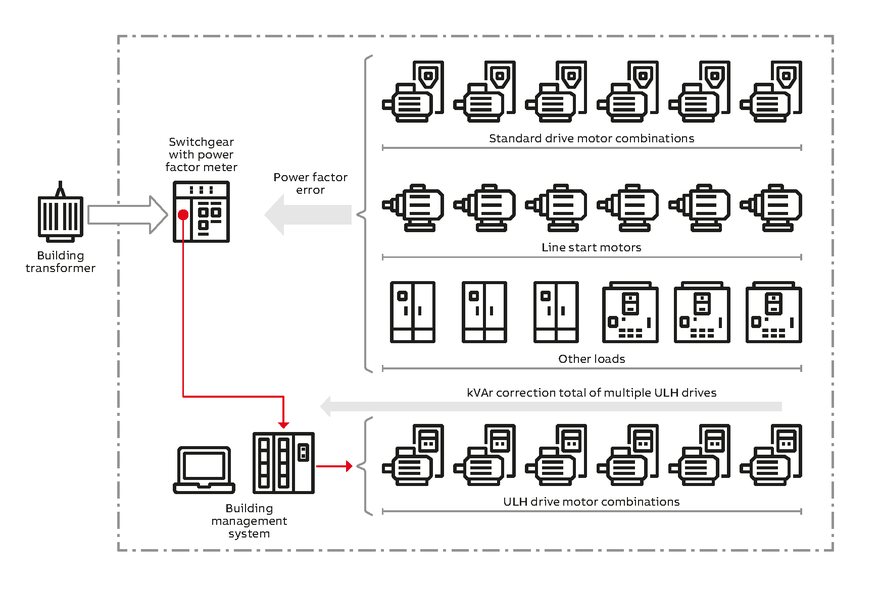


By feeding correction requirements directly from the BMS to the drives, facilities can monitor how efficiently their systems are running over time.
“Monitoring power factor lets you track equipment degradation, from transformers to motors to power conversion devices containing capacitors. Rising current can indicate faster degradation, helping predict potential premature failures.”
Achieving unity
As we’ve established, power factor is a critical parameter in electrical systems, reflecting how efficiently power is used and directly impacting both energy costs and equipment performance.
“When looking at the power industry, the ability to save energy through more efficient power use is just as important as generating more energy and reducing operational expenses. Improving power usage efficiency is essential for conserving energy, lowering electricity consumption, and supporting decarbonization strategies,” explains Shircel.
Newer technologies now allow facilities to correct power factor and reduce harmonics across a range of devices. AFE Drives, for example, are specifically designed to optimize power quality and efficiency, enabling operators to make the most of the energy already in use.
“We’re seeing increasing environmental responsibility, as well as legal rules and regulations that push companies to use power wisely,” Shircel continues, adding:
“Responsible governance and industry solutions – like those from ABB – help organizations reduce energy consumption, protect equipment, save money, and minimize environmental impact. For all responsible companies, managing power usage efficiently is not just smart – it’s the right thing to do.”
For more information, visit ABB.
More from ABB
-
Sponsored The hidden disruptor of data center harmony: Vol 1
Managing electrical harmonics so you don’t waste your energy on energy waste
-

Data centers: Energy efficiency and management
Actions must be taken to increase the efficiency of data centers during their operating life
-

Comments