
Across the industry, there’s one word on the tip of everyone’s tongue: power. More specifically, where to get enough of it. As grid constraints intensify and delays to securing sufficient capacity continue to grow, operators are increasingly looking beyond traditional utility infrastructure to support today’s complex, high-density environments.
In this shifting landscape, power inverters – devices that convert direct current (DC) electricity into alternating current (AC) electricity – are emerging as a critical competitive advantage.
“I think the industry as a whole has a lot to learn about power,” says Devin Dilley, president and chief product officer at EPC Power. “I think we all recognize it’s an issue, but there are solutions that can be provided by what I like to call digital power processing.”
Speaking at DCD>Connect New York 2026, Dilley and Adam Kabulski, chief growth officer at EPC Power, explore how Agile Grid Forming technology could reshape the way data centers manage power.

The role of inverters
“People think of inverters as just bulk power, moving at 60 hertz,” says Dilley. “But what they really are under the hood is signal processors. We can make any waveform possible if you have enough fast compute in the inverter.”
EPC Power’s latest power conversion platform, the M System, is built entirely on silicon carbide technology. According to Dilley, the architecture itself is one of the key differentiators:
“The latest inverter that we’re shipping today isn’t just one inverter, it’s actually ten. There are five on one side and five on the other. The main enclosure is really just a housing for those inverters.”
This modular approach enables flexible redundancy models and allows the system to operate either as a single coordinated inverter or multiple independent sources, depending on deployment requirements.
“It’s a full silicon carbide and fully grid-forming inverter,” adds Dilley.
Silicon carbide is becoming increasingly important in modern power electronics because of the performance advantages it offers over traditional silicon-based systems.
“One of the most fundamental things it does is increase the voltage that the devices can handle,” explains Dilley. “Instead of using silicon as a substrate, the substrate itself is a different crystal – silicon carbide – and its blocking voltage is significantly higher. That lets us choose circuit topologies that are more performant.”
Traditionally, silicon-based insulated-gate bipolar transistors (IGBTs) placed some limitations on inverter performance. Silicon carbide, however, enables greater efficiency and responsiveness from both the hardware and software layers controlling the system.
Managing variability and fragility
For EPC Power, the industry’s most distinct power-related challenges can be broken down into two critical pillars: load variability and load fragility. The first issue stems from the highly dynamic and unpredictable nature of modern AI and training workloads.
“Particularly in an AI training facility, the load variabilities can be synchronized, and you have this kind of pulsation as a result,” explains Dilley.
These fluctuations may occur over intervals of around half a second. For inverters this is considered slow, but it’s still severe enough to disrupt power systems.
“This can cause physical damage to rotating machines, whether it’s reciprocating engines or gas turbines,” continues Dilley. “It can also cause disruption to a typical grid.”
The second challenge is that data center loads themselves are highly sensitive to disturbances. When facilities are built, there’s a huge amount of work that goes on behind the scenes to run models and simulate grid faults. Even brief utility disturbances can create significant operational issues:
“If the utility company experiences a glitch that clears after 100 milliseconds, the UPS, which is supposed to be an uninterruptible power supply, disconnects itself from the grid,” explains Dilley.
Agile Grid Forming technology
Some operators have attempted to address variability at the rack level through local batteries or ultracapacitors. However, Dilley believes these approaches only solve part of the problem:
“Ultra-capacitors in the rack or nearby batteries can help, but they consume white space and don’t solve some of the fragility issues that are inherent anyway. Some variability happens in milliseconds, but it can also occur over half a second. That’s still outside the range of what generation systems and traditional UPS architectures can handle.”
This is where EPC Power believes standard grid-forming technology falls short. “You may have heard companies recently saying that grid-forming is all you need,” continues Dilley. “But for us, standard grid-forming by itself is not actually sufficient.”
Instead, EPC Power has developed Agile Grid Forming technology, a grid-forming approach designed to help data centers manage load variability and ride-through requirements.
“It’s connected like a standard battery energy storage system (BESS),” he explains. “The difference is that the inverter is not only a standard BESS, but also grid-forming.”
This architecture allows the inverter to absorb and smooth rapid fluctuations from the data hall before they ever reach the generation source.
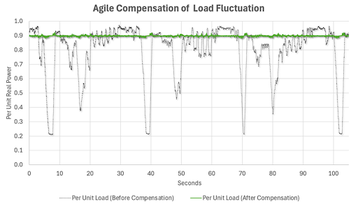


Crucially, EPC Power’s inverter technology is storage agnostic, meaning it can work in conjunction with fuel cells, flow batteries, long-duration storage, short-duration storage – provided there is a suitable DC source.
Aligning supply with demand
Securing utility interconnects is becoming increasingly difficult, not only because of variable loads, but also because utilities are concerned about the fragility of today’s large-scale data center infrastructure.
Operators need systems capable of remaining connected during faults and continuing to support cooling and compute loads through disturbances. Kabulski points to ERCOT (Electric Reliability Council of Texas) as an example of a grid operator already adapting to these realities:
“ERCOT has learned the hard way. During Winter Storm Uri, they experienced rolling blackouts. Out of necessity, they’ve had to think about how to build the most robust grid possible.”
As a result, ERCOT has introduced stricter requirements while simultaneously becoming an attractive region for data center growth due to its generation availability and renewable energy capacity.
Behind-the-meter power solutions are increasingly emerging as a practical response to these kinds of constraints.
“Utilities are not a monolith,” says Kabulski. “Every ISO is different. Every RTO is different. There are different rules.”
Rather than applying a universal strategy, EPC Power believes successful deployments depend on selecting the right partners and tailoring systems to local requirements.
“Whatever you do with the data center load, you have to ensure you have a low enough ramp rate so that you’re compatible with the generators and the ride-through requirements,” says Dilley. “You can’t be a fragile load. You have to be a robust load that’s willing to stay online and consume power.”
Digital modeling
Beyond smoothing variability, EPC Power is also using digital modeling to help utilities and operators understand how these systems behave under fault conditions.
“We provide models directly to utility company engineers,” says Dilley. “They work on them for months to study the inverter’s impact on the network.”
Utilities simulate conditions such as voltage sags, glitches, and phase jumps to determine whether the inverter stabilizes or destabilizes the grid. The result is that utilities have been able to identify opportunities to stabilize their network.
Dilley describes EPC Power’s inverter systems as effectively recreating the stabilizing behavior traditionally associated with rotating generation:
“What we provide is essentially a resynthesized rotating machine. If we’re processing power digitally, with high-speed compute and silicon carbide switching, why can’t we match the performance of a rotating machine?”
Across the industry, digital twins are becoming increasingly essential for infrastructure design, and power is no different. Building a full model of the system architecture is increasingly vital for ensuring facilities will function as required during faults or failures, reducing uncertainty ahead of deployment.
Preparing for tomorrow’s grid
For EPC Power, this technology is no longer theoretical: “This is shipping today,” says Dilley. “There are real sites being built with this right now. We’ve done full-scale demonstrations in our labs for hyperscalers and customers.”
The company’s systems are designed not only for today’s constraints, but also for the long-term evolution of grid infrastructure.
“We designed this with the assumption that you may start off-grid and eventually connect to the grid,” continues Dilley. “This isn’t about designing something that works for two years. It’s about designing something that works for the life of the project.”
Ultimately, EPC Power sees a future in which full decoupling between the load and the power source is the long-term objective.
“If you can isolate all the load fluctuation and the sensitive loads from the sources, then you’ve achieved full decoupling,” concludes Dilley. “Once you decouple those two problems, you’re free to choose any generation source, whether it’s turbines or whether you’re grid-connected.”
To find out more, check out EPC Power’s full Showcase Stage Session from DCD>Connect New York here, and visit their website here.
Comments