
Across the data center ecosystem, a series of AI-driven shifts are actively redefining power infrastructure requirements. Facilities are growing from tens or hundreds of megawatts toward gigawatt-scale campuses.
Rack densities and cooling architectures are evolving rapidly and load behavior is becoming more dynamic. At the same time, grid interconnection timelines increasingly extend beyond the schedules on which developers and operators need compute capacity online.
"The scarcest resource in AI infrastructure isn't chips or capital. It's the availability of energized megawatts on a certain date," says Dhruvay Jain, director of global strategy and ventures, power systems at Cummins.
For operators and developers, the implication is clear: the value is not in securing megawatts on paper, but in getting usable power to the IT load when the campus needs it.
As a result, both uncertainty and complexity have become intrinsic to data center construction and operations.
Where isolated strategies that treat individual components as standalone building blocks are no longer enough, the new power landscape demands a more advanced approach to power design and deployment. Instead, the principles of orchestral harmony are increasingly relevant: each component has a distinct role, but the real value lies in how they work together to produce a unified output.
If AI is a complex symphony, it will take the entire data center orchestra working together to hit the right notes.
Even a small change in how modern systems operate and synchronize can have meaningful consequences for performance. As demand for AI increases and facilities become increasingly interconnected in response, the stakes are rising, making a holistic approach to power architecture more important than ever.
To unpack this idea, Jain explores the importance of system-level availability over component reliability and the necessity of early architectural planning for managing risk and ensuring long-term scalability.
Adopting an architecture-first mindset
Traditionally, power infrastructure was designed around the grid as the primary resource, with onsite assets providing backup according to a defined load profile and redundancy strategy.
This model is quickly becoming outdated. As operators increasingly turn to onsite assets as primary sources of power, the value – and the risk – is shifting beyond individual components towards the interaction between them.
“You could have highly reliable generators, batteries, and switchgear, but if you don't have the architecture-first thinking in place to understand how these systems will operate together, you could have disjointed systems that are meeting your performance criteria, but not necessarily delivering the right reliability or performance,” explains Jain.
The objective is not simply to have reliable individual assets, but to ensure the overall architecture delivers the availability, scalability and performance the campus requires.
Prioritizing system-level availability is a broader concept that considers how the entire power architecture performs when individual assets fail or need to work together. Jain breaks down the core principles behind this thinking into three distinct vectors:
The first is containment. Systems need to contain failures rather than propagate them. The idea isn’t to create a system where nothing ever fails, but one that can maintain performance when something does.
“Anybody can design a power system that works when everything works,” says Jain. “The architecture proves its value when something fails at 2am. Reliability is about whether an asset fails. Resilience is about what the campus does next.”
The second is repeatability. Rather than treating every site as a first-of-a-kind system, operators need repeatable modules that can be scaled and improved without requiring costly and time-consuming re-engineering each time, particularly as developers scale across multiple phases or campuses.
Third comes the controls. Once an array of assets is operating as an integrated system, the hardware and software responsible for coordinating them become increasingly important. The architecture needs more than reliable instruments – it requires a good conductor.
“Controls used to be a bit of an afterthought,” says Jain. “They were important, but they weren’t looked at as the cornerstone that ties all of these pieces together. Now, with these setups operating almost like mini power plants, controls must be looked at as first-class citizens.”
Together, these principles shift the focus from individual equipment reliability to repeatable, system-level availability.
Pitch perfect
Today’s power ecosystem is increasingly complex, bringing together generation assets, battery storage, controls, power electronics, utility connections, and renewable energy sources. And with each operating according to different physical characteristics, control requirements, objectives, and failure modes, a fundamental orchestration challenge is afoot.
“When we think of power electronics, they tend to respond in microseconds, while batteries operate in milliseconds,” says Jain. “Our reciprocating engines operate in seconds, and then you put turbines and others in place that tend to go in minutes.”
The challenge therefore lies in managing these different timescales so the individual components complement rather than compete with one another – creating a coordinated power system for the IT load
Beyond response times, protection systems, charging infrastructure, and communications also need to work together, while interoperability remains a critical industry-wide challenge. When different assets lack standardized methods of exchanging data, the interfaces between the equipment can become just as important as the components themselves.
It is a principle built into the hardware: Cummins' 5MWh BESS uses a flexible DC block architecture designed to work across multiple power conversion and energy management ecosystems, and to integrate with diesel and natural gas generation rather than operate alongside it.
As grid constraints push data center operators to consider alternative approaches to meeting growing power demand, this ability to integrate technologies becomes increasingly important, particularly where natural gas prime power and battery energy storage are deployed together.
Coordination across different timescales, combined with the interoperability required for efficient data exchange, enables individual assets to operate as one resilient system. The result is a power architecture where every instrument has a role, but none is expected to command the stage alone.
Designing for the unknown
The reality of today’s data center landscape means designing architectures capable of supporting a future generation of technology that has not yet been created. Without a crystal ball, the solution lies in designing with uncertainty at the core.
“Any projection that we have today of the future is most likely inaccurate,” says Jain. “There are different rack densities, cooling systems, and load profiles – all of them are moving so fast that it’s almost impossible to identify exactly how to host them even a few years from today.”
Key to managing this uncertainty is distinguishing between reversible and irreversible decisions. Foundational elements such as site layout and electrical topology can be difficult and expensive to change once construction is underway, making flexibility from the outset essential.
“Designing these core elements with the mindset that you can alter, augment, or modify them – instead of packing walls and floors to the brim with efficiency – is the first design principle,” says Jain.
Other decisions can be made more easily and relatively economically, allowing for additional flexibility to be built into a site. Extra switchgear, conduit, communications cables, and other provisions may represent a relatively small investment during construction but become significantly more valuable as a facility evolves.
This is where the distinction between functions and interfaces becomes critical. Individual assets have defined functions, but they also need to interface with the wider system through elements such as modular switchgear and interconnection points.
“We think of future scalability as an interface problem before it’s a capacity problem,” says Jain. “If you’re able to factor in those interfaces from the get-go and think about how to leave space for interconnections to happen, then you’re already designing for the future.”
Foresight cannot be retrofitted. Future-proofing therefore means creating the conditions for new technologies and systems to be introduced without requiring campuses to be fundamentally rebuilt.
This principle extends to fuel readiness, too. A gas platform deployed today needs a trajectory towards alternative fuels – whether through hydrogen blending, renewable fuels or efficiency improvements. Similarly, battery selection should be driven by the specific role they play within the wider system, helping to manage energy between assets, responding to load fluctuations or supporting performance at the point of interconnection.
This is why architecture-first thinking starts by defining what the power system needs to deliver, and the role each asset will play as those requirements evolve.
“Onsite power isn't a bridge you demolish when the grid arrives. Designed well, it stays as standby, as peak support, as grid services. You have to define that second life on day one, or speed today becomes stranded capital tomorrow,” adds Jain.
Securing this scalability also requires early validation. As a project moves from architectural design towards procurement, construction and commissioning, the cost of discovering a problem rises sharply.
“The most expensive place for any engineer, OEM, or solution provider to discover a problem is when you’ve deployed that in the field,” says Jain. "Now it's the field with the revenue clock running – a month of delayed energization isn't a rework cost, it's a month of compute revenue on hundreds of millions of dollars of installed silicon."
Pushing risk upstream by leveraging simulation and modelling allows operators and their partners to test how the different instruments in the orchestra will perform together before the full system reaches the stage.
Setting the record straight
Managing risk also means selecting reliable partners across the ecosystem. Beyond supplying individual products, suppliers need to support the operational shift towards architecture-first thinking.
"Customers don't experience component reliability. They experience system availability. In response, we’ve expanded from a product-centered engagement to more of an outcome-centered engagement,” says Jain. “More and more, customers are asking what outcomes we can drive for them, and not necessarily what equipment we can supply.”
For Cummins, the shift toward architecture-first power builds on capabilities developed over decades. With close to 40 years serving the data center industry and experience designing paralleling power solutions dating back to the 1960s, Cummins has long brought together generation, controls, switchgear, and system-level integration to deliver reliable, resilient power.
This combination allows Cummins to approach the power system as an integrated architecture rather than as a collection of individual assets.
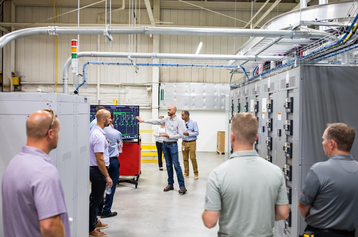
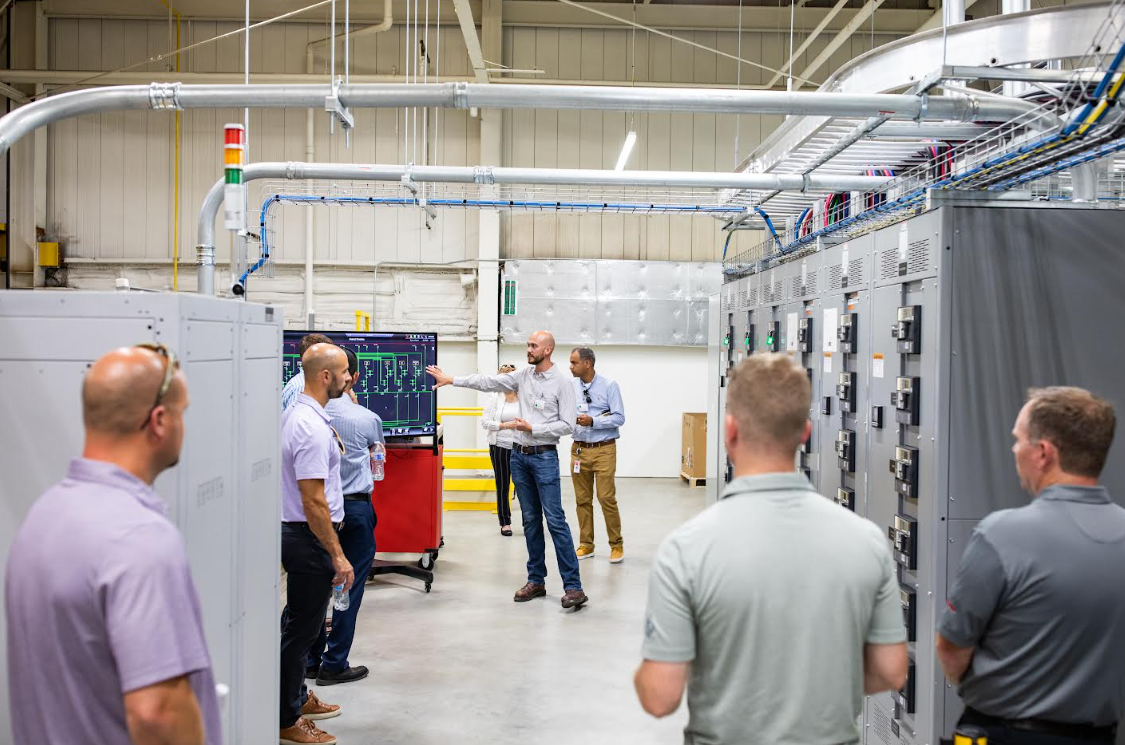
The infrastructure to support that systems-level approach is already in place. Cummins’ Power Integration Center provides an environment to configure, integrate and validate multi-asset power systems before deployment, helping identify interactions and potential issues before they reach the customer site.
Recent projects demonstrate how that approach translates into very different power architectures. Cummins worked with Circe Energy, an AI high performance computing platform, in West Texas to architect a first of its kind microgrid architecture with HSK78 and QSK60 natural gas generator sets, preconfigured and validated with integrated controls, and long-term service. In another project announced in August 2026, Cummins specified and integrated battery energy storage systems for a large US data center project, its largest BESS deployment to date.
There, the solution was defined around utility requirements for managing AI-driven load fluctuations, mitigating load oscillations and supporting ride-through performance at the point of interconnection.
“Nobody buys a battery,” says Jain. “They buy a load profile the utility will accept. That's what we were solving for.”
The technologies differ, but the engineering principle is the same. “In both cases we started from the same place,” says Jain. “What does this system have to deliver, and what role does each asset play in delivering it? The equipment list comes last.”
The speed at which these capabilities are moving from development to deployment reflects another change in the market. Cummins launched its BESS platform in May 2025, with its largest deployment to date following almost 15 months later. Over the same period, they are actively expanding and have committed high-horse power gas platforms to major prime power projects for data centers with deliveries extending from 2026 through 2030.
As AI changes both the scale of demand and development timelines, power roadmaps are having to evolve just as quickly.
“The capability of integration isn’t changing. It’s the scale at which customers need this to be deployed that’s altered most dramatically – and the consequences of getting it wrong are huge,” adds Jain.
This shift is reflected in the conversations Cummins is having with customers. Rather than beginning with questions about generator specifications, the focus is increasingly on the underlying problem: what role will the grid play today and in the future? How will the system need to expand? How should it be serviced throughout its lifetime?
Part of this broader role also means challenging assumptions that no longer reflect the realities of AI infrastructure.
One common misconception is that AI data centers are simply bigger versions of traditional facilities. According to Jain, with power densities, cooling systems, power electronics, controls, and load behaviour becoming increasingly tightly coupled, the reality is more fundamental.
Similarly, many still believe that securing a certain number of megawatts automatically means a site is power ready.
“A nameplate megawatt is not a compute megawatt,” says Jain. “What matters is what survives derating, maintenance intervals, reserve requirements, fuel constraints and power quality and whether it actually reaches the IT load when you need it.”
A third assumption concerns how the decision itself is framed. Operators routinely compare the capital cost of onsite generation against a grid connection and conclude that onsite power is the expensive option.
"This comparison does not accurately capture the economics of the decision," says Jain. "Denominate the decision in time rather than dollars, and the costliest megawatt is the one that arrives three years late."
Play on
For Jain, the crux of architecture-based thinking comes down to a simple question: how can data centers absorb change without sacrificing reliability?
“Change is imperative and it will happen,” he says. “So, when we’re building this future-ready AI infrastructure, it starts with how we build the right platforms – which are repeatable and not just one-off projects. This means modularity of power blocks, standardization of controls philosophy, and validated interfaces.”
For Cummins, these principles are increasingly shaping how established systems expertise is being applied to the next generation of AI infrastructure. As campuses bring together a broader mix of onsite generation, storage, controls, and grid connections, architecture will increasingly need to account not only for how those assets perform together today, but for the roles they may be asked to play tomorrow.
"A campus with gigawatt-scale onsite generation, storage and real controls is functionally a power plant,” says Jain. “The future-ready ones will be designed to give something back to the grid because that's both an economic opportunity and a social licence question. Communities will favour data centers that strengthen the grid over ones that strain it."
That evolution underscores the value of designing for optionality from the outset. The power architecture built to meet a campus’s needs today may be asked to play a very different role tomorrow – making adaptability as important as capacity.
“The digital infrastructure that’s being put in place is evolving on the semiconductor timeline and power infrastructure has traditionally evolved on a project basis. I think an architecture-first approach is the best way to reconcile those two philosophies into one, and help operators secure a long-term competitive advantage,” concludes Jain.
For operators, the challenge is not to predict every change ahead, but to ensure the power system they build today can absorb it. Cummins is drawing on decades of power systems expertise, alongside multi-asset integration, controls and validation, to make that adaptability repeatable at scale.
As the power landscape grows more complex, resilience will depend not only on the quality of each instrument, but on how well the entire system performs together.
The power architecture you design today decides what your campus can do for the next 20 years. Cummins works with operators, developers, and EPCs from the earliest planning stages to design, integrate, and validate complete power systems – generation, energy storage, controls, and power infrastructure, engineered to perform as one. To start the conversation, visit https://www.cummins.com/en-na/generators/data-centers
More from Cummins
-

Sponsored The new data center playbook: Diversifying power strategy to unlock growth
Managing the power bottleneck by redefining it as a strategic lever for growth
-

Minimizing generator set exercising
Optimizing diesel generator testing strategies to reduce emissions, fuel consumption, and operational costs while maintaining backup power reliability
-

Sponsored Beyond innovation: How partnership and integration are powering the data centers of tomorrow
Innovation alone isn't enough – it must be matched by resilient, end-to-end service with the right people behind it
Comments