
The digital economy, desire to automate core functions of our personal lives, and a push for business or geopolitical power are driving tremendous data center demand. To accommodate this demand, data centers have evolved. But I believe we’ve reached an inflection point where data centers will transform in even more dramatic ways over the next 25 years.
The positive development is sustainability as a force for transforming data centers for the better. I break it down here, but first, let’s see how far we’ve come and where we must go.
Computer rooms to data centers to AI Factories
When computer rooms started in the 1970s, they were concrete bunkers housing an analog mainframe the size of a small house. Next came digital mainframes and minicomputers in multi-use buildings. The era of rack-mounted Intel X86 type servers arranged in very large server farms and clouds came next, and the name migrated from computer rooms to data centers.
In these data centers, IT racks were arranged in rows and around 3kW per rack on average. The average power per rack would rise marginally over a few decades to 5kW then 10kW per rack. A large data center in the 1980s was about 3MW in size. In the 1990s, as we entered the cloud era, we started to see 5-10 and even 20MW data centers. In the 2000-2010s, a 25-100MW data center was considered extremely large.
Today, 1000MW data center campus projects are under construction, with plans for 10 GW AI Factory campuses that will be built in stages. At the end of 2030, my estimation for the total GW of all data centers installed worldwide will be 200GW.
Major changes will happen
The digital economy and automation of core functions are moving through AI, and I see major changes today and many more coming for data centers. The following predictions consider where we’ve been and where we’re headed in 25-year intervals: 2000, 2025, and 2050.
Utility power source
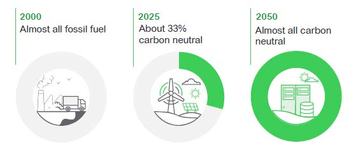
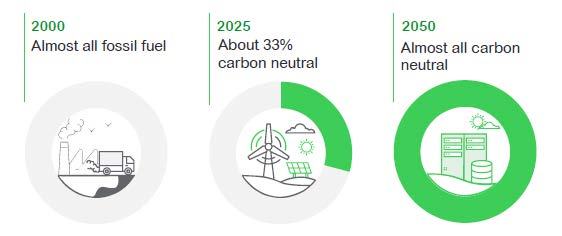
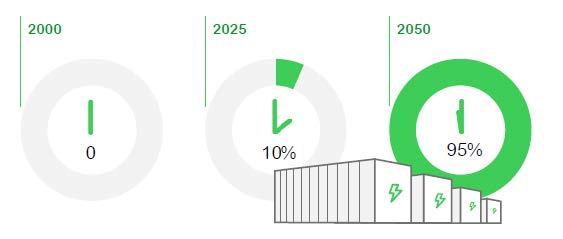
CO2 wasn’t an issue when data centers were smaller and far fewer of them existed, but today’s facilities are rightfully carbon-conscious. Today, they would all likely run off 100 percent carbon-free sources if available and will transition quickly when they are. These will include SMRs (small modular reactors), traditional nuclear, green H2 fuel cells, geothermal, hydro and wind and solar.
The beginning of 2025 ushered in an era of self-power generation. The majority of these plants are natural gas turbines, many with carbon capture which effectively contain 90 to 95 percent of the carbon produced during operation. However, carbon capture is energy intensive. I expect the self-powering trend to continue for a decade and then an era of transition to SMRs and eventually green hydrogen. So, 10 more years where the total data center power will be neutral to carbon additive followed by 15 years of a transition to carbon free.
Onsite battery storage hours
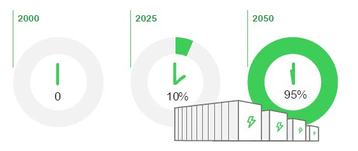
As utility power sources become increasingly distributed with wind and solar, they’ll need to be not only stabilized with battery energy storage, but two to four hour data center battery storage will become a strategic grid connected asset that charges when carbon free sources are available and discharges during grid stress or when only high carbon sources are available. This allows data centers to act as a player in the power grid ecosystem without generating carbon emissions.
Diesel fuel-based backup
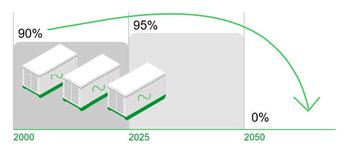
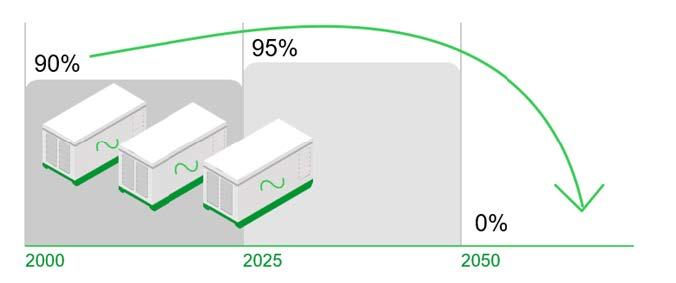
Increasing capacity in the data center industry is one of the factors driving the diesel generator market, which is expected to grow from USD 1.1 billion in 2023 to USD 2.1 billion in 2032. But a significant change in data center utilization will be the phasing out of diesel fuel used in these generators.
Renewable HVO (hydrotreated vegetable oil), also called R100, is drop-in replacement that can lower CO2 emissions by 90 percent. Biodiesel B100 can drop carbon dioxide emissions 60 to 90+ percent but needs to be mixed with diesel. Newer gen sets are being designed to natively run on hydrogen while modifications can be done on existing diesel generators to have them run mostly on hydrogen (~90 percent hydrogen) when the hydrogen is green, which will help cut CO₂ emissions by ~85 percent. Running generators on fossil diesel will most likely go the way of the dinosaurs.
Green hydrogen-based backup
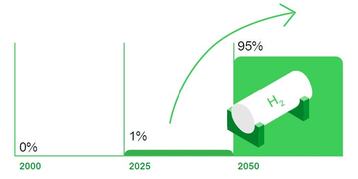
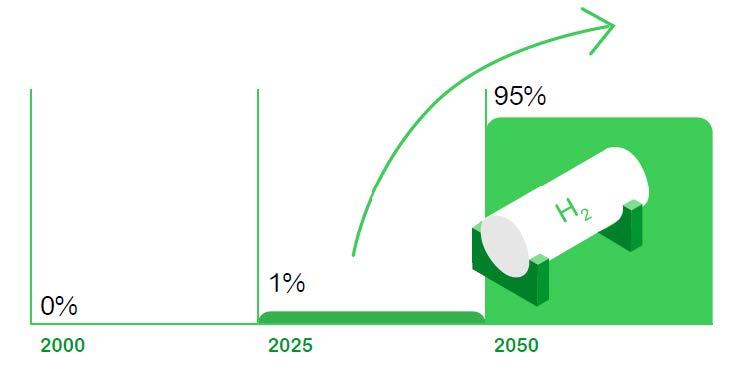
As carbon-free utility sources scale and become ubiquitous, electrolyzers are constructed, green H2 costs decrease, and methods for storage and distribution are developed, fuel cells, back-up power engines and turbines running on green H2 will become more viable. Gray hydrogen, mostly consisting of fossil fuel-based steam methane reforming, makes up the majority of the market for hydrogen power today.
However, it will likely phase out in favor of clean hydrogen, as demand increases and costs become more competitive. By 2050, clean hydrogen is forecasted to make up 75 to 100 percent of hydrogen demand.
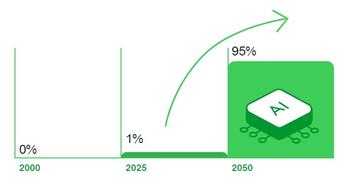
Utility collaboration, integration and automation
Transparency and close collaboration can pave the way for data center deployments at scale. Contracts and written agreements exist today but are limited to peak shaving and load shedding. Next comes intelligent processes for supply and demand management with data sharing for interactive decision-making and actions. In the AI future, power automation between data centers and utilities will be commonplace. The global smart energy market is already significant, being valued at USD 219.1153.80 billion in 2026, on its way to USD 416.2 billion in 2033.
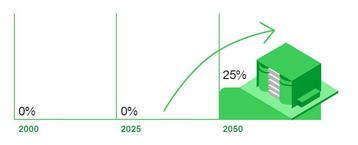
Primary power on-site
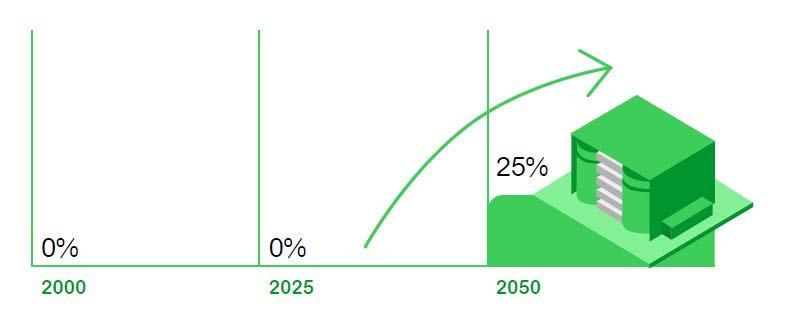
Speed to power is driving more and more data center operators to source their own supplies of power on site or site adjacent. Natural gas turbines are appearing first, with very large turbines heavily back ordered, but energy parks are being designed to parallel 50MW turbines into very large capacities. SMRs (small modular reactors) look promising once they are proven to be safe and reliable.
While there has been much excitement surrounding SMRs recently, they will not be a panacea in the near term to meeting on-site power needs. The US, Russia, China, United Kingdom and Canada are leading the way in SMR technology among developed nations, but most of the reactors now under development won’t be online until 2035 to 2040.
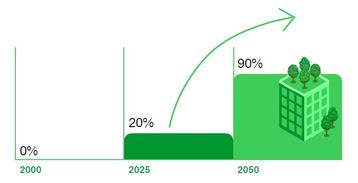
Green construction
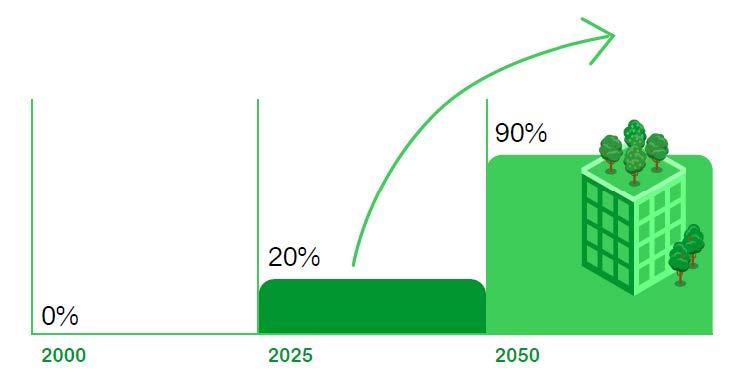
Green materials were not available in 2000. Going forward, green materials including cement and steel will be used as availability increases and cost decreases. The market is poised for dramatic growth over the next decade as these materials become increasingly desirable and accessible. Globally, the green buildings market is forecast to more than double from USD 565.33 billion in 2024 to USD 1374.2 billion by 2034.
Water use
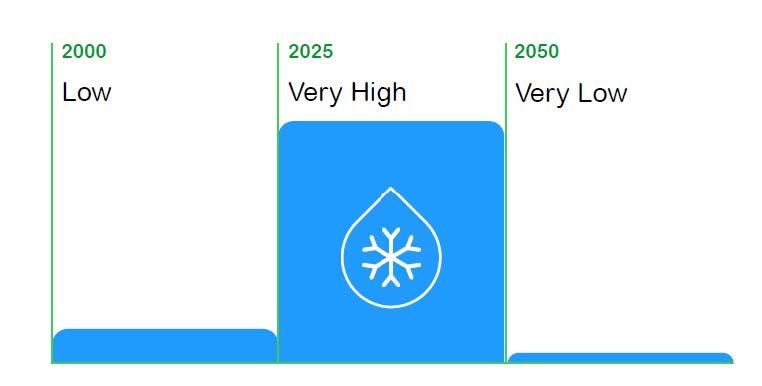
The data center industry has traditionally depended on air cooling that evaporated water to use less electricity. It sounds paradoxical, but liquid cooling can use little to no water, and the industry is rapidly adopting these water-economical cooling options to support AI.
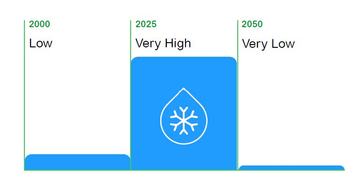
Closed-loop liquid cooling systems only have to be filled once – like the cooling in your car. Plus, many of the newer GPUs can run at very high temperatures, so the liquid circulating through the cold plates can be at 45C (113F), which is very warm. This means the heat rejection does not have to work as hard and we get benefits of free cooling in most climates using dry cooler heat rejection which are essentially large passive radiators.
Average power density per IT rack
The average power density per rack is already on the rise: 15kW on average today and moving faster than any time in history with Vera Rubin at 227kW per rack and AMD Helios 455 at 267kW per rack. The AI forces commencing in GPU-accelerated servers will continue to drive densities higher, with projects passing 1MW per rack. This density will push liquid cooling and power distribution systems to mature and innovate to keep up. Space reallocation is a reality and will continue as the physical space inside modern "AI factories" is shifting. Computer footprint sizes are shrinking while heavy electrical and cooling infrastructure – such as dry coolers, chillers, generators, and switchgear – grows dramatically.
Direct-to-chip and immersion liquid cooling
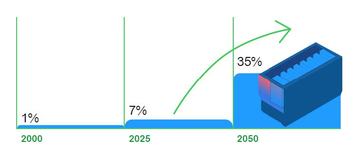
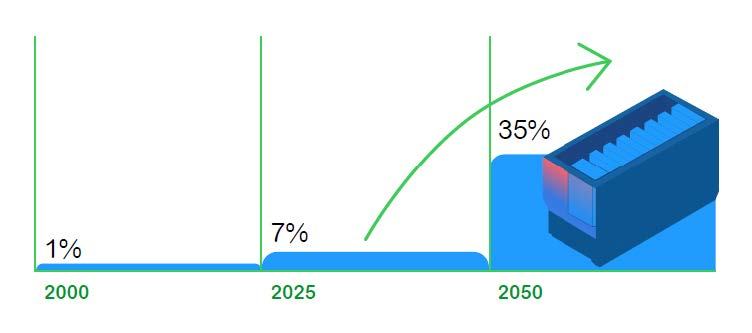
The latest and most powerful GPU-based accelerated servers are all liquid-cooled servers and will continue to be. The liquid cooling market is projected to grow at an astronomical CAGR of nearly 25 percent between 2024 and 2031, to an estimated USD 16.79 billion. More of the server boards are adding more cold plates for the CPUs and other silicon making a higher percentage of the servers liquid cooled (94 percent for the Vera Rubin). In the future, the networking equipment and the 800 VDC power supply cabinets will be liquid cooled but could be cold plate or immersion.
Voltage feeding the servers
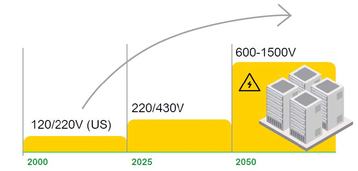
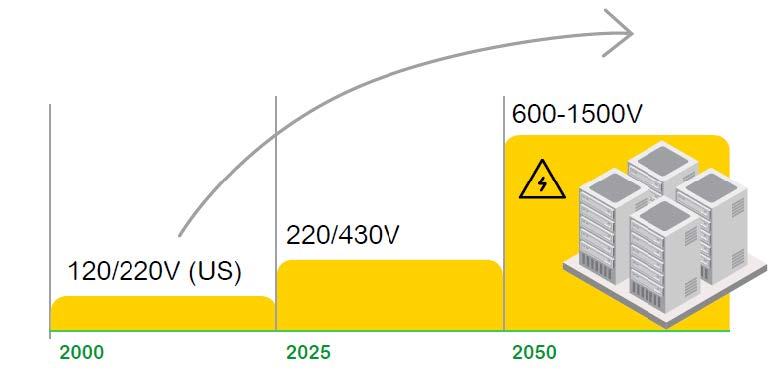
As the current voltage rating in the IT room makes power cables and copper busway prohibitively large, raising the voltage brings current levels back into a manageable range. Distribution voltage will be 800VDC initially and then go to 150 VDC. There will be many configurations and architectures with component evolutions like liquid cooled connectors, solid state transformers and electronic DC breakers. At these power levels, data centers will not be “human friendly” and will be highly secure, closed environments. Maintenance will most likely be done under full power downs.
AI operations optimization
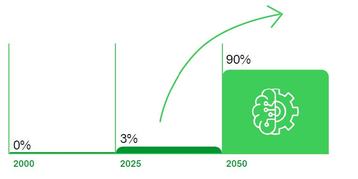
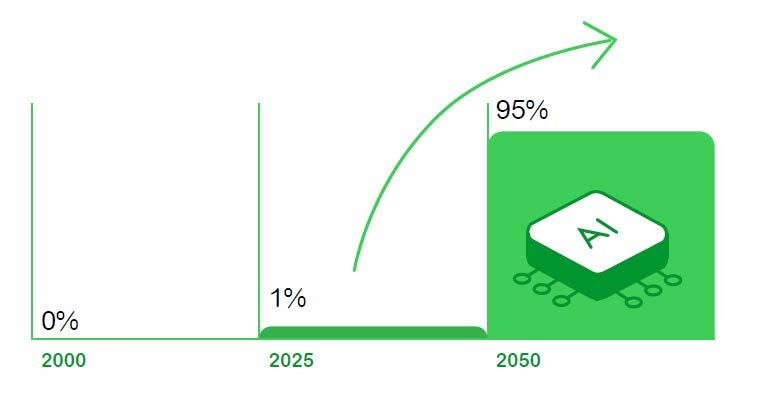
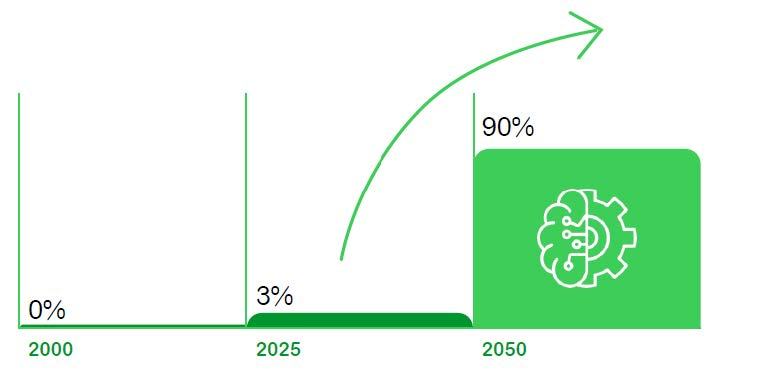
Leveraging AI to optimize cooling, power, server room temperatures, move IT workloads, integrate automation of the data center control of the power systems to the utility systems, and using robots for installation maintenance and operations will all be realized by 2050.
Data center transformation
Our industry is notoriously risk averse, and the landscape has evolved slowly over the past few decades. But the digitization of society is driving scale. The shift to using AI to automate our lives requires new IT systems and data centers that are more power intense – data centers that require transformation in many areas. By 2050, data centers will have a fleeting resemblance to today’s large, utilitarian facilities.
Schneider Electric is an end-to-end AI Factory partner, helping to design, build and optimize the next generation of data centers. Learn more.
More from Schneider Electric
-

Sponsored An ecosystem for scale
Portfolio planning and the strategic decisions behind AI infrastructure operations
-

Sponsored Powering the AI revolution: A grid to chip story
Building the infrastructure of tomorrow requires an entirely new approach that moves far away from bespoke, piecemeal solutions
-

Sponsored Tackling complexity in AI data centers: leveraging fully integrated solutions
Increasing densities, equipment varieties, and services have led to complexity challenges. What the market needs is integrated solutions from a provider that can support the AI wave at every step
Comments