
Rack integration is not a subject that gets talked about a lot. In fact, you’re probably scanning this article now, wondering if it’s even worth your time. Let’s assure you – it absolutely is – and it could change your AI-enabled data center planning for the better. So here’s the elevator pitch:
TL11 Rack integration (sometimes ‘rack level integration’) is a very simple idea. Instead of installing your racking, then equipping it with chips, servers, switches, and interconnects, the whole thing is assembled to your specification at the factory, tested to every known standard, and then delivered, ready for you to install in one fell swoop. It’s a great way to reduce on-site installation time and risk in a world of time pressures and fine margins. Because we all want to get to revenue faster, right?
If your AI build is aiming for high density, speed or rapid scale, you will certainly be looking for ways to minimize deployment headaches. In which case, allow us to show you how rack integration can do just that.
If you’re a hyperscaler deploying hundreds of racks, a Tier 2 operator looking to accelerate time to revenue generation or an integrator looking for a build partner, the idea of a solution that gives you cabled, labeled, and tested racks before they’re even through the door – then spend less time troubleshooting and more time innovating by shifting to rack integration.
Have we piqued your interest? Then let us introduce Sarah Koogler, market development manager, HSDC, Corning Incorporated to tell us how early engagement with a company such as Corning can make rack integration work for you.
She begins by explaining the different levels of integration:
“The typical categories that we see are L10, where it's just a basic mechanical assembly, including racks, your rails, and power cooling. L11 takes it to that next level by integrating the optical and network cabling as well. L11 is critical in that sense, because it addresses some of the main pain points of AI deployments, which includes the cabling density, reducing errors and making sure it's very serviceable on site without locking customers into any specific compute platforms.”
As Koogler explains, L11 is our main focus, but you can go a stage further – L12 takes things to another level, where instead of having in-rack integration, you have a multi rack cluster assembly that includes your compute and storage networking cabling between racks, not just within the rack, plus validation of the software stack. However, this is a much rarer requirement for operators, and so for our purposes, we’ll be exploring the more cost-effective benefits of L11.
At this point you may be thinking, “If L11 rack integration is so great, why haven’t I heard about it?” The fact is that there’s been remarkably little said about this sort of offering, until now. Koogler adds:
“L11 is critical because it solves some of the most pressing issues or challenges with deploying an AI infrastructure, such as the complexity of the cabling, the speed to deployment that's being requested, and the reliability of the network. But despite its importance, L11 has really been underrepresented in industry discussions, so Corning sees this as an opportunity to lead with educational resources, and thought leadership, considering that we have a deep expertise in structured cabling and a lot of innovation in optical connectivity.”
Corning still offers standard solutions for data center builds, but rack integration goes further to align to the custom requirements of the project, such as smart labelling to exact specifications, cut-to-size optical bundles, and specific connector types. This makes it easier to accommodate the idiosyncrasies of your data center in terms of things like airflow, service access, and rack layout, all of which means more flexibility and better performance.
Koogler tells us more about the types of technologies that make rack integration so versatile:
“A few big ones we're seeing right now are mass insertion, which means ganging multiple connectors together. This is happening a lot around MMC connectivity, where there's custom patch panels. We’re seeing real improvement in speed as a result of this.
This is just one example of creative use of rackspace, a constant battle in terms of both speed boosts and maximizing available real estate in the rack.
“Rack space is a tough commodity to get and it’s an issue we’re constantly looking into. There's ever less room available for the patching, so we're looking at creativity of rack space available, by not just looking at the actual rack units, but vertical space on the side, space on top of the racks, and 0U designs that don't take up any actual rack mounting locations.”


But it doesn’t stop with mass insertion: “There's also smart labeling and traceability systems, and modular hardware to make upgrades and maintenance as easy as possible. We want it to be scalable, have that high density and keep it service friendly.”
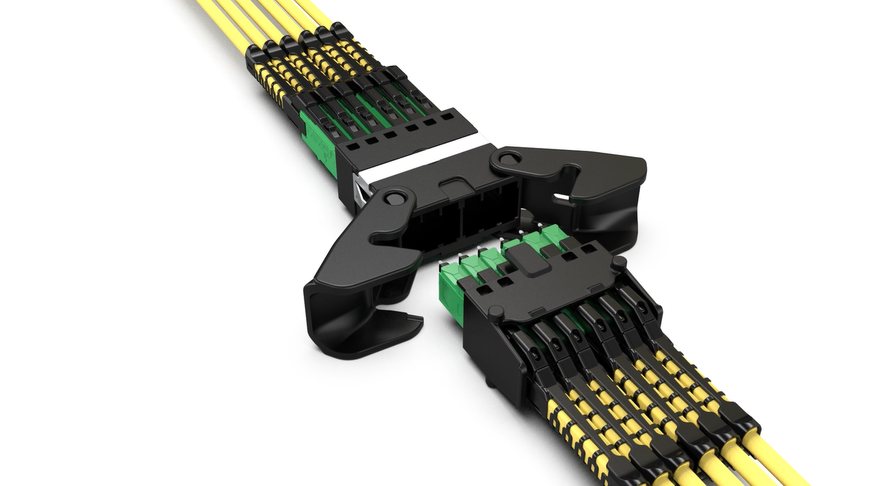
By ganging MMC connectors, you can save time and space because they can be removed and inserted simultaneously. They enhance density with increased fibers per ferrule and reduce the connector size by nearly 50 percent, compared to a traditional MPO connector. This makes service easier, and improves reliability. In the event of any fault, the cause can be isolated to a single connector, which reduces the “blast radius” and makes troubleshooting much easier.
Koogler is enthusiastic about the future of rack integration as a solution that will evolve as demands increase. She tells us: “Corning stays really close with our technology partners and end users to make sure that we're integrating both of their requirements into our solutions.

Advancing the AI revolution
Fiber first for the future of AI
“We're looking at different innovations around modular hardware that make it really easy to scale and grow for these AI deployments. We're looking at different cabling designs that are AI optimized – the smart labeling systems as well. One example is developing those 0U patch panels to help maximize rack space, allowing for even greater density in these AI deployments.”
That level of innovation is already turning into engagement from many of Corning’s customers:
“Our major key customers are already looking at ways to deploy rack integration, and it's trickling down to the Tier 2s and working through ODMs and OEMs to make this a more industry wide solution.”
And so, as you’re still reading, we’ve clearly managed to turn your head with the possibilities of rack integration, and at a time when everyone wants to move faster, and more simply – you’ve found a way to reduce your troubleshooting, improve reliability, and go to market faster than ever. And the time to explore it is now.
To find out what else is new with Corning, you can check out their upcoming broadcast ‘Multicore fiber: More density, faster builds, same pathways’ airing April 13th, here.
More from Corning
-

Corning unveils suite of next-gen optical tech to connect AI data centers
Multicore fiber and CPO offerings on display at OFC 2026
-

Sponsored The missing piece of the puzzle: Rethinking connectivity
To fuel the AI era, sourcing more power is only half the story. A fundamental reimagining of networking and connectivity are equally as critical for enabling continued growth
-

Innovation for the future
Foundational connectivity solutions for next-gen networks
Comments