
Artificial intelligence has entered a phase of large-scale deployment, transforming energy from a supporting resource into the defining requirement for AI data centers (AIDCs).
Where not too long ago conversations centered on large language models and benchmark ratings, tokens have emerged as the critical metric for measuring AI workloads, performance, and infrastructure demands.
This evolution marks a fundamental shift in how the next generation of AIDC infrastructure must be designed in order to meet the challenges of the coming decade.
To answer this question, Huawei Digital Power hosted the 2026 Global AIDC Industry Summit, which brought together nearly 1,000 industry leaders from the energy, intelligent computing and carrier sectors, to explore the future of AI infrastructure. Taking place in Dongguan, China on 15-16 May, Huawei unveiled its grid-interactive AIDC strategy, alongside a portfolio of new products designed specifically for the AI era.
Huawei’s grid-interactive AIDC strategy
As AI adoption accelerates worldwide, power infrastructure has become just as critical as computing infrastructure. Without reliable electricity, GPUs cannot operate effectively. And without stable, efficient power, tokens cannot be generated economically.
Speaking at the Summit, Bob He, vice president of Huawei Digital Power, argued that the defining capability of next-generation AIDCs will be their ability to convert energy into AI output as efficiently, reliably, and rapidly as possible.
“The value of an AI server is much higher than that of a traditional server. If there is a fault, the impact will not just be limited to a single piece of equipment, but it will also impact the training tasks, inference services, and business revenue.”
The relationship between the AIDC and the electricity grid is undergoing a pivotal change. Traditionally, data centers were viewed simply as large consumers of electricity. Today’s AI campuses, however, can demand hundreds of megawatts – even approaching gigawatt scale. Their startup, shutdown, and load fluctuations can all affect grid operation.
At the same time, electricity networks themselves are becoming more complex. The growing share of renewable energy is introducing greater variability into power generation, while many regional grids are becoming weaker and less predictable. As a result, AIDCs must not only withstand increasingly volatile grid conditions but also play a more active role in supporting grid resilience.
He points to a recent incident in Northern Virginia, where around 60 data centers disconnected from the grid almost simultaneously, causing approximately 1.5GW of demand to disappear:
“This is no longer just a data room incident. It is a grid-level event,” He says, adding:
“So future AIDC must have two capabilities. On one hand, it must adapt to weak grids and keep itself stable when the grid fluctuates. On the other hand, it must also support the grid by providing regulation capability during frequency, voltage, and load fluctuations. This is why we believe AIDCs must move from a traditional load to a grid-friendly intelligent load.”
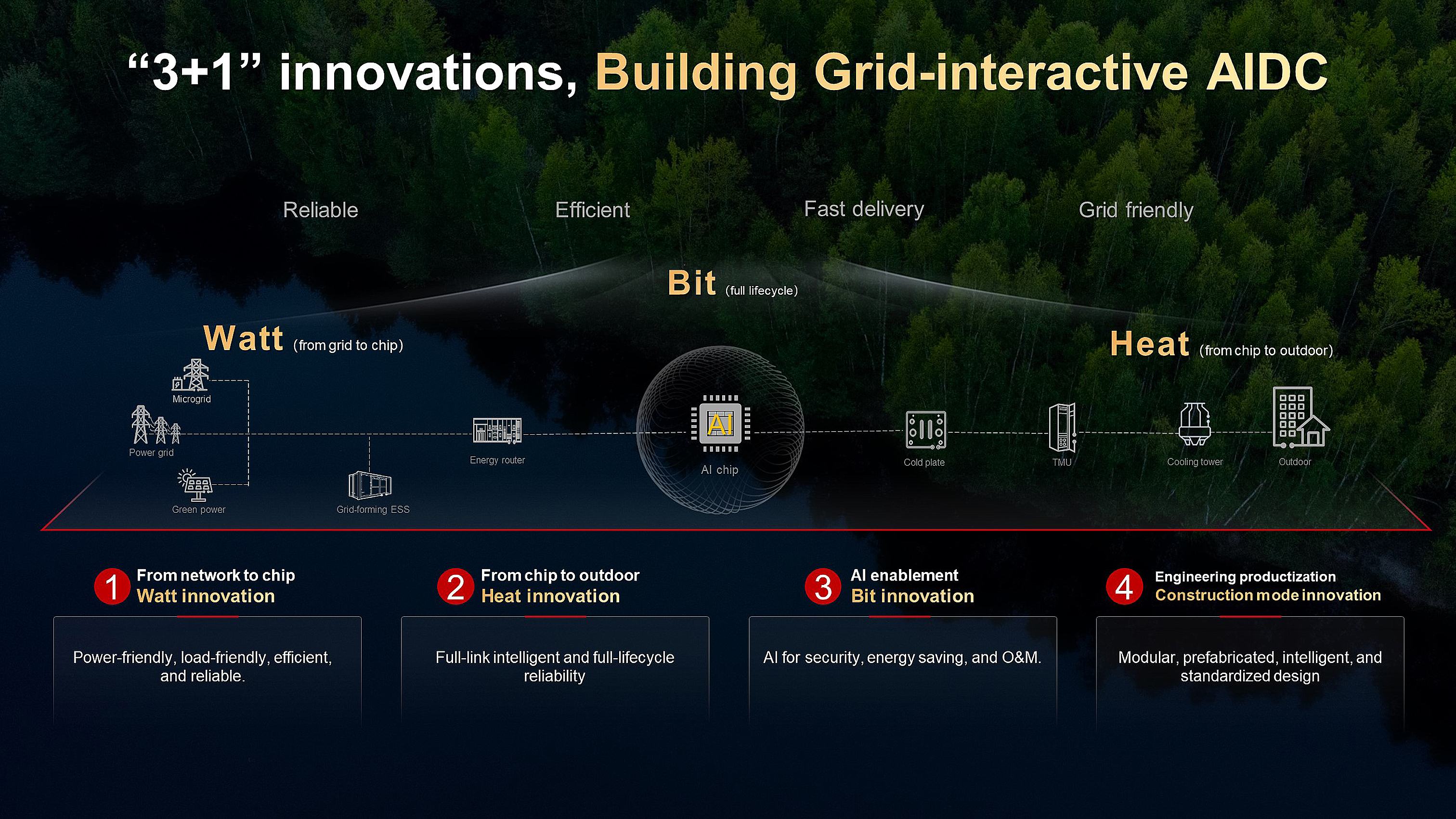
Summarizing Huawei’s vision, He identifies four priorities for the next generation of AIDCs: greater reliability, higher efficiency, faster deployment, and infrastructure that is ready for future AI demands. To deliver on these goals, Huawei introduced its “3+1” innovation strategy built around the four pillars – Watts, Bits, Heat, and Construction.
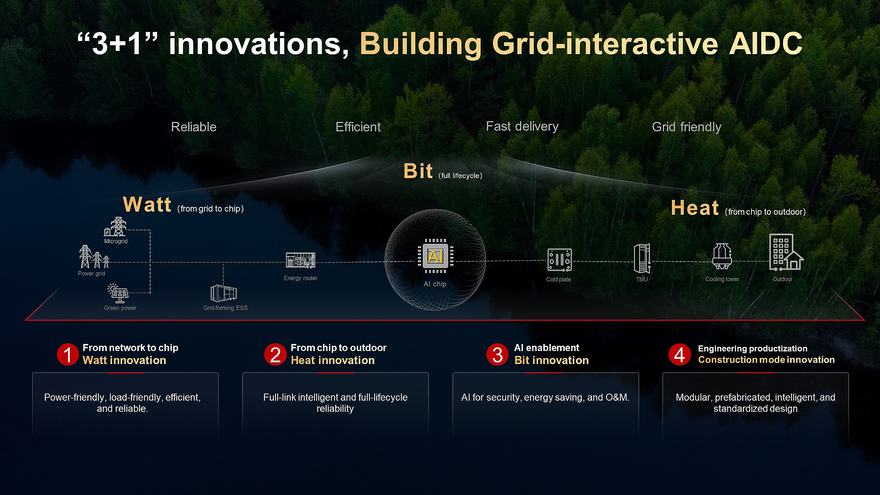
1. Watt innovation
The first pillar of Huawei’s “3+1” strategy focuses on power – or watts – reimagining how AIDCs interact with increasingly complex electricity networks.
Central to this vision is Huawei’s newly launched multi-input, multi-output (MIMO) power architecture, designed to integrate generation, grid, load, and energy storage into a unified, grid-forming system. Rather than framing the future as an “AC vs DC” debate, Huawei believes both architectures will coexist for the foreseeable future. Instead, power infrastructure should be determined by the needs of the AI workload itself.
According to He, the next generation of AIDCs requires the ability to accept multiple energy inputs, deliver power in multiple formats, and intelligently manage energy across different levels.
“The value of MIMO architecture is not only that it is technically advanced. More importantly, it truly fits the future complexity of AIDCs,” He says.
The MIMO architecture is designed to intelligently schedule multiple energy sources while supplying both rigid and flexible AI workloads. This enables AI campuses to move beyond simply tolerating grid fluctuations to actively stabilizing them.
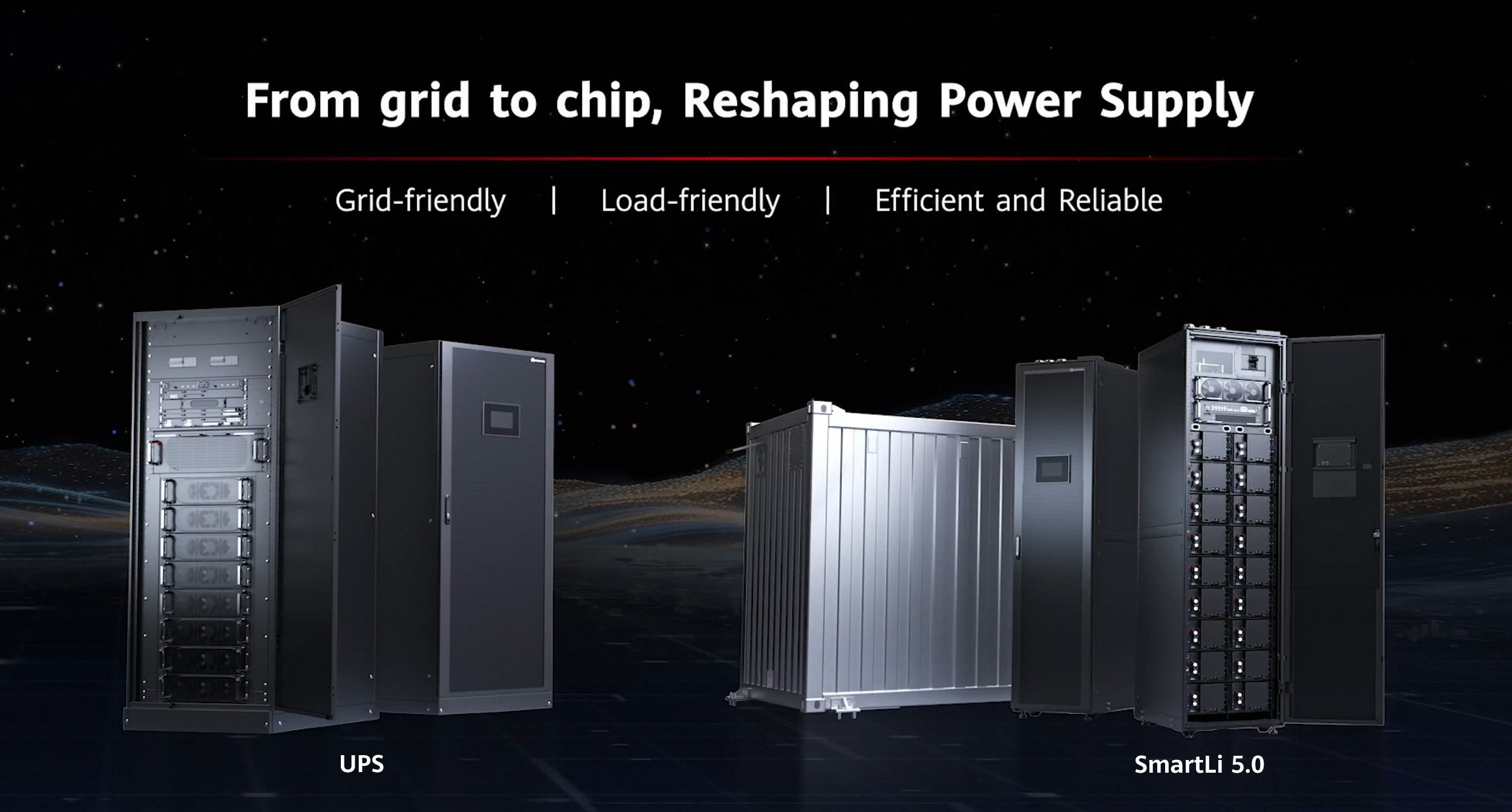
Huawei’s grid-friendly UPS technology, for example, not only protects critical IT systems during power interruptions, but also smooths load fluctuations and improves grid resilience. Meanwhile, grid-forming energy storage evolves from a backup power source into a campus-wide regulation asset, helping AIDCs operate reliably despite weak grids, increasing renewable energy use and highly dynamic AI workloads.
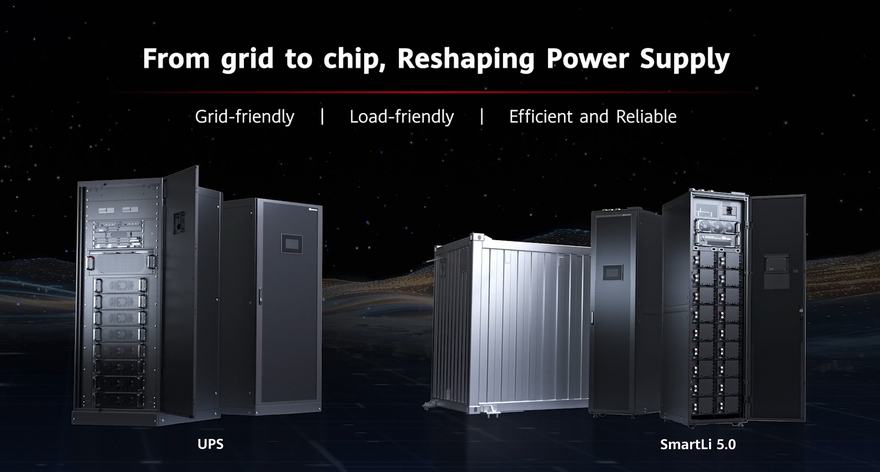
Supporting this architecture is Huawei’s new-generation TaiShan UPS, unveiled during the summit. He explained that the TaiShan name symbolizes unwavering stability and the ambition to reach new technological heights.
According to Huawei, TaiShan UPS delivers up to 98 percent peak efficiency, supports power densities of 1,280kVA per cabinet and 160kVA per module, and is designed to operate reliably even when short-circuit ratios (SCRs) fall below three – a key requirement for weaker grids. It can also restore active power within just 0.5 seconds, which He described as the fastest performance currently available in the industry.
For Huawei, these gains translate directly into AI economics:
“UPS efficiency is not an isolated metric. It directly impacts total campus power loss and cost per token. In a one gigawatt data center, a one percentage point efficiency gain can save 19 million kilowatt hours of electricity annually.”
Alongside TaiShan UPS, Huawei also introduced its next generation of power conversion technologies and new energy storage designs, including what it describes as the industry’s first SmartLi energy storage system compatible with an 800 VDC architecture.
Together, these technologies are intended to provide the foundation for MIMO power systems capable of supporting future AIDCs. Ultimately, Huawei sees its role extending beyond supplying individual components:
“What we provide is not a single device. We provide system-level design capability from grid connection, energy conversion, storage configuration, to load power supply,” says He.
2. Bit innovation
If “Watt” innovation is about delivering energy more intelligently, Huawei’s “Bit” innovation is about ensuring every unit of energy delivers greater AI value.
As AI workloads continue to expand, the industry is shifting focus beyond measuring model size toward tokens as a more meaningful measure of value, making the ability to generate more tokens with less energy and lower operational cost a truer measure of an AIDC’s performance.
“In essence, these AIDCs are token factories because the end product is tokens. The exponential demand and growth of tokens pose new challenges for AIDCs. We must find a way to help these factories operate more efficiently,” says He.
According to He, this is a global challenge – not limited to hyperscalers or specific regions – requiring a fundamental shift in how AI infrastructure is monitored, managed, and optimized.
“Over 10 years ago, when Digital Power was just launched, we introduced the idea of managing watts with bits. Today, we want to evolve that vision further, so AIDCs can transition from passive operations and maintenance to systems capable of proactive sensing, optimization, and protection,” He explains.
This philosophy is reflected in Huawei’s proposal to replace traditional infrastructure metrics such as power usage effectiveness (PUE) with a new AI-centric evaluation framework – the TokEnergy Index.
Rather than focusing solely on how efficiently electricity is consumed, the TokEnergy Index measures how effectively energy is converted into AI output, with the ultimate objective of achieving the lowest possible cost per million tokens.
Huawei says the framework evaluates the complete energy-to-computing value chain through three core performance indicators:
- Token output per watt (TPW)
- Lifetime token yield (LTY)
- Carbon footprint per token (CPT)
The TokEnergy Index also considers four operational factors that influence AI productivity:
- Grid-to-token energy conversion efficiency
- Computing power continuity/reliability
- Computing power onboarding speed (or time-to-token)
- Green energy penetration rate
Collectively, these measurements are designed to help operators optimize – on top of energy consumption – the output, resilience, sustainability, and long-term business value of AI.
3. Heat innovation
As AI infrastructure becomes denser and more power-hungry, thermal management has emerged as one of the industry’s most critical engineering challenges. With liquid cooling now viewed as the inevitable direction for next-generation AIDCs, scaling the technology requires close attention. Coolant circulates in close proximity to high-value chips, servers, and electrical equipment, meaning even a single failure can have significant operational consequences.
“It starts from the chips, the servers, and within the cabinets to the equipment room and then to the outdoor scenario. It is important to dissipate heat – not just to take heat away, but to rein in the risks in these high-density scenarios,” says He.
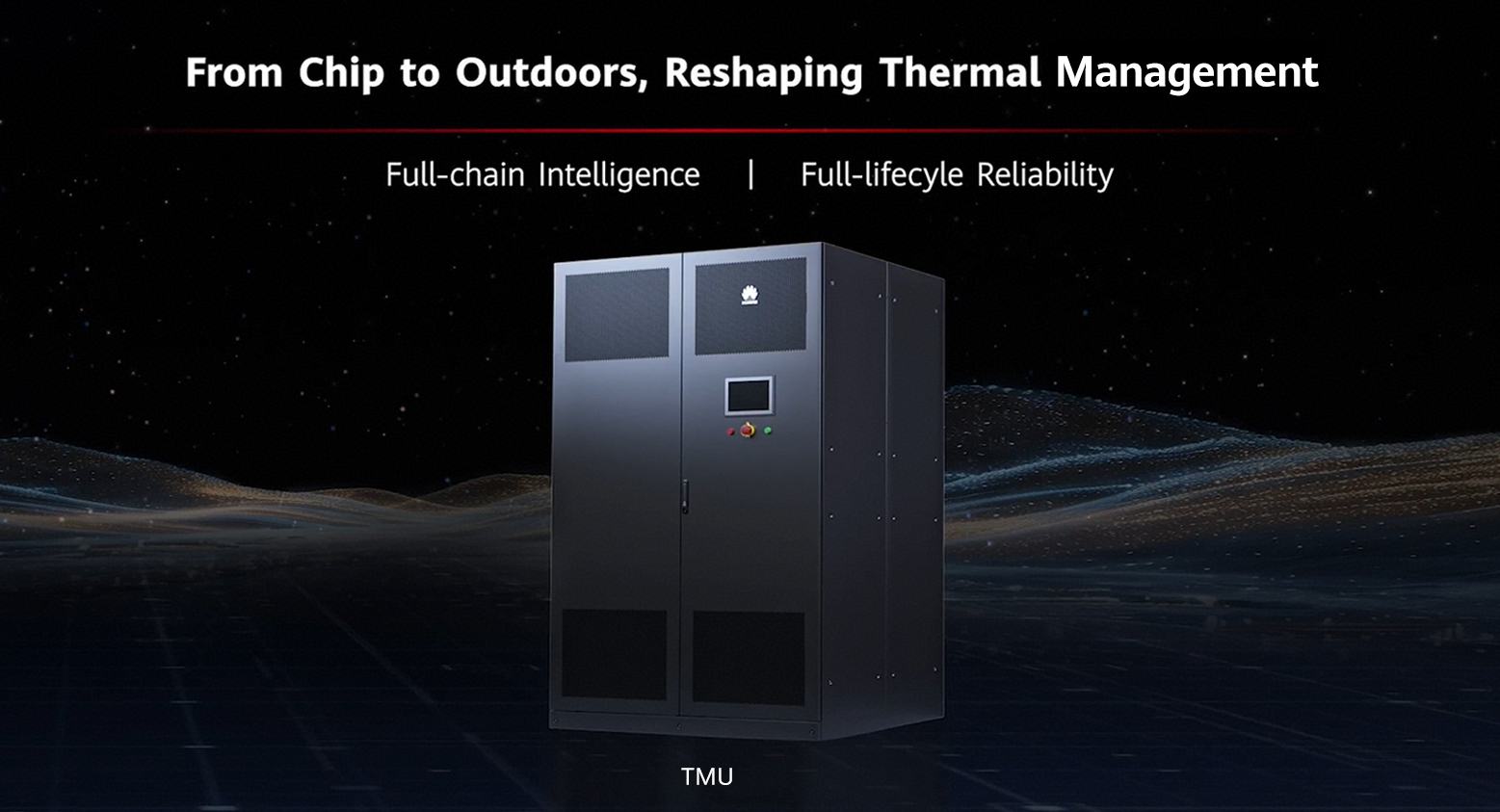
To address this, Huawei unveiled a new megawatt-level liquid cooling solution designed around system-level reliability rather than protecting individual components in isolation. At the heart of the architecture is what Huawei calls a thermal management unit (TMU), a new concept that differs from a coolant distribution unit (CDU). According to He, the distinction is significant:
“It’s like the brain of the liquid cooling system. The complexity of AIDC liquid cooling is so high that we cannot simply rely on manual experience to cover the entire system. That's why we need a brain – the TMU.”
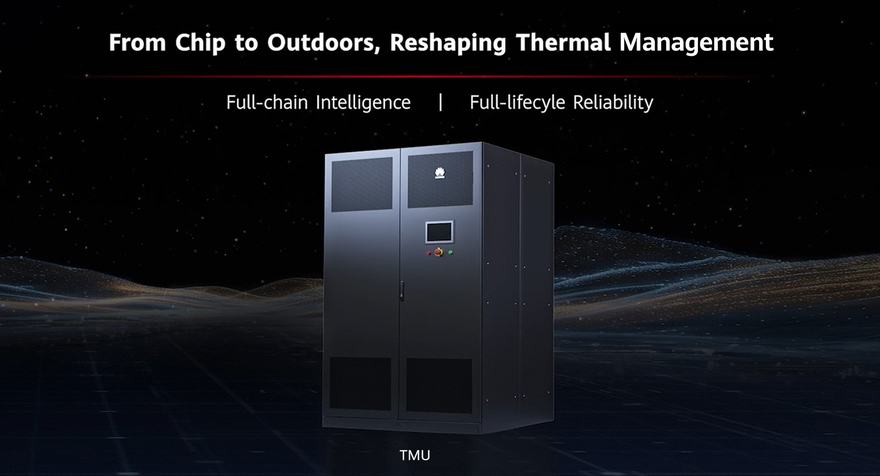
Powered by AI, the TMU continuously monitors a wide range of operating conditions to help deliver uninterrupted cooling at the megawatt scale. Rather than reacting to a single parameter such as water pressure, the system analyzes multiple indicators – including pressure, conductivity, water quality, and pH levels – to identify subtle changes before they develop into faults. This predictive approach enables proactive maintenance while reducing the risk of unplanned downtime.
Huawei has also integrated thermal management more closely with power management. During periods of rapidly fluctuating AI workloads, relying solely on changes in coolant flow can limit cooling responsiveness. Instead, Huawei’s architecture uses electrical signals to communicate directly with the TMU, allowing cooling performance to adapt in step with changing power demands and improving overall system efficiency.
For Huawei, this represents a broader shift in how liquid cooling should be designed. Rather than viewing it purely as a hardware subsystem, the company sees thermal management becoming software-defined and AI-driven. The result, He argues, is a more resilient cooling architecture capable of supporting the reliability demands of next-generation AIDCs.
+1) Construction innovation
The final element of Huawei’s “3+1” strategy shifts the focus from infrastructure design to infrastructure delivery. As demand for AI computing accelerates worldwide, Huawei argues that the industry can no longer rely on traditional, engineering-led construction methods. Instead, AIDCs must be delivered as products – standardized, modular, and factory-built – to reduce deployment times while improving quality and reliability.
“This symbolizes a huge challenge. Some core customers ask if we could deliver in six or nine months. Some are even asking if it is possible in just three months, because the faster the delivery, the sooner AI services will be provisioned.”
Huawei’s answer is to move away from on-site system integration toward a product-based delivery model. Much of the engineering, integration, and testing is completed beforehand in the factory, and extensive system-level verification allows commissioning to begin much earlier, reducing project uncertainty.
“To tell you the truth, every data center is different. We can no longer rely on traditional engineering methodology for AIDCs. They need to be product-based, prefabricated, and modularized, moving the complexity into the factory to provide customers with greater certainty.”
Huawei has applied this philosophy throughout the power distribution system, redesigning fundamental components such as circuit breakers and switchgear to better support the higher power densities required by AI workloads.
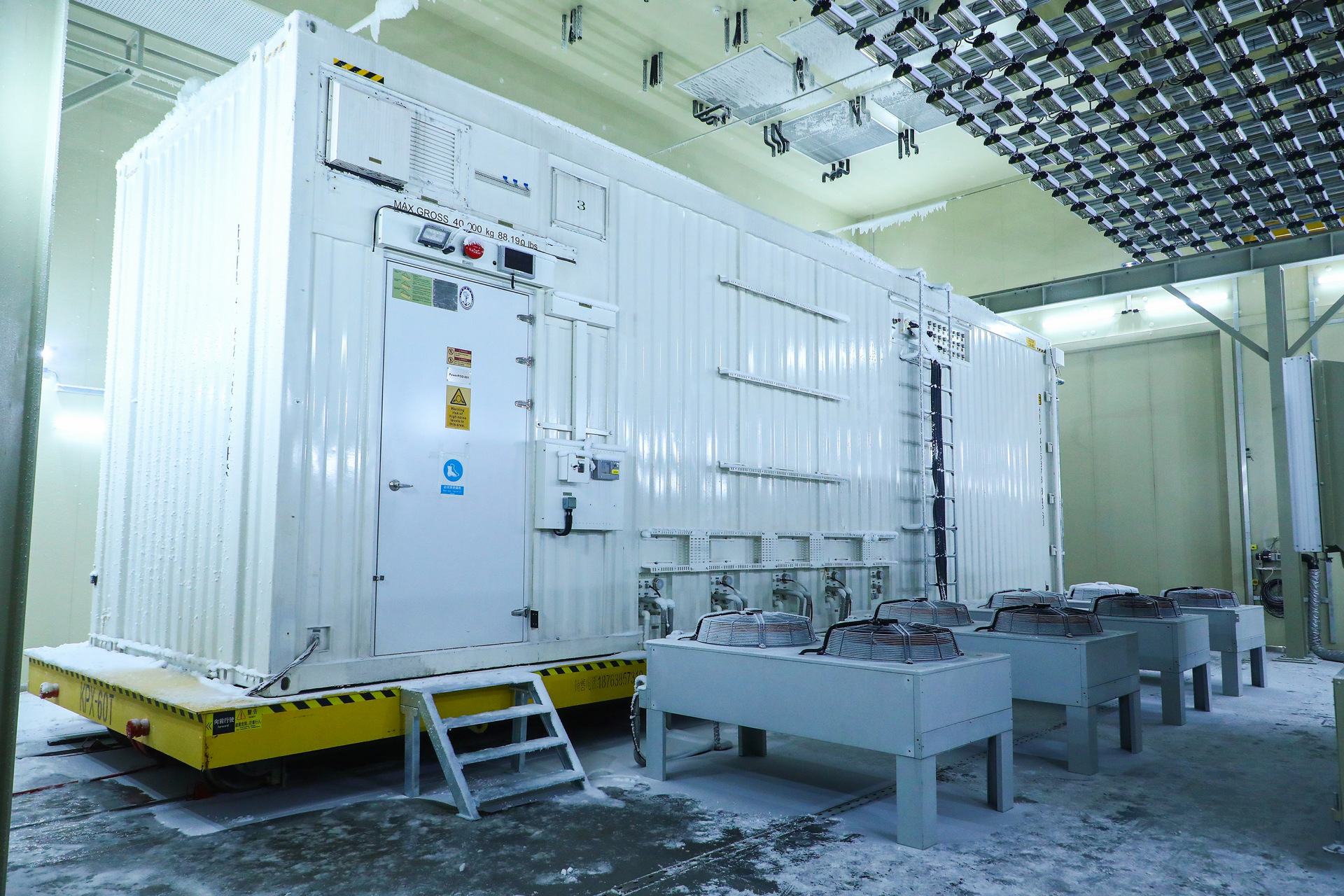
The resulting architecture occupies less floor space, freeing more room for compute infrastructure, while increasing the amount of capacity that can be integrated within a single container. The modular design also simplifies transportation and enables faster replication of AIDC deployments around the world.
The company says this represents an evolution of its prefabrication model from 1.0 to 3.0, transforming construction from an engineering project into a repeatable manufacturing process. To support this approach, Huawei has also invested in automated factory testing capable of validating complete systems before they leave the production line:
“Huawei has automated equipment for testing at the factory site. That allows us to make delivery truly product-based and ensure high reliability. Our lab also has system-level capabilities like the environment lab, where it can cover very extreme scenarios like extreme heat, freezing, high humidity, heavy rainfall, snow, and intense solar radiation.”
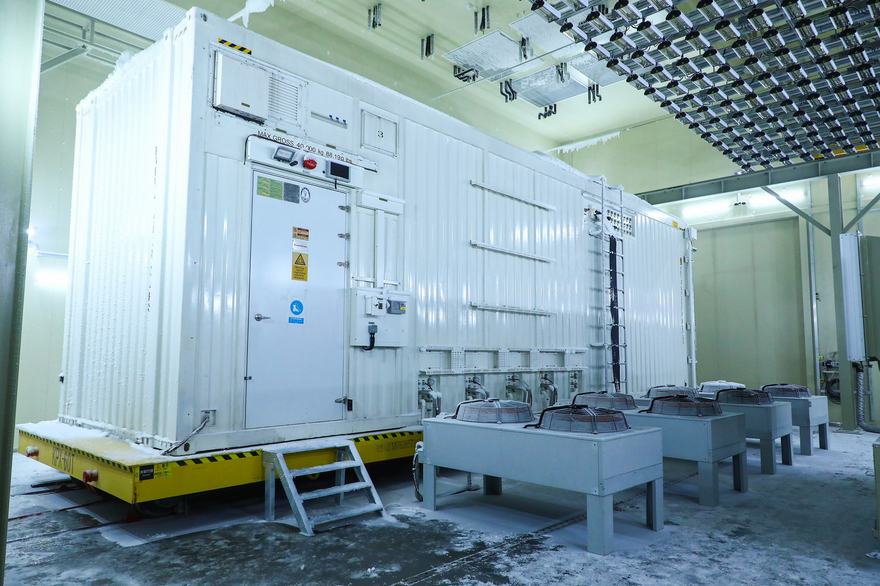
By shifting complexity from the construction site to the factory floor, Huawei believes AIDCs can be deployed faster, replicated more consistently, and operated with greater confidence as demand for AI computing continues to accelerate.
3+1 for the future
Across its “3+1” innovation strategy, Huawei’s message is that the future of AIDCs will not be defined by computing power alone, but by the intelligence, resilience, and efficiency of the infrastructure that supports it.
From grid-interactive power architectures and AI-driven thermal management to token-centric operational metrics and product-based construction, the company is positioning AIDCs as integrated systems designed to meet the demands of the AI era.
Learn more about Huawei's AIDC facility solutions here.
More from Huawei
-

Sponsored Huawei redefines AI infrastructure at MWC 2026
At Barcelona’s MWC, Huawei unveiled the AIDC architecture and a new generation of AI-Powered Green Sites designed to tackle the challenges of high-density computing
-
Powering the digital era forward
Huawei Global Data Center Facility Summit 2024
-

Sponsored Physical and digital infrastructure across deep canyons boosts rural development in Guizhou
Huawei and China Mobile will continue to innovate in rural network technologies and provide digital skills training to help more regions bridge geographical and digital divides
Comments