
In the business development department at Rehlko, Ben Rapp leads strategic product development efforts with his team. On any given day, they explore emerging technologies and forward-looking concepts – often extending the two- to three-year commercialization period to shape products needed five to eight years in the future.
“We aim to understand what these future products will look like, how they could influence Rehlko’s direction, and how they can serve our customers as they seek new backup power technologies,” Rapp explains.
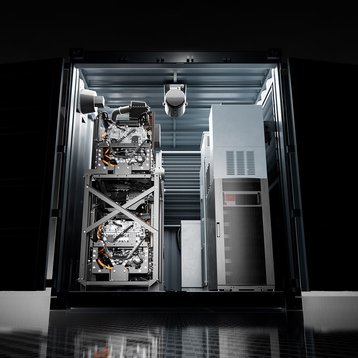
One such technology the strategic product development team has been evaluating for several years is hydrogen fuel cells – a next-generation backup power solution that, Rapp notes, is no longer just theoretical but ready for deployment today.
H2 + O2 = H2O + energy
When we think of traditional backup power for data centers, combustion processes – typically involving diesel or natural gas – come to mind. The most striking difference with hydrogen fuel cells is that they operate without combustion. Instead, they rely on an electrochemical reaction.
Hydrogen and oxygen go in, electricity and water come out. Much like a combustion engine needs a steady flow of fuel to keep running, these fuel cells require a continuous supply of hydrogen and oxygen. Through a controlled chemical reaction, they produce electrical current and water, without the emissions associated with combustion.
So, what does this mean for data centers?
Modern data centers are under increasing pressure to meet – and exceed – stringent sustainability targets, whether driven by internal mandates or regional regulations. Depending on location, certain fuels or technologies may be more viable than others. In other words, one size doesn't fit all. As Rapp explains:
“When we think about data centers and the potential of hydrogen fuel cell technology, it often comes down to permitting issues that arise with conventional solutions like diesel or natural gas. That’s why we pursue a parallel path in product development, so we can offer our customers a broader range of solutions.”
It’s got the reputation, but does it have the performance?
By now, many of us have heard about hydrogen fuel cells, but their real-world, mission-critical viability has yet to be fully demonstrated. While the technology may be ready, the question remains: can it meet the demands of today’s data centers, especially with the rapid growth of AI and increasingly dense, variable workloads?
According to Rapp, Rehlko’s long-standing reputation for delivering reliable, high-quality solutions underscores the importance of proving the company’s expertise in deploying fuel cell technology effectively.
Through a combination of rigorous engineering and careful system integration, the aim is to meet the conventional standards of performance. Typically, that means delivering the uptime data centers expect – five nines reliability – as well as fast startup and responsive load-following capabilities. As hydrogen fuel cells move closer to commercialization, Rapp emphasizes that meeting these benchmarks is non-negotiable:
“We’re committed to showing that this technology performs on par with conventional systems. Our customers shouldn’t have to choose between decarbonization and performance – we want to eliminate that trade-off entirely.”
But performance claims need to be backed by evidence. That’s where Rehlko’s in-house testing comes in.
“Understanding how hydrogen fuel cells compare with conventional solutions we’ve deployed for years starts with reliability testing in our labs,” Rapp explains, adding:
“We define performance metrics, assess component failure rates, conduct in-house reliability testing, and work closely with suppliers to understand failure probabilities. By conducting a full Design Failure Mode and Effects Analysis (DFMEA), we can confidently say it's a reliable, high-quality system.”
Bonding in real life
As with many modern innovations, success often depends on strong partnerships. In Rehlko’s case, its partnership with Toyota has been instrumental in integrating Toyota’s fuel cell stack into Rehlko’s system package:
“We’re able to leverage Toyota’s longstanding expertise in this field – they’ve been developing and deploying fuel cells for decades. They have millions of miles of hydrogen fuel cell use on the road, particularly with the Toyota Mirai car, and we’re building on that technology and reliability data to adapt it for off-road applications like backup power.”
That said, integrating fuel cells into the data center context is far from easy. Rapp explains that Rehlko spent a considerable time developing and refining its hydrogen fuel cell integration package – starting small within R&D, gradually moving into pilot projects, and finally reaching real-world deployments.
One key project Rehlko highlights is its hydrogen fuel cell installation at Klickitat Valley Health (KVH), a hospital in Washington State. As Rapp notes, the hospital sought to decarbonize its operations while also gaining operational flexibility beyond traditional backup power.
“When you look at the techno-economic analysis of hydrogen fuel cells, you see added operational value because you’re not limited by emissions restrictions,” he explains.
“So we worked with KVH to deploy a permanent, small-scale 100kW system – built on our partnership with Toyota. This pilot, to this day, has allowed us to collect ongoing reliability data that can inform future, larger-scale systems suited for more mission-critical facilities.”
Beyond business-to-business bonding, projects like this foster stronger ties with the community. As a critical access hospital, KVH serves as a vital hub for rural residents during emergencies – not only for medical care but as a broader community resource.
Its mission-critical role demands the highest level of backup power reliability. For local residents, this project symbolizes a commitment to dependable, multi-source power in times of need.
Moreover, showcasing a clean-energy technology that reduces emissions and improves air quality adds to the project’s local impact.
“It’s not just a hospital, it's a community center. Klickitat Valley Health serves as a lifeline for the surrounding region, so ensuring resilient, sustainable power is critical – not just for patient care, but for the wider community that relies on its services during emergencies,” says Rapp.
Predictability in unpredictable circumstances
The rapid and fluctuating power demands of AI-driven data centers present a unique challenge for emerging backup power technologies. While traditional data centers pose fewer issues in this regard, the widespread adoption of AI is pushing facilities toward higher-density, higher-output racks – raising the bar for power systems to keep pace with the digital era.
According to Rapp, the solid polymer electrolyte membrane fuel cell technology used by Rehlko is well-suited to load following in traditional settings, capable of handling the ramp-up and ramp-down as loads vary. However, managing the sharp fluctuations associated with AI workloads requires additional system sophistication – specifically, an inverter-based architecture:
“When we combine the fuel cell’s load following capabilities with an inverter-based system – like our complete hydrogen fuel cell package at Rehlko – we're able to manage those fast-changing AI loads effectively,” Rapp explains.
“The batteries, the fuel cells, and the inverter all work together to respond quickly, minimizing modulation and avoiding the kinds of faults you might see with conventional systems. This solution is designed specifically for AI-type loads.”
The reaction needs the right conditions
Chemistry has long played a role in shaping transformative technologies – from powering engines to enabling breakthroughs in energy systems. Hydrogen fuel cells are a continuation of that tradition: clean, science-driven, and increasingly ready to handle the variable loads of AI-powered data centers. But if the technology is ready, what’s holding back its broader adoption?
Unsurprisingly, the main barrier is financial. With most data centers focused heavily on capital expenditures, it can be difficult to shift the conversation toward the longer-term value that hydrogen fuel cell systems can deliver, especially when compared with the more familiar diesel or natural gas options.
“I think the real barrier to adoption still remains the acquisition cost of the system – specifically the upfront price manufacturers can offer customers – largely because the technology is still in its early stages from a manufacturing volume standpoint,” says Rapp.
That said, long-term financial value through clean, emission-free power systems is becoming increasingly viable, particularly as sustainability mandates tighten and innovation scales up.
In addition to cost, Rapp points to familiarity as a lingering hurdle. Fuel cell technology, while not new, is still unfamiliar territory for many data center operators. Rehlko is working to close that gap through education and real-world demonstrations:
“Can we translate what we've done at the hospital to the data center space? Even if it's not at the 50- or 100-megawatt scale right away, we’re looking at three- to 10-megawatt systems that we can deploy and demonstrate.”
“There will always be demand for diesel-based systems – we’re still supporting and improving those, but there’s also a growing segment of customers who, maybe because of grid limitations or environmental regulations, are ready for a cleaner, more flexible alternative,” Rapp adds.
Catalyzing change, carefully
When people hear “hydrogen fuel cell,” safety likely isn’t the first thing that comes to mind. Yet it’s a critical part of the conversation when discussing fuel cell integration, particularly the challenges around safely storing and handling hydrogen on-site.
In the US, companies must adhere to strict safety standards, primarily those set by the National Fire Protection Association (NFPA). These regulations cover aspects such as setback distances, which vary based on storage type and pressure. As industry familiarity with hydrogen grows, so too does the competence of handlers and first responders.
Today, the severity of potential incidents is lower and better understood than once feared. In fact, according to Rapp, something as simple as installing a barrier or wall around a storage facility can be enough to meet key safety requirements.
That said, safety regulations aren’t the main roadblock. Rapp points instead to market dynamics that ultimately influence how regulations evolve and how quickly adoption can scale.
“Data centers, especially with the AI boom, have enormous power demands – enough to influence future energy infrastructure. Everyone’s trying to secure power, and hydrogen is absolutely part of the conversation. If the hydrogen supply challenges are solved, it may well have been data centers that drove it forward.”
Hydrogen remains costly and difficult to source across much of North America, with prices – especially for renewable hydrogen – high and rising. Producing green hydrogen today is estimated at $4.50 to $6.50 per kilogram, an increase of 30-65 percent over earlier projections, according to a report by the Hydrogen Council in collaboration with McKinsey & Company. While US government initiatives have aimed to boost production, green hydrogen remains many have been slowed by long timelines, supply chain issues, and a lack of strong demand signals.
“It’s a classic chicken-and-egg scenario: suppliers are hesitant to invest without clear demand, while potential buyers won’t commit unless a reliable supply is already in place,” says Rapp.

Hypothesis proven
As alternative fuel sources gain traction in mission-critical industries, both availability and regulatory frameworks continue to evolve. In the US, with a growing mix of energy solutions, from advanced geothermal to natural gas, data center operators are increasingly open to exploring alternative power systems that help them serve customers quickly while reducing costs. In Rapp’s view, hydrogen fuel cells remain a key part of this exploration.
Looking ahead, the best indicator of future trends is often how technology has evolved in the past. Data centers, for example, have seen rapid increases in rack density in recent years, leading to larger facilities that require significantly more backup power capacity. Through its pilot and scaling projects, Rehlko aims to show that its systems can deliver reliable, high-quality performance and strong financial value – whether at 100kW or at a multi-megawatt level.
“Our microgrid project in California will be another great example of how these fuel cell technologies can be used and translated into tangible customer value,” Rapp adds.
Having established that hydrogen fuel cells have a solid place in the backup power landscape for mission-critical applications, now is a crucial time to expand these case studies globally. This doesn’t mean diesel will become obsolete, but offering additional alternative fuel options creates greater value for a wider range of power customers. It’s sustainable resiliency – achieved in more ways than one.
For more information, please visit powersystems.rehlko.com.
More from Rehlko
-

Sponsored Scrolling to survival: The power behind modern life
Rehlko on tackling the big questions behind resilient energy in a data-driven world
-

Sponsored Bridging the gap: The role of EPDs in advancing data center sustainability
How environmental product declarations (EPDs) are transforming data centers’ sustainability efforts by bringing transparency and accountability to Scope 3 emissions
-

Sponsored The Wilmott Group officially joins Rehlko
The completed acquisition ushers in a new era of critical power expertise and innovation across UK & EMEA
Comments