
As data centers evolve to support ever-more powerful technologies, managing heat efficiently has become a critical challenge. Strategic thermal management, particularly heat reallocation, is needed to address the increasing density of chips and meet evolving sustainability goals.
Jeremy Lee is the general contractor program leader at Trane and a company veteran with over 20 years of experience. At the forefront of this mission-critical space, he sees an emerging opportunity for Trane to “meet the moment” amid the rapid expansion of the vertical data center market.
“I can’t remember another time that you saw this level of compound annual growth,” Lee notes, emphasizing the immense potential ahead.
Right on schedule: Uptime for hyperscalers and colos
Reliability and uptime are non-negotiable in the mission-critical space. By definition, there is no room for downtime. As Lee explains:
“There are millions of dollars at stake when you look at this operation, and any interruption can lead to significant financial loss. Consistency, reliability, and uptime are the key performance indicators for hyperscalers and colocation providers.”
Over his tenure at Trane, Lee has observed a shift in how the company addresses risks to uptime and reliability as they evolve. While Trane has long been known for its portfolio of high-reliability products and global technician footprint to support data center owners, the industry’s demands have grown.

Today, proper installation and commissioning are absolutely critical to ensuring system performance.
“This reinforces the level of trust with the hyperscale or colocation owner, ensuring that they have a system that performs the way it was intended to, and they get long-term reliability and performance over the equipment’s life,” says Lee.
In other words, meeting today’s uptime challenges requires not just dependable products, but also robust service support and commissioning to safeguard mission-critical operations.
No stopping for short-term thinking
New opportunities have emerged for customers through Trane’s expansion into liquid cooling and combined air- and water-cooled solutions, with a strong focus on being a trusted advisor and committed to delivering for the owner. As Lee explains:
“You'll see us use terms like thermal management system, not just chillers, air handling solutions, pumps, and cooling distribution units. We talk about performance multipliers, meaning the whole is greater than the sum of its parts.”

Based in the US, Lee also highlights a key difference between American and European conventions for heat reallocation. While Europe has more widely regulated and implemented heat reallocation strategies, the US largely still views land and power as the main drivers of data center development, despite rising chip density increasing the volume of heat produced:
“The heat, which is significant with these data centers, is often looked at as a byproduct that’s just wasted and rejected. However, leveraged strategically, this can be coupled with sustainability objectives as an energy source that could be reused.”
One of the industry’s greatest shortfalls today is the tendency toward short-term, profit-driven decisions in the absence of standardized regulations. This approach may benefit individual companies quickly, but risks long-term harm to society – environmentally and financially.
“Trane takes pride in being a leader in sustainability, adhering to our sustainability objectives without compromise. We view ourselves as an incumbent disruptor, consistently challenging the status quo and maintaining our commitment to sustainability, regardless of fluctuating market pressures or changing administrative climates,” Lee asserts.
Notably, Trane established its Center for Energy Efficiency and Sustainability (CEES) in 2010, preceding the widespread adoption of sustainability in global business.
Meet the moment
With over a century of engineering expertise, Trane leverages its global scale combined with a local service model to deliver reliably for data center customers amid the fast-growing market. Lee emphasizes:
“Our built infrastructure, with the right people leveraging global capabilities at a local level, is how you deliver for the owner and truly meet the moment.”
Manufacturing alone isn’t enough; a strong distribution network is critical to actually deliver those products where they’re needed most. So when Lee uses the term “meet the moment,” he is reflecting that Trane is uniquely positioned to best support this industry and then reinvest in itself to continue as this industry evolves.
“Your manufacturing plants are only as good as your distribution network to deliver those solutions to the opportunities that need them,” says Lee.
Trane continues to affirm that its greatest strength isn’t just in the products it creates, but in the people who create them – a team whose depth of experience and wide perspective shape its continued success.
And when the pace of change is ever-increasing, strategic collaborations make all the difference. According to Lee, Trane wants to put the best solution in place for the customer, and when another company offers complementary expertise, it is ready to align and collaborate.
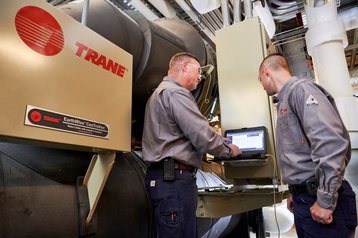
Trane has pursued strategic alliances in order to expand existing offers with liquid-cooling technology and magnetic bearing compressors that will enhance equipment performance.
This demonstrates that a combination of innovation, infrastructure, and partnerships positions companies uniquely to support the data center industry now and into the future.
All systems go
Meeting today’s data center demands requires a diversified solutions portfolio that can address everything from energy efficiency and water conservation to return on investment (ROI) goals. This flexibility empowers operators to select the best-fit approach for their unique challenges while future-proofing their investments.
“We’re not limiting ourselves to chillers – we’ve invested in air-side solutions, cooling distribution units, liquid cooling, and we’re leaders in hybrid systems too,” says Lee, adding:
“We’ve been in business for over a century – and you don’t last that long without doing what’s right for the customer over the long term.”
Traditionally known for HVAC and chiller systems, Trane has purposefully expanded its portfolio to meet the specific needs of data centers, helping customers optimize PUE, manage water use, balance first costs, and maximize long-term ROI.
To keep pace with evolving demands – driven by AI and GPU workloads – Trane invests heavily in data and analytics, focusing not just on unit-level controls but on intelligent, system-wide controls that leverage cloud data to drive ongoing innovation. Whereas suppliers once waited to fully design and rigorously test products before sharing them publicly, the rapid evolution in mission-critical technology has forced a shift. Lee underscores Trane’s approach:
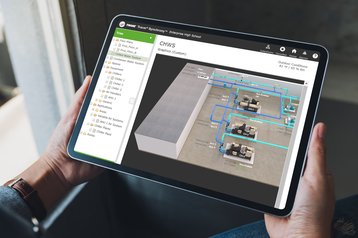
“We are engaging with customers even earlier in the process than ever before. This shift allows us to better meet customer needs by refining solutions while in initial development.”
Controlled zone ahead
The regulatory landscape for data center thermal management and heat reuse is highly variable by region. Traditionally, US regulations tend to be reactive, focused on avoiding blocks to industry growth, while Europe takes a more proactive stance, aiming to balance expansion with environmental and social governance goals. That said, the regulatory climate is evolving in the US.
Ahead of strong regulations, industry leaders play a crucial role in driving sustainability initiatives. By designing systems that capture and reuse waste heat, converting it into power to support additional data processing, Trane aims to help customers improve ROI while delivering community benefits through symbiotic energy use.
“When considering high-performance systems, low-GWP refrigerants, electrified systems, energy storage, and low embodied carbon, there isn’t a single silver bullet solution,” Lee explains, adding:
“Instead, it’s essential to leverage the full range of tools available to develop a holistic, sustainability-focused system.”
Beyond engineering innovation, Trane actively monitors and influences regulatory developments, advocating for sustainable policies. This forward-thinking approach ensures that solutions not only perform reliably today but also scale effectively as data centers grow in phased deployments.
Destination: Real impact
As AI continues to drive data center growth, it’s not enough for the industry to pay lip service to performance and sustainability goals. Users of these technologies expect genuine, measurable results.


Hyperscalers and colocation providers that can demonstrate that they’re delivering true sustainability – not just the perception of it, but real, tangible impact – will strengthen their credibility and deepen customer trust. Lee concludes:
“What’s really exciting with the data center industry is the opportunities available for customers. With the right consultative partner, customers can use efficiency, ESG goals, and performance results as strategic levers to drive growth in their business.”
With that in mind, it seems Trane is committed to delivering solutions that meet the moment – today and into the future.
For more information or to consult with a Trane data center system expert, visit Data Center Cooling, Data Center Design | Trane Commercial HVAC.
More from Trane
-

Sponsored Cool thinking: How collaboration and holistic planning is powering future-ready cooling
As high-density workloads turn up the heat, Danielle Rossi from Trane shares why the company is taking a whole-system approach to cooling strategies, and driving cross-collaboration
-
Sponsored Innovating for mission-critical spaces: Trane’s legacy of performance engineering
As chip innovation accelerates, Trane leverages over a century of engineering expertise to evolve and deliver optimized future-ready systems and solutions
-

DCD>Talks: A holistic approach to hybrid cooling with Danielle Rossi, Trane
Danielle Rossi, Global Director of Mission Critical Cooling, Trane speaks with DCD’s Zoe Turner about holistic cooling design and development.
Comments