
The data center industry didn’t emerge from a grand, orchestrated plan. Instead, it has been an organic progression, but one that has now reached unprecedented heights. As infrastructure development accelerates at an extraordinary rate, the challenge is not only to move quickly but to do so with discipline.
In this DCD>Talks episode, Jason Green, co-founder and COO of Raeden, explores how the company evolved from his earlier ventures, developed through a highly prescriptive methodology, and how Raeden’s blend of real estate insight and data center operating experience now underpins fast, scalable data center infrastructure.
The challenge of repurposing existing buildings for data centers
There is a great deal of misinformation when it comes to data centers and the financial payback associated with them. While the construction of new facilities is often portrayed as a lucrative endeavor, what is frequently overlooked is client serviceability.
Delivering spaces on time – and ensuring they operate in a manner consistent with the needs of the business – requires a significant level of trust. Green explains:
“Much of today’s media attention is around the magnitude of these buildings, the sheer quantum of power, and the unprecedented amount of resources needed to support what we think we understand as the actual technology. Yet, the underpinnings of that are the devices, operating systems, software, and management of all those interstitial organizations.”
Through conversations with customers, he found a consistent frustration in the need to deploy equipment in existing buildings and locations that were never where they ideally wanted to be.
With co-founder Kari Schrader’s deep background in real estate, Raeden functions as a middle ground mechanism enabling real estate and technology companies to communicate more effectively about their needs, rationalizing business requirements, and applying data center expertise to enable real-time, bespoke deployment.
“As we went through that, the critical process of identifying data center assets made it clear that not just data centers, but virtually any building, could potentially serve as a home for technology,” says Green.
But working within existing structures is rarely straightforward. Legacy buildings often come with incomplete documentation, unknown configurations, and a power and fiber history that may be difficult to trace.
“On top of that, is the building even zoned and entitled so it could represent what we want it to represent? Is there the ability to staff the building the way we want to, as if this were a brand new bespoke facility?” He emphasizes, adding:
“It’s challenging to take any existing building and determine how to turn it into a data center or network infrastructure location, but that’s the expertise we bring to the table.”
Meeting the demand for AI data centers
The demand for AI-ready infrastructure is being driven primarily by hyperscalers. Neo-cloud providers supply the resource infrastructure and platforms that grant access to GPUs, while the hyperscalers themselves purchase vast amounts of capacity for their own use. Within this environment, Raeden supports adaptive reuse for data centers across the entire ecosystem – from the customer to manufacturers.
As data centers evolve, so too does the need to stay attuned to shifting physical requirements, from changes in spatial dynamics to the growing complexity of thermal management. Green explains:
“Through the close relationships we have with GPU manufacturers, their reference architecture helps us understand what they expect in terms of performance – how their devices are supposed to function.
“When we stay close to the integrators, we’re able to align with what the data center needs to develop into and operate as, so the customer using that infrastructure gets what they expect.”
In practice, the one request customers consistently raise is speed of installation. It falls to solutions engineers like those at Raeden to unpack what that truly means for each individual project.
“We find that it’s far more actionable – and frankly, more cost- and time-effective – when we can get close to them and show that this is a partnership. It’s not just about how fast you can turn the lights on. If that’s the only focus, critical steps get missed, and the result isn’t effective for the client.”
There is no single correct path for building AI data centers, but adaptive reuse is rapidly emerging as a critical component of the deployment landscape. It offers a way to establish the foundational elements of AI infrastructure as quickly as new requirements can be imagined.
As the pace of technological change accelerates, existing assets with pre-established resources can often be deployed far more quickly than constructing a new building from scratch. And as real estate partners in dense data center hubs struggle to find available land for new AI facilities, the opportunity to repurpose a building that already has power and key utilities becomes increasingly compelling.
Watch the full DCD>Talks episode here.
More on Raeden
-

DCD>Talks: Adaptive reuse for modern AI data centers, with Jason Green, Raeden
DCD's Zoe Turner and Jason Green of Raeden discuss reuse for AI data centers, focusing on complexities of building reuse, infrastructure demand, and key questions about speed and power.
-
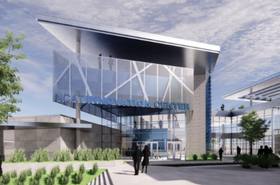
ImpactData partners with Raeden for Greensboro data center in North Carolina
20MW of capacity due online in Q2 2026
Comments