
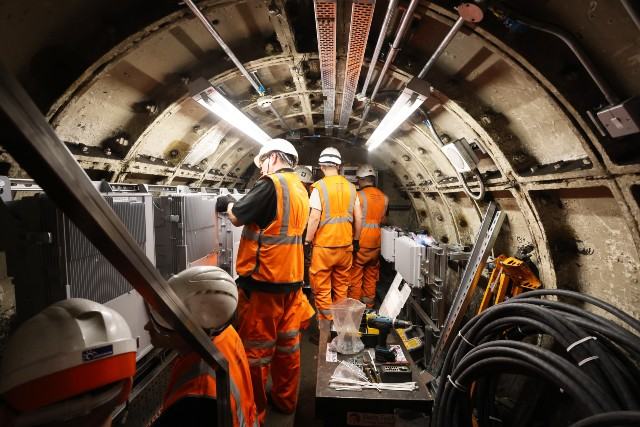
Limited mobile coverage is a headache that London commuters are all too familiar with.
Poor signal is par for the course even above ground in the UK capital, and for those who use the London Underground, the city’s subway system, connectivity has always been nonexistent. Until recently.
Now the Tube is getting a 5G network, and the task of bringing it to life has been handed to neutral host provider Boldyn Networks, formerly BAI Communications.
In 2021, Boldyn was awarded a 20-year contract by TfL to provide high-speed, 5G-ready mobile coverage across the entire London Underground network. The company is investing around £1 billion ($1.35bn) in the project.
The UK’s three mobile networks, EE, Virgin Media O2, and VodafoneThree have provided their own network coverage on top of the network hosted by Boldyn, and are sharing the infrastructure to allow customers to surf the web on the tube.

DCD Magazine out now: Quantum of Promise
Building the chips to power quantum computers
“Can you hear me?”
Until 2021, connectivity between stations in the Underground’s tunnels was unheard of, with people instead forced to read a book or stare blankly into space. The best connectivity you’d get would be WiFi – if you were lucky – between stops. Even many of the network’s above-ground stations would be signal blackspots.
But nearly five years since its inception, the 5G project is taking shape. In January, DCD was invited on a press tour of the network facilities installed at Battersea Power Station tube station, which itself only opened in 2021 as part of an extension to the Tube’s Northern Line, to see how the network is maintained and keeping commuters connected.
Boldyn’s team has become subway experts in recent years, says Brendan O’Reilly, the company’s CEO for UK and Ireland and group COO. “We're doing similar work in New York on the MTA subway, San Francisco for the BART (Bay Area Rapid Transit), and also in Rome,” he says. “But this will probably be the biggest DAS (Distributed Antenna System) globally once it's finished, it’s a huge project for us.”
Tunnels and leaky feeders
Installing the network has required Boldyn to run fiber optic cables across the numerous tunnels that connect London’s tube system. This was completed last year, according to Matthew Griffin, head of commercial telecoms at Transport for London, the body that oversees, well, public transport in London.
To support this, ‘leaky feeders’ have been installed throughout the tunnels.
“A leaky feeder is effectively a massive coax cable with slots cut out of it, and that allows the signal to leak out and your mobile phone radio to be received through an antenna, and then about a kilometer back, it connects to these radios here [in the station],” explains Griffin.
Boldyn was unable to show the tour down the tunnel, for obvious reasons, but did demonstrate a recording of a LiDAR scan that highlighted how these cables were able to feed through the tunnels at window height.
Although the job of connecting the tunnels with the cables is complete, Boldyn still has to add high-power radios in the stations.
Back of house
The tour, which was led by TfL, extended to the back-end of the station, not usually seen by the public. Each station houses Boldyn Network equipment in cabinets, where the fiber connects to the tunnel and back to the base station hotel.
“Every station has one of these cabinets that has the key fiber network that goes on through the tunnel back to the base station hotel,” says Griffin.
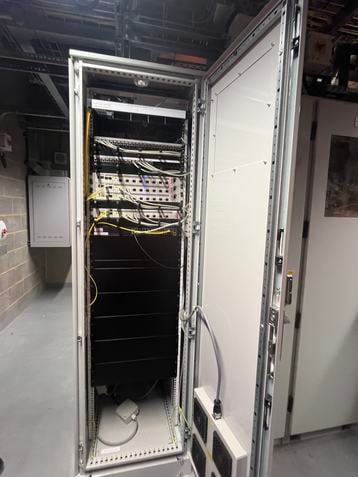
Griffin explains that the reason a neutral host such as Boldyn is preferred for this project is because of limited space. Each individual network installing its own infrastructure would not be practical in such a constrained environment.
“We find it very difficult to install even one of these cabinets, so to install four times the equipment would be impossible,” says Griffin, who adds that this can also cut costs for telcos.
It’s worth noting that it’s not the same for each station, with some bigger stations requiring more cabinets than others. For example, Tottenham Court Road, one of London’s biggest tube stations, houses 18. Others, such as Cannon Street, have as few as two racks.
While walking along the platform, it was evident that the antennas weren’t overly visible on the Underground. This wasn’t a coincidence, explains Griffin.
“History is really important to us, so you've got to make sure that this is as invisible as possible. Now, in this station, these speakers are white … in other places, we've had to paint these the same color as the background,” says Griffin, adding that commuters don’t want to see “hideous radios.”
Griffin explains that the antennas are fed by coaxial cable. At Battersea station, there are 16 radios front of house and 67 back of house. Such a high number of radios is needed to support the emergency services.
“We have made location data from the mobile network designate you at one of those stations so emergency services will go to the right place,” says Griffin. “It means your location will always show as a station rather than halfway along the tunnel.”
Such is the importance of having a reliable emergency services network in place, the Home Office supported the funding of these areas, providing an undisclosed sum to finance the installations.
Base station hotels
If it’s just Boldyn deploying a neutral host network within these stations, then where do the mobile network operators come into this?
The answer in the base station hotels, which are scattered around London, effectively operating like data centers. There are nine of these base station hotels in total, connected to in-station cabinets using fiber.
They house telecoms equipment, such as the Baseband Units (BBUs) for multiple mobile network operators, promoting the consolidation of network infrastructure, which in turn allows operators to save costs.
EE, VodafoneThree, and Virgin Media O2 colocate their 4G and 5G network equipment within these hotels. Signals are carried between them and the London Underground over the fiber optic cables that connect through to the cabinets.
“The fiber optic cable via a few jumps all the way back about five or six kilometers away to the base station,” explains Griffin.
Griffin explains that the number of base station hotels required is governed by the laws of physics. These restrict the distance of useful fiberoptic connections to a maximum of 12 kilometers (7.4 miles).
“The limiting factor is the speed of light,” he says. “Mobile phone services are really dependent on timing, so you need a timing signal. And the way it works is we effectively have a delay from this system.
“Light takes too long to get further than 12 kilometers and back for that timing. So that means you can only be 12 kilometers.”
London’s unique headache
Although Boldyn has experience supporting networking deployments for transport systems globally, the task at hand for the London Underground is unique, particularly as parts of the network date back to 1863, making it the world’s oldest subterranean passenger railway.
Its age means the Underground wasn’t initially created with mobile connectivity in mind, and its tunnels run beneath large amounts of clay, earth, concrete, and anything in between.
Because of this, there was no set rulebook for Boldyn and TfL to deliver the build-out, which will eventually cover all 121 stations on the Tube network that are located underground.
“I think it's fair to say the 121 stations are all unique,” says Rebecca Bissell, director of information technology, TfL. “They’re all different. Some of them [the stations] pre-date the technology and radio itself, so they're very difficult environments to work in.”
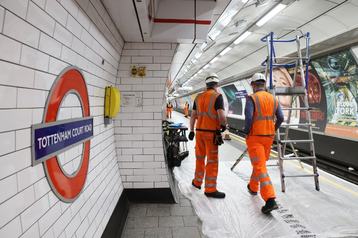
To make matters that much more difficult, the working window for engineers is very short, often as little as three to four hours.
Given the fact that the tube network is in use every day, it’s impossible to carry out the work during normal operating hours, meaning Boldyn and TfL can only get busy during the early hours, when train services aren’t running.
It’s a complexity that Boldyn hasn’t experienced in other deployments, such as in New York, where there’s more room to work with, both literally and metaphorically speaking.
New York’s Subway “operates 24/7, but they've got bigger tunnels,” says Nick Hudson, UK&I CEO at Boldyn Networks.
“This environment is completely unique. Just to give you a sense of scale right now, we've got pretty much 400 guys every night working in these environments.”
Because of this, it’s tougher to connect within the tunnels, where space can often be a limiting factor for engineers.
The few hours that engineers can work include the preparation of bringing the equipment from above ground down to the platform, and then clearing the platforms ahead of the tube services resuming in the morning.
“You've got to take everything down every night and bring it all out and close everything up to get the punters back in the station the following morning. So it's a complete operation, shift in and out every night, and you've got two and a half hours to do it,” says O’Reilly.
To help with the operation at hand, a lot of the kit being installed is pre-cut, while engineers will know their roles, adds Griffin.
On track for completion
At the time of writing, Boldyn is around halfway through its deployment, with 62 out of 121 tube stations, which are located ‘underground’ and covered with mobile connectivity across ticket halls, corridors, and platforms.
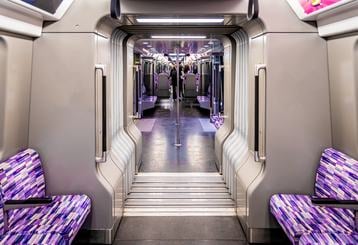


This includes the entirety of the Elizabeth Line, in between tunnels, plus the first sections of the Circle and District lines.
The aim is to extend coverage to all 121 ‘underground’ tube stations by the end of this year, which is something Boldyn says it is on track to achieve.
“The latest stations and tunnels to go live now mean that we are on a clear path towards having 4G and 5G mobile coverage across the whole network by the end of 2026,” says Isabel Coman, director of engineering and asset strategy at TfL.
For now, there are plenty of late shifts to be had for the Boldyn engineers, so those rush hour phone calls in the Elizabeth Line tunnels between Farringdon and Liverpool Street connect without a hitch.
Comments