
Ever since its founding in 2018, Universal Quantum (UQ) has had a “somewhat idealistic picture” of wanting to build a quantum computer that is helpful for humanity.
“Our founders, CEO, Dr. Sebastian Weidt, and CTO, Professor Winfried Hensinger, and the company in general, have always come at the idea of building a quantum computer from a rather equitable place - that’s what our vision is,” Mark Webber, quantum algorithms lead at Universal Quantum, tells DCD.

“Sure, there are lots of applications that we can get excited about from a more economic perspective, and we wouldn't disregard them, but what really gets us excited are those applications of things that can change people's lives.”
Universal Quantum was spun out of the University of Sussex in 2018 and is based on research undertaken by the two founders into the development of trapped-ion quantum computers. Based at a “state-of-the-art” research and manufacturing facility in Haywards Heath, near Brighton on the south coast of England, the company has grown from a team of around eight when Webber joined in around 2021, to an organization now employing more than 100 people.
Today, Webber leads a team of scientists that investigate both quantum applications - “how we will use quantum computers” - and quantum error correction, which he says is a “a really critical piece of the story that allows us to actually know when and how quantum computers will be useful,” though perhaps not so relevant for those that are purely interested in the practical applications of quantum computing.
For companies like UQ, which are both developing underlying technology and also want to make sure this technology is governed and deployed responsibly, when it comes to the list of useful and equitable applications for quantum computers, life sciences is near the top. Webber says this is, in part, because the scientific community’s ability to design drugs is hampered by the limitations classical computers have simulating the impact of these drugs.
Enter quantum computing.
Quantum for good
It was this ‘quantum for good’ ethos that led UQ to the Open Quantum Institute (OQI) and ultimately the project that is the focus of our conversation: Can quantum computing help to cure endometriosis?
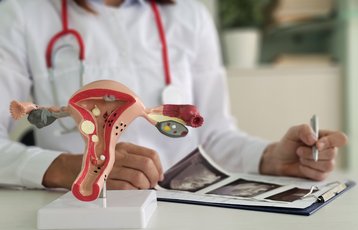
Endometriosis is a condition where cells similar to those in the lining of the uterus grow in other parts of the body. Whilst endometriosis is most commonly found in areas around the womb, such as the ovaries, fallopian tubes, and lining of the pelvis, it can also affect organs such as the bladder and bowel. Globally, around ten percent of reproductive-age women and individuals assigned female at birth are estimated to be living with the condition, a figure which equates to about 190 million people.
It is not known what causes endometriosis, and there is currently no cure. While surgery is an option for some - ranging from the removal of the endometriosis cells or parts of the affected organs, to a full hysterectomy - the condition is most commonly treated with over-the-counter painkillers or hormones, such as the combined contraceptive pill.
The Open Quantum Institute was launched in March 2024 by the Geneva Science and Diplomacy Anticipator (GESDA) in collaboration with the UN’s International Telecommunication Union (ITU), CERN, and other international bodies. It serves as a neutral platform to explore and support quantum use cases with global public benefit, including climate science, healthcare, food security, and more.

Part of OQI’s focus is to ensure that quantum technologies are developed and applied in alignment with the UN Sustainable Development Goals (SDGs), which cover, alongside a myriad of other things, life sciences.
Webber says UQ didn’t approach OQI initially with a want to cure endometriosis; rather, the project evolved as a result of successive conversations between the two about what could be achieved in alignment with the UN Sustainable Development Goals that OQI is focused on delivering.
Life sciences has become a focus for UQ because, according to Webber, the impact is high, but also the advantage for quantum computers in the area is already rather well understood – there are problems in the life sciences space that quantum computing companies are already excited about, optimization on classical data and machine learning, for example.
“[At UQ] we're focused on equity… which we've demonstrated through attempts at collaborations where we've looked to provide value that isn't solely through the more commercial lens, or what makes us the most money,” Webber says. “So, from that respect, we had alignment with OQI.”
As conversations between UQ and OQI progressed, the two partners worked together to define a goal that they were both excited about.
“It started initially rather broad in the drug design space, an area where there's a lot of excitement and we have some internal expertise on how we think we might be able to use a quantum computer to help in that space,” Webber says. “As those conversations developed, we decided to make it more targeted, and in particular, focus on women's health. And once we made the choice to focus on women's health, one particular application came to the forefront, which was endometriosis.”
This particular project aims to explore how quantum simulations can accelerate the discovery of non-hormonal, shelf-stable therapeutics that target endometriosis, with a focus on underserved populations in rural or economically developing regions.

The Life Sciences Supplement
AI meets frontier medicine
“Now, let's be transparent, a lot of the work that we're going to be doing, innovating the quantum algorithms and understanding the quantum hardware, is not specific to endometriosis,” Webber notes. However, a lot of the work that UQ plans to do in collaboration with classical quantum chemists and drug design companies will focus on endometriosis as a use case.
And while Webber says that OQI does provide some funding for the project, that wasn’t the main draw for QC. “[OQI] is a name that opens doors, and while waving their banner, we can bring in other collaborators as well.”
From a delivery perspective, the technical aspects of the project will fall directly to UQ, with Webber saying that the company plans to run workshops with end users in the life science and drug design space, including experts from the fields of biomedicine, computational chemistry, and women’s health. This will help bridge the gap between classical simulations for complex modeling and quantum algorithms, and will ultimately see UQ reproduce bio-molecular systems on quantum processors in an effort to better integrate these insights into drug discovery workflows.
Drug companies use a mixture of techniques for simulation, not just classical computers, Webber says, meaning that “having those conversations and understanding the end users’ perspective is really important.” He explains: “It’s very important to work with those that understand the classical version of the simulations that they're running, because at Universal Quantum we've got varied skill sets, but we are not the world experts in computational fluid dynamics, or drug design, or portfolio optimization.
“We mostly have the skill set on the quantum hardware and the quantum algorithm side, so it’s important to bring those two together and work with end users that understand the classical bottlenecks and how they formulate their problems, because when you plan to use a quantum computer, it is not the case that you trivially take that current algorithm being used on a normal computer and just run it on your quantum computer.”
A lot of the work centers on mapping the problem, understanding where advantages can be gained using quantum computers, and how to maximize that advantage. Quantum computers “are not a silver bullet, but are inherently better at all tasks,” Webber says.
He continues: “You need to bring in that combination of really understanding the end user problem formulation, which we rely on through collaboration, and then bringing together the quantum algorithm understanding to find the best way to run that problem.”
The race is on
While the eventual applications of Universal Quantum’s system are a cause for excitement, nothing will be achieved unless the technology can be proven to work.
UQ is focused on developing a trapped-ion quantum computer, one of a number of different technological approaches to quantum computing being pursued by companies currently – as Webber explains, “it’s a bit of a race at the moment, and it’s not immediately clear what underlying technology is the best route forward.”

On a basic level, within a trapped ion quantum computer, individual ions, otherwise known as electrically charged atoms, represent qubits, which are controlled by electromagnetic fields. Quantum operations are performed using laser or microwave pulses, which can manipulate the internal states of the ions and the interactions between them.
While quantum computers do exist already, Webber says most existing systems are not currently useful because they don’t have enough qubits – quantum bits. Scaling quantum computers as quickly, efficiently, and cheaply as possible is what’s required to make quantum computers useful, and while a number of companies have now passed the 100-qubit threshold, Webber says, regardless of technology, those qubits are still noisy and hard to control, making them unsuited for tackling large-scale problems.
Universal Quantum has staked its reputation on the trapped-ion approach, allowing it to scale in the quickest and most efficient way, but Webber says the company also believes “there’s a sliver of truth” to the idea that this approach is also most suited to life science applications.
But he says: “I think what really will differentiate the quantum hardware and their suitability to applications is not the specificness of the hardware properties to the application; it will solely be how advanced the hardware is that will vary greatly, as we push our timeline out between different hardware providers.
“There are different strengths and weaknesses. There's great variation in the fidelity of physical operations, the quality of control, and the rate of operations is an important one that varies greatly.”
While UQ has endometriosis firmly in its sights, ultimately, the firm is a quantum hardware provider, and Webber explains that, for the company, the main focus will be the continuous improvement of its hardware so it can build a quantum computer that provides an advantage.
“[While this project is ongoing], our quantum hardware will be developed, put forward, and improved. At some point, I'm sure we will be running things on our early-generation hardware, but it's not the main focus of this project,” he says.
“We are focused on building truly large-scale machines that will make a very serious impact, and we don't believe these first-generation devices - of anyone's, not just ours - are going to be able to provide that, outside of maybe some very niche situations where some clever techniques will give us something that we're excited about.
“These first-generation devices are more in the realm of being learning tools – using them, understanding how they behave, running proof of principle demonstrations of use cases, but not giving those final answers.”
The future is bright, but it’s not here yet
Right now, the project to cure endometriosis is still in its early stages, with UQ organizing some initial workshops and setting up a network of interested parties to better understand their problems. Those involved with the project are also currently producing documentation and reports to help estimate the resources that will be necessary to see the project through and the feasibility of the desired outcomes.
There’s also a lot of work outside of the quantum space happening in parallel, Webber explains, including UQ developing its understanding of the current state of drug design.
For this particular project, curing endometriosis, Webber concedes that it’s unlikely an outcome will occur on the company’s first-generation hardware, but in three or five years, “whatever it happens to be,” as the hardware becomes more advanced, that will put UQ in the best possible position for making advancements.
This is because, as he explains, all the hard work on the quantum algorithms and understanding the hardware expectations will already be in place, allowing the interested parties to take advantage of the technology much more quickly than if a project such as this had never been started.
“There's a lot of that will be provided over a concrete time period, but this won't be the end of the story at the end of this project, as currently defined,” Webber says. “At that point, we will have those ingredients, so it will become the case of marrying them with the sufficient quality hardware to start running the experiments that actually provide the advantage, and that will continue beyond the scope of this project.”
This feature first appeared in the DCD Life Sciences Supplement. Register here to read the entire supplement free of charge.







Comments