

In 2020, then Iceotope CEO David Craig wrote an article for DCD in which he argued “the Edge has needs which only liquid cooling can satisfy.”
“As companies across almost every vertical sector begin the deployment of IT in the myriad of locations where data processing and access is required close to people and things,” Craig wrote. “These new Edge environments will not be uniform in nature, but common to all will be the need to keep the IT equipment cool.”
Five years later, Craig has retired from the liquid cooling company, but it would appear his predictions have come to fruition.
The Edge Supplement
The Edge state of play
Neil Edmunds, Iceotope’s VP of product management, describes Edge as anything outside of that “super highly controlled white space that data centers typically have,” meaning that pretty much anywhere could be considered for Edge deployments, given access to the right technology.
While the AI revolution has been characterized by daily headlines about the hyperscalers increasing their data center footprint to house all their AI compute needs, high-powered infrastructure is not just the preserve of those with the deepest pockets or the largest data centers. For example, in February 2024, Supermicro partnered with Nvidia to launch application-optimized Edge AI servers that support a host of different Nvidia hardware deployments, including multiple H100s - although according to Supermicro’s website, all those servers are air-cooled.
That being said, the Edge is continuing to grow in popularity, especially as companies increasingly shift from AI training to inferencing – where the model applies its learned knowledge – as most of this work can take place in an Edge environment, reducing the time required to send data to a centralized server and receive a response.
As a result, not everyone who has managed to get their hands on some Nvidia H100s wants to keep them in a data center in Virginia, US, or Slough, UK.
Edmunds says Edge deployments can be found anywhere from up a pole or lamp post, where the IT equipment is exposed to wind, rain, or even snow, to an office block or repurposed building. A company might also be considering an Edge deployment in an environment, such as the Nordic nations or South America, where it could be subject to extreme temperatures.
All this means is that while, in some cases, the Edge location could be clean and well-lit, it’s unlikely to have all the amenities you’d find in a traditional data center. With such a wide range of potential Edge locations, versatile cooling solutions are needed, and this is where liquid comes into play.
Edging out air cooling
Liquid cooling isn’t a new concept, having been used in some capacity to chill compute hardware since the 1960s. However, while most conversations around the technology relate to its role in helping to sustain and grow the increasingly dense racks required for AI workloads, for those looking to deploy compute infrastructure at the Edge, it’s also a practicality.
Proponents of liquid cooling say it is particularly suited to Edge deployments because it is easier to install than air-based systems. This could make converting an abandoned building, for example, much easier, Edmunds says.
“There may not be very much space to put an external heat rejection system of traditional size and scale for an air-cooled facility,” he explains. “So typically, certainly for Iceotope and I would presume for other liquid-cooled technologies, the outdoor infrastructure needed for heat rejection of liquid-cooled designs to air is much more compact than air-to-air infrastructure.
“On typical data centers, you have huge cooling towers that evaporate loads of water, big air-to-air heat rejection systems, or a fresh air system to blow through. All of these things are going to be very challenging to deploy at the Edge because they usually come with tons of filtration, lots of space requirements, and potentially lots of power requirements to operate them. The need for a compact, almost portable, deployable heat rejection system is going to be pretty important to enable people to utilize previously occupied spaces which are now abandoned.”
However, Sean Graham, research director for cloud to Edge data center trends at IDC, said that, while it certainly has its benefits for some deployments, the case for liquid cooling at the Edge is perhaps not quite as cut and dry as one might be led to believe.
Graham feels that, when it comes to the various types of liquid cooling technologies on offer, immersion is best suited for the Edge. But, ultimately, the answer to which cooling option is best always depends on deployment.
“It really becomes down to what compute you have,” Graham says.
“The world talks about AI, but even at aggressive projections, it's only going to be 20 percent of the entire data center market.
“So, when you start talking about traditional workloads, it's not going to be all AI, it's not all going to be high density, and air is still an appropriate cooling method. You even have liquid-to-air, these hybrid solutions. So air still has a very valid place in the market.”
Furthermore, Graham notes that if your Edge location is already set up for air cooling and your densities are low, splashing out on liquid cooling might not necessarily make the most sense.
Australian geophysics company DUG, previously known as DownUnder GeoSolutions, has chosen to eschew air and bring liquid cooling to the Edge.
Originally founded to process seismic data at mining locations, since 2003 DUG has been providing immersion-cooled high-performance computing (HPC) solutions for scientific data analysis.
Ron Schop, EVP at DUG, says two factors fueled the company’s decision to dive into the world of immersion cooling.
“The first thing was the data was becoming denser and bigger, so our compute requirements were getting bigger,” he says. “The second was that we were working on new technologies to do seismic imaging, and that also required even more compute.
“So the bottom line was, for everything we were looking to do in the future, we just needed more and more compute. Then we looked at our power bill and thought, this is not sustainable.”
While Schop says the company did look at other technologies (“liquid-to-chip is interesting, but probably on the scale we need, not applicable”) it was immersion cooling that could offer DUG the cooling and efficiency it so desperately needed.
“For us, it was just initially about the dollars, because the compute we had was too expensive [to run] and yet we needed more of it,” says Schop. “So we really seriously started looking at alternatives, and immersion cooling for us was the clear winner.”
Immersion cooling exists in two forms, single-phase and two-phase, and is the practice of immersing the servers directly into a tub of dielectric fluid and using the high heat-carrying potential of these fluids to move the heat away from the IT equipment, offering an extremely high cooling efficiency.
It is far from the only liquid cooling technology on the market. Iceotope, by comparison, combines both immersion and direct-to-chip cooling for its liquid cooling offering – precisely targeting the hottest components of compute with a small amount of dielectric fluid, a model which the company says allows it to recapture nearly 100 percent of the heat generated.
But once DUG had decided to throw its weight behind immersion, it encountered another problem - the solutions on the market at the time didn’t quite live up to their promise, particularly when deployed at scale.
Schop recalls: “It became quite clear that we wanted a single-phase solution, where the fluid just stays in the tank, because as soon as fluid moves out of the tank, that's a whole other set of problems.
“We started out in a garage, we’re very much a ‘can-do’ sort of company, and we thought, well, we can't see the immersion solution that we need so let's build it ourselves. So we started building our own cooling tanks.”
Consequently, DUG became known as an early adopter of immersion-cooled data center designs. Schop says he occasionally still has arguments with “die-hard air-cooled proponents” but his response is simply to show them the data DUG has collected to back its offering, telling the nay-sayers that the company spends half the amount on electricity, its compute doesn’t break down, and it sees hardly any outages.
He adds that when you have so much equipment, the “logical choice” is to use immersion cooling, and says: “The Edge compute we offer would be very hard to put together in an air-cooled solution. And, on top of that, by having [the compute] sitting in a tank, we can put it in some of the most extreme places in the world.”

How low can you go?
In October 2024, DUG deployed a prototype immersion cooling data center container, dubbed Nomad, at the Adacen data center in Silver Spring, Maryland.
“We’ve got a Nomad 10, a 20, and a 40 - that's a 10-foot, a 20-foot, and a 40-foot,” Schop explains. The 10 model contains a single immersion tank, and though the larger Nomads are still at the design phase, the 20 is likely to have six tanks, while the 40 will have 12.
Schop says that while DUG’s solution might not look as attractive as other immersion cooling tanks on the market, “they’re built to work,” and as a result are “pretty robust," which could be music to the ears of those looking to deploy at the Edge.
Nomad has now moved from prototype to product, and Schop says the Nomad 10 has roughly around 50-60kW of heat rejection capacity.
“We’re still working on the 40-foot container, but it’ll probably have about 750kW of heat rejection, and we’re hoping to get that up to 1MW,” he says.
DUG has been using a PAO6 fluid but is now moving its tanks to PAO8 as PAO8 is a higher-viscosity fluid for better wear protection under load. (PAO is a dielectric fluid called Polyalphaolefin.)
Schop says the fluid used by DUG in its tanks has been “a great investment” because not only can you use it for a really long time, but it also brings the energy costs down and the compute components that are immersed in the fluid don’t move, meaning they run even more efficiently.
“We get the most value out of our expensive GPUs because they sit immersed in oil, therefore, they don't degrade,” he says. “We only upgrade because we get better CPUs and GPUs available on the market.”
Schop says customers often ask DUG how much compute can you put in Nomad, to which he says the answer depends on what you want and what you can afford.
“The interesting thing is that often, in the past, your amount of compute was directed by the space that you had,” he explains. “In our tank, we’ve got 26 rack units and that would be the thing that determined what kind of compute you could put in there. Now, it's not about the rack units you have, it's about how much heat you can reject. Because if you can use 26 rack units and stuff them with GPUs, which we're close to doing, then you're getting a lot of compute for your buck.”
Bringing whitespace to the Edge
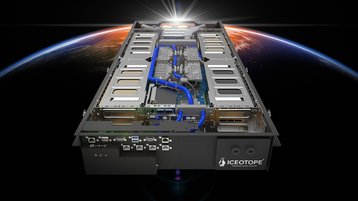
At present, Iceotope’s liquid cooling offerings fall into three main categories: KUL Data Center, KUL AI, and KUL Edge. The latter comes in three different designs that the company says has been optimized for “high-density, low latency Edge computing.”
Iceotope says its KUL Edge solution can provide a 40 percent energy reduction and requires no water, while the KUL RAN – designed to meet the needs of high-density, low-latency vRAN, Open RAN, and 5G services offered by telcos – can deliver 20 percent energy savings, or 40 percent when compared to traditional air-cooled systems.
Edmunds says that when it comes to Edge deployments, typically customers approach Iceotope when they don't want to over-invest in a white space build out in an Edge location – “imagine how much it's going to cost to convert a potentially tenanted or rented space into something that can have a traditional air-cooled system deployed in it,” he says.
He says that Iceotope has been working with one customer looking to deploy “a significant amount of AI racks” in obsolete office spaces around the UK and has consequently been contending with these types of issues, particularly how to reject the heat from 200-300kW of compute.
“Instead, they would rather spend the money on the compute and the relatively low additional cost of Iceotope and the rack with its liquid-cooled infrastructure,” Edmunds says.
When it comes to cost, IDC’s Graham says that while liquid cooling at the Edge does have “compelling value,” it might not be the best financial choice for every company.
“With liquid at the Edge, there are definitely scenarios where it could have a lower total cost of ownership (TCO),” Graham says. “Deploying liquid is going to be more expensive just out of the box, but can present a lower TCO, not just from the heating and cooling expense or from the electricity needed to cool the compute, but it can also be beneficial support for IT infrastructure because there's a lot of reports out there that say once you have the device immersed in a fluid, it doesn't have as many problems.”
But, that doesn’t mean there aren’t potential barriers to deploying liquid at the Edge. Graham says that while liquid could have a lower TCO over its lifetime, it can also be expensive to deploy upfront, meaning that companies need to consider if they have the budget for it right now, or if the money could be better invested elsewhere in the business.
“You also have to consider the workloads and whether this going into an existing environment, in addition to your budget,” he says.
What Graham does agree with is that when it comes to solutions like Iceotope’s, whose liquid-cooled racks are delivered to customers as a sealed chassis to protect the compute components against potential contamination issues, the “value proposition is real.”
For example, Iceotope says in the “rare event of a service-related incident, only one server is affected, preserving the integrity of the remaining infrastructure.”
“I've heard complaints about leaves, cobwebs, or other stuff getting sucked in through fans and things like that, blocking the air ducts on servers and causing them to overheat or go down,” Edmunds says. “Then you have to send the service technician out to fix it, and that costs a lot of money.”
“There are so many elements rolled up into this Iceotope sealed solution,” he adds, suggesting it essentially means Iceotope’s racks become the data center white space, but closer to the IT itself, helping to address another question he says customers often have about Edge deployments – how do I put that amount of compute in an unusual space?
The answer, Edmunds says, always comes back to performance and efficiency, with liquid cooling acting as the great enabler when it comes to allowing these huge AI-focused compute deployments to run without issue.
And he says the way the company’s liquid cooling technology has been developed for Edge environments can also be a boon for traditional data centers. “In the mainstream data center we’re also enclosing and cooling extremely high-powered equipment in a very tight package, in a very small form factor,” he says.
“It's like a Venn diagram of technological benefits. Some apply over here but it’s the same over there too. And we really are going to continue pushing the limits on cooling performance and efficiency.”





Comments