
In this industry, you are your brother's keeper. You depend on each other up on a tower,” says Chase Goins, a cell tower climber turned broadcast tower technician.
Goins’ view was echoed by several of the telecom tower climbers that DCD spoke with for this feature. Brotherhood is a recurring theme, as if those in this profession feel a part of a club that many wouldn’t dream of joining.
Having spent most of his career climbing cell towers, Goins is well aware of the dangers of the job.
Scaling cell towers, which can reach several hundred feet, is a daunting prospect. Broadcast towers are often taller, with the tallest, a KRDK-TV mast, spanning 2,060 feet (627.9 meters), located in Galesburg, North Dakota.
It’s these sorts of heights that make the job of climbing a tower one of the most dangerous in the world.
Safety concerns
The stats back this up. A study carried out by the Communications Workers of America (CWA) union revealed 65.3 percent of respondents had been on a site where someone was injured.
The same study found that a quarter of people have come across on-site injuries on at least five occasions, while 17 percent have worked with someone who has been fatally injured on a site.
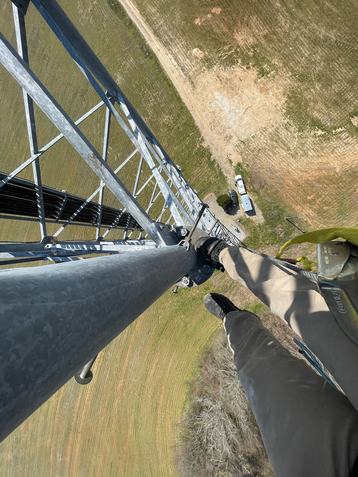
Four percent of respondents, including Goins, have witnessed a death while on a job.
“I had a co-worker pass away on the tower with me last year,” he says. “It was horrific.” Goins was there when Toby Coles, 62, fell from about 200ft (61m) from a cell tower in Little Rock, Arkansas, on September 12, 2025.
“He was a great man. It’s just another situation where I have no idea how or why it ended up happening. A moment of carelessness led to someone losing their life,” says Goins.
The Occupational Safety and Health Administration (OSHA) found the incident to be an accident, closing its investigation into the case earlier this year.
Last year, a total of six tower-related fatalities were recorded, up from two deaths in each of the previous two years. Wireless construction publication Wireless Estimator has been tracking these fatalities since 2003, noting 2006 as the record high for fatalities with 19. In total, since tracking these fatalities, 176 deaths have been recorded.
Daniel Hovey, a distributed antenna systems lead technician at Alpha 8 Communications and previously a tower foreman of eight years, has also witnessed a co-worker and friend fall to their death while on site. Devon Collins, 29, fell from 107ft (33m) after he had connected his lanyard to the open end of a nylon sling that was serving as an anchorage point and stepped out of the personal basket, and then fell backwards.
Despite falling nearly 110ft (34m) from the tower, it was another seven hours before Collins succumbed to his injuries.
“You work so long up there you forget you’re 100ft (30m) off the ground,” says Hovey. “All you’re focused on is the task at hand. The other guy on the tower with us quit. He realized that that could be him, he said, ‘I’m too comfortable’ - it’s that complacency that kills.”
These climbers are propping up the lucrative industry of telecoms, supporting the build-out of mobile networks that keep all of us connected.
According to the Wireless Infrastructure Association, the US cellular industry invested more than $10.2 billion in expanding network capacity and coverage last year, and this is excluding expenditures on spectrum, maintenance, and ongoing operations.
In total, operating expenses for US cellular networks reached nearly $54.7 billion in 2025, while total wireless infrastructure investments – including construction, maintenance, and operations – amounted to nearly $65 billion.
“Tower climbing is a critically important and needed role,” says Patrick Halley, president and CEO, Wireless Infrastructure Association. “Reliable connectivity for Americans doesn’t happen by magic – it’s built by skilled tower technicians. We’re grateful to the tower technicians who are on the frontlines every day to keep us all connected.”
Getting into this career
Given the dangers of the job, it’s fair to say that the average person wouldn’t fancy scaling several hundred feet up a tower for several hours at a time. So, who does this sort of job?

DCD Magazine #61 - Life and death on a tower
The cell tower climbers risking it all to help us stay connected
“I actually first learned about tower climbing from a segment I saw on TV. I remember early on thinking, ‘wow, these guys must be some of the most highly skilled professionals out there,’” Tommy Schuch, founder and president, Climber Protection Group, explains to DCD.
A passion for climbing and adventure is what got Schuch into the tower industry. This sort of path into the sector isn’t uncommon. A lot of climbers enjoy being high up, scaling structures that would seem unthinkable to most, and it is a crucial trait for the job.
“It's incredible,” Schuch adds. “Being up that high, seeing those views, the challenge of it's like nothing else. I especially loved climbing at night or in the cold. The more challenging the environment, the more I got out of it.”
Schuch doesn’t climb towers anymore. He spent 12 years performing antenna installations and maintenance, and led crews as a foreman. Although he enjoyed his job, he quit the industry – as a climber anyway – in January 2021.
“The reason I stopped climbing is pretty simple,” he says. “I realized the industry doesn't care about the people actually doing the work. Climbers are being sacrificed for speed and profit, placed consistently in unnecessarily dangerous situations, and being taken advantage of in the process.”
Indeed, his view is echoed by other climbers too. William Stone, who describes himself as a freelance tower climber, tells DCD that it’s important to make people aware, outside of the industry, of the challenges that climbers face.
“I’ve worked with Tommy a lot of times to try and bring stories to light and get climbers to talk, because the facts are, the industry as a whole has created a silence. It's a hush-hush kind of job,” says Stone.
He has been climbing for close to 15 years, getting into the profession after seeing a post on Facebook advertising a job. Within a day of his application, he was offered the role.
“I wasn’t scared of heights, and was previously a rock climber, so I decided to apply for the job. It wasn't even 24 hours, and I had a message to go to Montana,” he says.
Stone recalls that his first trip took him to “Cherry Peak” in Missoula, Montana. He says that on his first assignment, one of his colleagues was injured and had to be rescued by the fire department, amid a polar vortex.
“It was pretty gnarly conditions. We were on a 10,000ft (3,048m) mountain in Missoula. I watched the accident happen when my foreman cut his leg,” explains Stone. Despite this, he was hooked from day one.
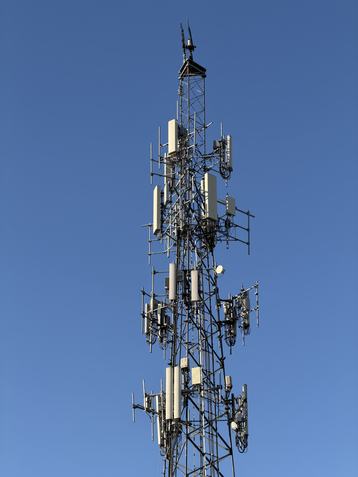
Each day is different
The job itself is seen as one that takes workers across the US, usually far away from home, and often for weeks at a time.
Day-to-day work will differ somewhat, depending on the task at hand, though it usually begins in the early hours of the morning.
Climbers will work in groups, usually made of three to five-person crews. The working hours differ depending on the tasks, meaning the job is not your typical 9-5. An average day is more likely to be 12 hours, and that’s only if things go according to plan.
The strength required to not only climb these structures, but to do so whilst carrying up heavy telecoms equipment, means that it’s also a physically demanding job.
The average pay for the job could be anywhere between $20 to $25 per hour, though most climbers DCD spoke with say that tower climbing only pays off because of overtime, as working weeks often stretch up to 60 or 80 hours. Night shifts aren’t uncommon either.
Furthermore, given the wide-ranging weather conditions across the US, tower climbers will encounter a diverse variety of conditions they must contend with.
This could be a heatwave or heavy rain, sleet, or even snow. However, OSHA regulations state that climbing is prohibited under certain conditions, such as storms or when winds exceed a certain speed. Not that this deters most climbers.
“If an antenna goes down, or a light needs to be fixed, somebody has to get up there, no matter what the conditions,” explains Schuch. “It might be at night, and it may be very cold, but as long as it's safe enough – and I say that lightly – to work, climbers will do that.”
Recalling his own experiences climbing in inclement weather, Schuch says he’s climbed cell towers in the middle of snowstorms in sub-zero temperatures.
Goins notes that the situation could depend on an individual crew’s view of the weather.
“You're not going to be out here working when it’s thunder and lightning. You’re not going to be forced to work in those types of conditions,” he says.
Before climbing any tower, crews have to carry out a Job Hazard Analysis (JHA) to assess current conditions and review an emergency rescue plan.
While on the tower, the industry adheres to a strict "100 percent tie-off" rule, meaning a climber must always be attached to a secure anchor point using their safety harness, even when moving.
Complacency
Pressure to meet deadlines can have an impact on the performance of tower climbers, notes Hovey, who says complacency can also creep in, even for the older, more experienced workers.
“When you just get too used to being up there, and you jump around quickly without taking the proper precautions,” he says. “That combines with the major push companies puts on everyone.”
He says there’s pressure to get jobs done quickly, which in turn leads to longer hours. Hovey claims to have spent up to 72 hours on a tower structure during one occasion.
“We were up there for three days without coming down, which is obviously dangerous with the lack of sleep and food,” he recalls. “They [the carriers] don't care, especially when 5G first kicked off, which put a major rush on everything, so safety just went right out the window.”
Hovey even claims that inexperienced tower climbers were being used to try to keep up with the demand for 5G installations.
“They were hiring guys to work with us that had never climbed before, and just putting them to work as quickly as possible. You’ve got to slow down, take time. Speed comes with time. Practice the right way and then learn efficiency.”
Does the industry have a voice?
Since hanging up his climbing harness, Schuch is still involved in the tower industry. He has his own YouTube channel that documents the tower industry’s workforce, providing a platform for people to share their experiences on the job, while highlighting the need for conversations around safety.
He’s embarked on arguably his biggest challenge since leaving the industry, and that’s the creation of Climbers Protection Group (CPG), a not-for-profit organization that seeks to give tower climbers a voice over issues the workforce is faced with.
CPG provides members with a safe whistleblowing platform to report job hazards and unsafe conditions anonymously.
Schuch set up the group alongside tower veteran Richard Bell and Dr. Brigette M. Hester, president of Hubble Foundation, another not-for-profit organization that aims to highlight the trials and tribulations of the telecommunications industry, in particular the towers segment.
“The reason I started CPG comes from everything I saw during my years in the industry, such as the shortcomings, the risks, and the lack of real representation for tower climbers,” says Schuch. “There wasn’t any organization giving climbers a voice, and nobody was actually listening to them.”
He says that the lack of a union led him to create the group, which currently stands at 150 members since launching in July of last year.
“I was also one of the key people working to build a tower climbers' union. I spent nearly two years working on that effort, but then that ultimately fell apart,” he adds.
It was at this point that he decided to document these challenges via his YouTube channel. These issues included a range of things, such as workers' pay, long hours, a lack of adequate training, plus the challenging conditions around the structures themselves, and all weather conditions.
“CPG is not anti-industry. It's pro-accountability, pro-transparency, and pro-fairness. Our mission is to reform the system and not destroy it, and look after the ones that cannot,” Schuch says.
NATE’s view
One of the largest bodies that covers the telecom tower industry is NATE, an acronym for the National Association of Tower Erectors (NATE).
Founded in 1995, NATE is a non-profit trade association that seeks to position itself as the voice of the telecom tower industry, tackling issues such as safety, pricing, and improved communications. The group is made up of more than 1,000 member companies, mostly based in the US.
“We represent the contractor firms that do all the wireless broadband, broadcast, and fiber deployments,” says Todd Schlekeway, executive director, NATE, adding that NATE was founded after the death of a tower worker in the 1990s.
“There was a fatality in Arkansas, and the owner of the company who experienced that fatality was one of the founders of NATE,” says Schlekeway. “One of his employees fell, and so they started NATE several years later.”
The group sets out critical safety guidelines, training, and resources for telecommunications technicians who work on comms towers and antenna arrays.
“We facilitate safety training. We have safety committees that have written all the national consensus safety standards that govern the industry…so safety is our core pillar as an organization, in large part because so much of the work is done at heights and then the work at the same time is getting more technical and skilled as well,” he adds.
Bell – a tower industry veteran – has since retired from the industry, but recalls how NATE has changed over the years, since its founding, when tower erector companies joined the association at first.
Over time, he says that the association grew to include safety manufacturer companies and engineering firms as associate members.
Others have been critical of NATE, including Schuch, who has previously said that NATE “shields corporations from liability,” while ignoring tower climbers’ concerns. Meanwhile, Doug Delaney, a former climber and author of the book Tower Dog, says that NATE’s focus has deviated from its original purpose.
“NATE started out as an advocate for the climber, but they quickly became an advocate for the carrier because that's where the money was,” says Delaney.
Schlekeway refutes such claims. “The characterization that NATE's primary focus is on mobile carriers rather than the technician workforce is simply inconsistent with both the history and the record of our association,” he says.
“No organization in the communications infrastructure ecosystem has devoted more resources, attention, or advocacy toward protecting and advancing the interests of tower technicians and the broader communications infrastructure workforce than NATE.”
He points to the safety and health programs, training resources and educational materials that NATE has introduced as evidence of this.
Calling out the carriers
One of the more notable voices in support of tower workers is the Communications Workers of America (CWA), a union for telecommunications workers across the US, which represents approximately 700,000 employees.
CWA created a union for tower technicians in 2022 called Tower Climbers Union/CWA, with the aim of holding wireless carriers and tower owners to account for the industry’s biggest challenges.
Indeed, in 2023, a petition was launched by tower climbers to improve their safety standards and work conditions. Then CWA president Chris Shelton sent letters to the CEOs of AT&T, Verizon, T-Mobile, Dish, American Tower, SBA, and Crown Castle, calling out the carriers and tower owners.
“Our country's wireless networks would not function properly without their labor. Yet, instead of taking responsibility for their working conditions, you have helped to create a network of contractors engaged in cutthroat competition that puts tower technicians at the bottom, their safety at risk, and far too often their very lives on the line,” wrote Shelton in the letters.
Interestingly, Schuch was one of the names quoted in the press release that the CWA put out at the time, reiterating his concerns for tower workers' safety and working conditions.
DCD has tried to contact the CWA several times, but has not heard back regarding the group’s focus on tower safety, while the last press release on the Tower Climbers Union/CWA website dates from May 2024. Schuch is no longer working the CWA and has since channeled his own efforts into CPG.
“I was involved with the effort and believed they were attempting to address legitimate concerns in the industry,” he says. “Ultimately the workforce is extremely fragmented, climbers move between employers frequently, and organizing a national workforce like this proved challenging. Today my focus is on Climber Protection Group and building a grassroots worker voice independent of any union affiliation.”
Silence from the carriers and towercos
The silence stretches to the country’s three main mobile carriers: AT&T, Verizon, and T-Mobile. All three declined to comment to DCD about the struggles the industry faces.
It’s not just the carriers that have been quiet; the tower companies have been too, not replying to requests for input on this feature.
One source told DCD during a previous meeting where CEOs of tower companies were present that one executive was dismissive of the workforce’s concerns.
He and a fellow tower climber expressed concerns about radio frequency (RF) while working on towers, making climbers unwell.
“Another climber and I brought this up to him, specifically a tower site where an AM tower was in close proximity to a cell tower, and that there was a crew up on that tower that was getting sick from this,” he claimed.
While the source did note that he’s not an expert on RF waves, he says that this can affect the tower climbers while they’re carrying out their work.
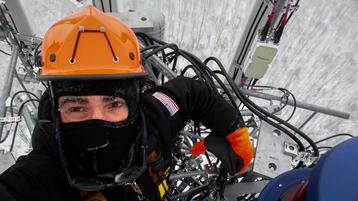
“So we brought this up to the CEO, noting that there's no communication between the different carriers or whoever owns the equipment on this tower to shut that off while we're working around it. And essentially he said, ‘Yeah, not our problem, talk to the carriers about that.’”
It’s this lack of communication that leaves a lot of the tower climbers feeling neglected, where the responsibility falls back on them, he adds.
“A lot of people want to just pass the buck off and say that it's the dumb tower climber's fault,” the source adds, noting that tower climbers are not engineers and don’t fully understand the complexities of these systems.
None of the tower companies DCD contacted responded to discuss this feature. However, NATE’s Schlekeway says that tower owners are well briefed on the tower assets they own.
“The tower owner companies are very good about knowing their assets. These are very valuable real estate assets, and so they are pretty good about ongoing maintenance to make sure that they're safe to ascend,” he says.
Setting the standards
Safety standards for the telecommunications industry are set out by the American National Standards Institute (ANSI).
ANSI sets out the guidelines for the tower industry to ensure that towers can withstand severe weather, seismic events, and safely support heavy equipment.
“That is the playbook that companies use to operate safely at tower sites in the US, and so many of the customers, the tower owners, carriers have required adherence to that safety standard,” explains Schlekeway.
Although ANSI sets out the safety guidelines for the industry, the implementation of training practices is provided by third-party training companies, says Schlekeway.
Contractor firms will do their own training, he says, via someone who is certified under the trainers model, mainly focusing on competent climber rescue training, RF safety, and OSHA 10-hour training.
While these foundational training courses might be commonplace now, this hasn’t always been the case for the industry, says Bell.
“We didn't wear any safety equipment in those days,” says Bell. “When we started in the late 1950s, contractors were not obligated to wear a bunch of safety equipment; it wasn’t necessary. It was left to the iron workers to do it safely, as safely as could be done.”
Halley notes that the level of training has improved, but does acknowledge that there’s still work to be done.
“Training has improved significantly over the past decade, and WIA is proud to have contributed to that progress through our Registered Apprenticeship program,” he says. “However, we would be the first to say that the work is not finished. The pace of technological change - new equipment, new network architectures, new safety requirements – means that training must continuously evolve.”
When it comes to safety and training, Goins says that various types of towers should be approached differently. He says that it’s important for climbers to be aware of where they should be mounting equipment.
Training in this instance doesn’t just include guidance for working safely on your own, but also ensuring climbers are able to respond to help rescue efforts if necessary, adds Schuch.
“I've watched good climbers risk their lives, not because they're reckless people, but because saying no would cost them their jobs. Add that to a lack of proper training, especially when it comes to rescue training, a lot of the guys aren't very well trained in rescue, which is a huge deal, because most of the time you're working in extremely remote areas, far from any help,” he says.
The industry’s high turnover rate is also a real issue for safety, adds Schuch, who suggests that under-skilled climbers end up training newcomers.
“This leads to a workforce of very under-skilled individuals, where you might have a guy that's up on top of a tower he's only been climbing for a year, and he's training a guy that just started,” he says.
Pressures to deliver, amid “overloaded” towers
Strict deadlines to match the carrier’s ambitious network rollout targets are leading to mistakes being made by tower climbers, suggests Schuch.
“Climbers make personal mistakes and fall, that happens,” he says. “But the bigger picture is far more complicated… when it comes to unrealistic deadlines, non-stop pressure, climbers working 12-18-hour days, and spending seven days a week on the road away from their families."
One of his biggest grievances is that a lot of these tower sites are structurally not fit for purpose or safe for climbers. Schuch mentions that cellular towers are overloaded with several carriers’ telecoms equipment, with these radios pushing weight limits and space on these towers.
“A lot of the time, working as a tower climber, you'll be up on structures that are under-maintained. They're overloaded. Those are the type of things that really create the real danger, and those are the situations that really can scare you because they're out of your control,” recalls Schuch.

Because of this, Schuch says that it can be difficult for climbers to appropriately follow safety procedures at all times.
“You're constantly working around live equipment, or you might have equipment that was shut down, that suddenly gets powered back up, and that's actually the number one reason climbers are overexposed to non-ionizing radiation in the industry.”
Overloading of towers is something that Brendon King, a former tower climber, has also encountered, which he says has become a common problem for climbers and a huge safety concern.
“Look at how many times OSHA has changed the standards, or the manufacturers have changed the standards on what's considered overloaded and not,” he notes.
King mentioned that on one such occasion, a Tier 1 carrier had a number of overloaded sites, but standards such as weight limits changed, meaning these sites were no longer considered overloaded.
“Overcrowding is a huge issue that you deal with nowadays, especially on the smaller sites. There are a lot of times when you just straight up do not have a place to tie off to, and the company will want you to do it anyway,” he adds.
On one such occasion in 2014, two tower climbers were removing tubular diagonal bracing from a communications tower when the tower in Clarksburg, West Virginia, collapsed, causing both men, Kyle Kirkpatrick and Terry Lee Richards Jr, to die on impact.
Firefighter Michael Dale Garrett, who attempted to rescue two other workers, died at the scene when a second tower in close proximity also collapsed.
Bell, who was called in as an expert witness for the investigation, noted in an interview that both towers were old structures.
“Both the towers were old, but had not been well maintained. There was a lot of rust, and it hadn’t been painted. The guy wires were rusty, and neither of the towers was well-maintained,” said Bell in an interview last year.
“The towers were obviously overloaded… Two of the faces of the tower were solid lines. There was no place to stand or move to work on the opposing faces. The climbing facility was given little consideration by previous installers; there were lines and antenna mounts and obstructions… It was just a heap of steel piled up.”
Tower climber Stone agrees that pressure for what he calls “unrealistic deadlines” has led to corners being cut.
“We’ve faced a lot of outbreaks of bad weather, which common sense tells you would delay projects, but it's a dog-eat-dog world,” he says. He notes that there have been instances where workers have been told to climb in between breaks in the weather to take photos and make progress on the site.
“We had tornado watches in place… You take safety into your own hands out here. It's pretty hectic right now, when it comes to the speed at which sites are being done, and because of this, it’s definitely jeopardizing safety.”
Overloading towers hasn’t been the only issue, adds Bell, who notes that with each generation change, the need to modify the towers is crucial.
“With every new generation, it meant that those antennas get a little bit bigger,” he says. “When they got into 4G, they realized that the original towers were designed to support four or five carriers. And then 5G was introduced, and now those antennas are about as big as a door,” adds Bell.
Bell says that Bell Tower Corporation, a tower manufacturing company, started receiving orders to deal with these modifications.
“I got one modification where it was so extensive that the modification steel that was just going to be welded up to the existing structure, and the steel going into the modification actually weighed more than the entire original tower did,” says Bell.
FCC: Elevated in the media
While the towercos and carriers remain largely silent on the tower industry, the Federal Communications Commission’s (FCC) chairman, Brendan Carr, has had plenty to say.
Carr, who has been chair of the FCC since January 2025, has form for climbing towers for photo ops, and recently ascended a 2,000ft (610m) broadcast tower in North Carolina.
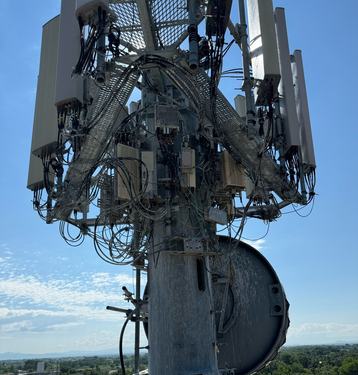
While on the mast, Carr told the press of the importance of these tower climbers, saying he wanted to highlight the work of tower crews across the US. Carr told reporters that he’s climbed around 30 towers in total.
“These crews are the salt of the earth,” Carr said at the time, before stating that climbers will be busy as President Donald Trump’s administration delivers its “Build America” infrastructure agenda.
Goins has climbed alongside Carr on a previous occasion. “It was an honor for me to climb with an elected official,” he says. “He had no reason to come up the tower, even when he just did it a couple of weeks ago. He has no reason to go up there. The average person isn't just going up a 2,000ft tower and climbing a double-stack antenna.
“I'm hoping it brings awareness to the climbers, and that him doing that helps bring awareness to all of us, whether it's broadcast or cellular.”
During Carr’s interview with the press atop the tower, he suggested that some salaries for climbers are as high as $100,000, when the truth is that most tower climbers make around $50,000. Zip Recruiter estimates that the average salary is $52,357.
However, Schuch is not convinced that this is the reality. “When people hear $50,000 a year, generally they don't realize that's often with quite a bit of overtime,” Schuch says. “In today's economy, that's not really a livable wage for someone supporting a family like a lot of these guys have out in the field.”
He added that most cell tower climbers won’t be making near six figures.
Dwindling workforce
A Wireless Estimator report found that there were around 29,000 US tower climbers in 2015. Just over a decade later, in 2026, that number is estimated to be around 20,000.
It should be noted that telecommunications carriers have significantly slimmed down in the past decade, too; for example, Verizon had around 177,000 employees a decade ago. That figure is around 85,000 now.


Schuch is far from the only tower climber to leave the industry. Another leaver is King, who spent 12 years doing the job before quitting the profession in June last year. He explains that he got into this career because his father was also a climber.
“I did it for 12 long years because I'm a second-generation tower hand. My dad did it, and from the age of 14, I knew that that's what I wanted to do. I would still be doing it if it weren't for some of the things that need to change,” he says.
King says that he chose to leave because the money in the industry has dried up, something he blames on the matrix pricing for cell tower contractors, which is set by wireless carriers and general contractors.
“I was running my own company in this because it was so lucrative, and it was amazing to do. But now there are these things called line item pricings, where everything's matrix-based,” claims King. “So what I used to be able to charge $4,500 for in a single day is now $75 worth of work. The carriers have squeezed and nickled and dimed every penny out of it.”
A report last year by NATE, in partnership with Brattle Group, outlined concerns that the Big 3 US carriers have too much power over the US wireless infrastructure services industry.
Brattle's survey found that mobile network operators "impose rigid, non-negotiable matrix pricing agreements that fail to cover the actual costs of labor, equipment, and region-specific deployment conditions."
The report found that this has contributed to the industry slimming down. More than half (54 percent) of the survey respondents said they have reduced employee counts in the past three years, while some experienced firms are exiting altogether.
The need for these engineers will be required in order to drive the rollout of wireless infrastructure, adds Halley of the WIA.
“As carriers accelerate their 5G densification strategies and begin laying the groundwork for future network evolutions, the demand for qualified tower technicians will increase. It is essential that we have well-trained tower technicians to get the job done, professionals that perform safe and high-quality work.”
Driving standards
While the industry hopes to see changes in the pricing system, the main priority for these tower climbers remains a safe working environment.
“It’s about holding each other accountable, making sure we are using our safety equipment properly, that we are paying attention to each other, that we're not being judgmental or rude about things that we say to each other,” says Goins.
“It’s about saying, ‘I’m here for you, I'm trying to make sure that you're aware of what you're doing, I want you to be safe. I want you to go home to your family.’”
Schuch, who has also emphasized the importance of the shared brotherhood in this industry, ultimately wants to see change for the better that serves society.
“The crazy thing is these changes would benefit everyone, the climbers, the carriers, the tower owners, I mean, the entire digital infrastructure, everyone who uses cell phones. It would be a better system. Why would you not want to make it better?” says Schuch.
Comments