
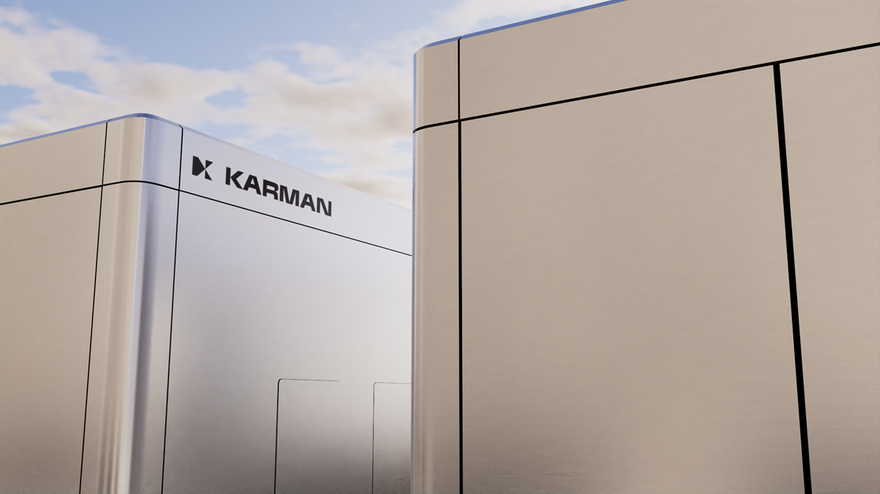
Karman Industries CEO David Tearse joins our Zoom call from an office high above his company’s Gigawerx factory in Los Angeles, California. The manufacturing facility looks so pristine and futuristic that DCD has to double-check we’re not viewing a virtual background.

The Cooling Supplement
Achieving efficient data center cooling
“That’s our first Kompressor right there,” Tearse says, gesturing to a cylindrical machine laid out on the factory floor. “We built it in a year and ran it through 200 hours of testing. Now hardware is starting to arrive for our first production build, which is very exciting.”
It’s certainly been an exciting year for Karman Industries, having closed a $20 million Series A funding round to scale up production of its data center cooling technology.
The ‘Kompressor,' which Tearse is so proud of, sits at the heart of the company’s Heat Processing Unit (HPU), which it says can cool servers and recycle waste heat, and can do it from a footprint far smaller than conventional cooling systems.
From cockpits to cooling
Tearse is a tech investor with a background in aerospace engineering. Before co-founding Karman Industries, he worked for Skyryse, a company developing a hardware and software platform for pilots to improve safety in the aircraft cockpit. He then spent a year as venture partner and entrepreneur-in-residence at Riot Ventures, a VC fund that invests in defense, manufacturing, and energy companies with a focus on automation.
He left this role in July 2024 to found Karman, though he clearly remains on good terms with his former colleagues, as Riot was the lead investor on his new firm’s Series A round.
“I’ve spent a lot of time in the investment side, and was looking to start my own company,” Tearse explains. “When I was entrepreneur-in-residence, I met my eventual co-founder, CJ Kalra. He’s one of the most brilliant people I know and is a world expert on thermal management.”
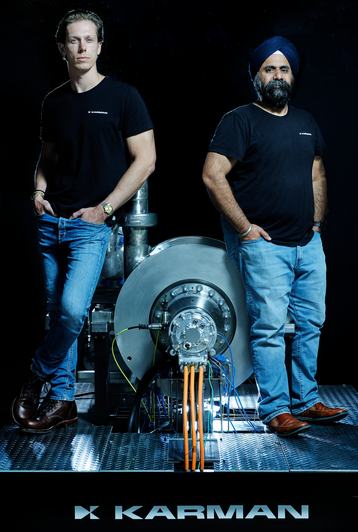
Kalra was most recently head of technology at battery storage firm Antora Technologies, and has a CV that includes engineering roles at NASA and GE Global Research.
Explaining the problem Karman hopes to solve, Tearse says: “Our high-level thesis for the company was that we wanted to build the next generation of thermal infrastructure.
“Fifty percent of global energy usage goes towards thermal management - heating something up or cooling something down - and often these systems are built with antiquated methods or tooling.”
At the same time, Tearse adds, hundreds of billions of dollars are being spent on advanced technology for aerospace, electric vehicles, and advanced manufacturing, which could be applied to cooling. He says: “We wanted to go back and pick better ‘Lego bricks’ and approach thermal management from a first principles design point of view. That way, we hope we can bring a step change to the market.”
Though neither of Karman’s co-founders is from a data center background, they soon hit upon digital infrastructure companies, with their ever-growing cooling needs - and large capex budgets - as ideal end users for the company’s system.
“We were always looking at this data center piece, and as we talked to more and more potential customers, we saw this groundswell of demand for a new solution,” Tearse says. “If you look at what has happened in the data center space over the last 24 months, let alone the last five years, you’ve gone from building a 50-100MW data center to a gigawatt data center, and that’s just a fundamentally different product.”
As rack densities rise, the amount of cooling units required at a data center is also shooting up. Tearse contends that this is unsustainable for a number of reasons, not least because the amount of space being taken up by cooling systems at large campuses is growing exponentially. “The cooling solutions in the mechanical yard today were designed for schools or hospitals, and you’d put two or three of them on a roof or in a yard, and it’s fine,” he says. “But if you put 500-1,000 of them together, the complexity gets very high, you get a lot of heat recirculation, and it doesn’t work well.”
Inside the HPU
Tearse describes HPU as an “umbrella term” to cover Karman’s suite of products, which can be set up in different ways depending on the end user’s particular situation. “The idea is that you think of heat of something that needs to be processed, and depending on your data center’s configuration, your chips, and the ambient conditions, you might want to do different things with it,” he says. “At the moment, too many companies treat heat as a liability, when really it’s an asset, it’s energy.”
To access this asset, the heat first needs to be removed from the servers. Karman is proposing to do this via 10MW CO2 chillers. CO2 cooling is emerging technology that works in a similar way to traditional air cooling, but utilizes carbon dioxide rather than an F-Gas-based refrigerant. F-Gases can be highly damaging for the planet, so proponents of CO2 cooling see it as an environmentally friendly alternative to traditional methods. Several other vendors are also developing CO2-based solutions but it has yet to be widely adopted across the data center industry.
Karman’s interest in CO2 is driven by its greater efficiency when compared to traditional coolants, Tearse says. An air cooling system works by passing pressurised refrigerant through an expansion vessel, which helps rapidly reduce pressure and temperature, so the refrigerant is ready to chill hardware. “When you run CO2 through the expansion process, there’s a lot of energy left over which we can harness,” Tearse says. “That makes it different from R134a, the refrigerant most people use. With R134a, there’s very little energy left over. With CO2, we have enough to power a turbine.”
The HPU does not use any water, and Tearse says it is able to do this because much less equipment is needed than in a traditional cooling setup, meaning it avoids the curse of recirculated hot air.
Tearse explains: “Recirculation is the enemy of all efficiency here, because when you’re just dumping hot air onto the next system, it makes it much more difficult to cool it. Our ability to eliminate that recirculation, so that our units are operating in an environment where the temperature is much closer to ambient, is how we’re able to unlock some performance gains.”
Coolant is circulated and heat removed by Karman’s compressor, or Kompressor as it has been dubbed by the firm’s marketing department. This apparently leans on technology from the aerospace industry and rotates at 30,000 rpm, making it significantly faster than other compressors on the market. Because the Kompressor’s motor is faster and more efficient, the company believes it can unlock savings for data centers. Tearse says Karman’s system can deliver significant reductions in power usage effectiveness (PUE), though he declines to put a figure on how much the HPU can bring down PUE.
“It depends on the configuration of your system,” he says. “In the harshest conditions, where you’re running the coldest cooling loop, and you need to do that on a hot summer day in Texas or Nevada, we are seeing 25 percent efficiency improvements over the best solutions currently on the market. Everything gets better from beyond that.
“If you can meaningfully reduce peak PUE, it allows more power to be allocated to compute versus opex. We think our system can really move the needle in this respect.”
With liquid cooling systems becoming more powerful all the time, it remains to be seen if Karman’s approach can match up. What seems certain is that it can cut the amount of physical space taken up by cooling units at a data center. Tearse believes it could reduce the required room by 80 percent when compared to an equivalent amount of chillers for a standard air or liquid cooling system.
Putting heat to use
To truly treat waste heat as an asset, one needs to be able to find an interested buyer. And as chip temperatures continue to rise, Tearse says the output from cooling systems is becoming a more useful commodity.
“There are several different views on how chips are going,” Tearse says. “Some people at data centers want to run their chips colder, and we think we can give them the most efficient way to do that.
“If you want to run your chips hot, you’re getting to the point where, depending on ambient conditions, the exit temperature is hot enough, and you have a big enough Delta T, to be able to do heat reuse.”
Delta T is the difference in temperature between the temperature of air entering and leaving a heating or cooling system. Tearse says Karman is targeting heating networks, primarily in European markets where such networks are more prevalent than in the US, as well as looking at “co-generation,” where the heat is used to produce power.
Further development of these ideas will be enabled by the company’s $20 million funding round, which has helped it complete the build-out of its Los Angeles factory, Gigawerx, and employ a team of engineers who have previously worked at aerospace big names such as SpaceX and Rocketlab.
Tearse said the firm hopes to reveal news of which data center companies it is working with in the near future, and that it is in discussions with multiple hyperscalers.
“Over the rest of this year, we will be building up the production systems here and running them through rigorous testing,” he says. “Customers also want to be able to see what we’re doing for themselves. True deliveries to customers, from a scale manufacturing standpoint, will start in 2027.”
By the Fall, Gigawerx will have the capacity to handle production of 1GW of cooling systems annually, Tearse says, and the company is aiming to scale this up to 4GW as demand requires it.
He believes his company’s approach - and the team it has assembled - will help it stand out in what is an increasingly crowded cooling market.
“We started the company here in Los Angeles because of all the aerospace and defense companies that are clustered here,” Tearse says. “That’s enabled us to bring in some very high-caliber people who have done a lot of amazing things in their careers and are bringing knowledge, innovation, and design principles to this space.
“When you build a satellite, you put it in a rocket, and you never get to touch it again. It either works or it doesn’t, and you don’t get to fix it if there’s a problem. Bringing that philosophy to this industry is what I think has allowed us to move so quickly.”
He continues: “We’re not borrowing one core piece of technology [from aerospace], but we’re bringing some materials our team has worked with, and some manufacturing techniques, but mostly about how you design these things on a system level. A lot of companies will concentrate on one part of the product, or have siloed groups working on different parts of the cooling puzzle, whereas we’re able to think more holistically and not be held back by those constraints.”







Comments