

Few events have the power to shut down the Las Vegas Strip, but for one weekend each November, the regular hubbub of tourists and slot machines is replaced by the sound of screeching tyres and roaring engines.

The Sport Supplement
Pitch-perfect digital infrastructure
Revived in 2023, the Las Vegas Grand Prix has rapidly become a fixture on the Formula 1 calendar, with the likes of McLaren’s Lando Norris and Red Bull’s Max Verstappen doing battle on a 3.85 mile street course that includes a dash past the hotels and casinos of the famous Strip.
The event attracts more than 300,000 spectators, contributing more than $900 million to the Las Vegas economy each year.
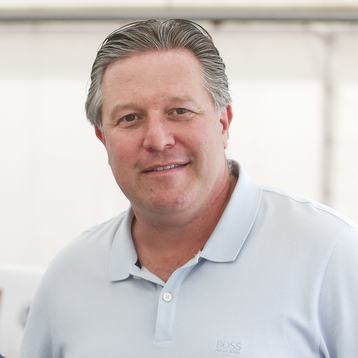
The 2025 edition of the race, won by Verstappen, coincided with Schneider Electric’s Global Innovation Summit, also held in the city, and McLaren F1 boss Zak Brown told delegates at the conference how digital infrastructure has been key to his team’s renaissance in motorsport’s premier competition.
Pole position
Brown has been at the helm of McLaren since 2017, and has helped the team emerge from the doldrums. In 2024, it claimed its first Constructors’ Championship title for 26 years, and followed that up in 2025 by doing the double. Though Norris lost out to Verstappen in the Las Vegas race, he was celebrating two weeks later when he secured the points required to take the Drivers’ Championship, with his team retaining the Constructors’ crown.
Brown believes the margins between success and failure in F1 are minuscule. “The competition is unbelievably high,” he said. “You’re talking about a two percent difference between the best and worst teams in Formula 1, so even the ‘worst’ team is very good.”
With such small differences between cars, it is no surprise that teams lean heavily on technology to try and find an edge. F1 is perhaps the sport most intricately intertwined with IT, as the myriad tech company logos that adorn its cars attest.
Brown gave delegates at the Schneider summit an insight into the sheer volume of information computed by the team’s digital systems over the course of a single race weekend, which encompasses the main event itself, as well as practice, qualifying, and sprint races.
“We pull down 1.5 terabytes of data per race weekend and have 300 sensors on each racing car,” he said. “That can be data overload, but we often need to be able to make split-second decisions. So, for example, if an incident happens in front of the pit lane as we’re about to make a stop, we might have two seconds to make a choice about which tyres to use, and there’s not time for a long debate about it.
“It’s quite easy to get that wrong, and you have to use your instinct, but also trust the data, and we now use AI to filter that data and make sure we have the right data available to us.”
With so much information needing to be processed (Brown says McLaren “runs a million simulations” each race weekend to try and prepare for all scenarios) Edge computing infrastructure is an important part of McLaren’s arsenal. While some processing is done in the cloud via a partnership with Google Cloud, the team uses Dell servers and Cisco switching gear at trackside, linking back to its data center at the McLaren Technology Centre in the UK via a dedicated 100 Mbps Multiprotocol Label Switching, or MPLS, network connection. In MPLS, information is arranged in packets with labels, rather than long networking addresses. Routers can then use these labels to transfer information, rather than having to inspect the contents of the packet, speeding up transfers and reducing latency.
At the Technology Centre, McLaren runs a Dell AI factory, powered by Nvidia GPUs, to help with the development of its vehicles. This is used not only to simulate how different components will affect performance, but also to crunch available information from the other teams competing in the Championship to look for strengths and weaknesses and identify ways McLaren’s drivers can use race tactics to get ahead.
Drive to survive
Making Formula 1, a sport where heavy cars and large teams of people are flown to far-flung corners of the world every other week, sustainable is no easy task. In total, F1 produced 168,720 tons of CO2 equivalent in 2024, but says this is down 26 percent compared to 2018’s figure, and that it is on track to reach net zero by 2030. New rules have arrived for 2026 around the types of fuels that can be used, to try and reduce the reliance on petrol.
McLaren says it is doing its bit by working with Schneider Electric, a long-time partner, on ways to make its IT estate more sustainable.
In January 2026, following the Innovation Conference, the two organizations announced a new collaboration, with Schneider becoming McLaren’s official energy technology partner. The agreement covers the F1 team, as well as the Arrow McLaren IndyCar Team, McLaren F1 Academy, and McLaren’s United Autosports WEC Hypercar Team.
Schneider will work with McLaren on projects including optimizing existing assets in and around the team’s wind tunnel, manufacturing facilities, and data centers, installing “resilient systems to reduce energy consumption, enabling electrification through advanced energy technologies, and leveraging digital twin insights to enhance efficiency and sustainability.”
Olivier Bloom, Schneider Electric CEO, said: “Racing is one of the most challenging environments to demonstrate the value of advanced energy and digital technology. McLaren Racing pushes every system to its limits, which is exactly where our expertise in performance, reliability, and efficiency makes the difference.”
Brown argues sustainability can go hand-in-hand with faster cars, telling the conference: “The secret sauce for us is that we’ve been able to bring sustainability to the table without compromising performance.”
He said: “We live in a world where milliseconds make all the difference, where we need a lot of power and connectivity, but efficiency has to come with that. The great thing about working in Formula 1 is that it’s a sport that embraces new technology, and we’re always looking for tomorrow’s solution. Sometimes that can be with an off-the-shelf product, but sometimes it involves coming up with new solutions, and it’s exciting to be able to work with our partners to solve this [sustainability] problem.”


Comments