
Twice a year, the Top500 project ranks the most powerful supercomputers in the world. This gauntlet for geeks pushes the boundaries of what a computer can actually do.
It’s easy to look at the upper echelons of the lists to see what brand of GPU is powering some of the most intensive computing workloads ever known to man. But there’s an often overlooked component that’s the real performance powerhouse behind these impressive feats of engineering.
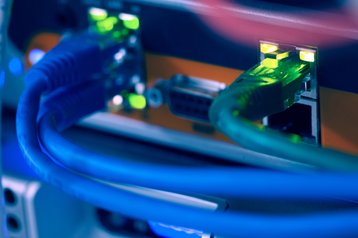
The interconnectivity, which brings the various disparate GPUs together, is the real supercomputing marvel. Able to move workloads from one chip to another at ungodly speeds, all while ensuring the data being transmitted remains intact.
And while the Top500 list pits supercomputers against one another, there’s a second battle that’s been raging on: should clusters leverage Ethernet or InfiniBand?
It's a debate that's run for more than two decades, with each commandeering control from one another in constant peaks and troughs for dominance akin to Formula One drivers jostling for podium places.
DCD sat down with Mike Vildibill, VP and GM for Slingshot high-performance networking at Hewlett Packard Enterprise (HPE), to work out how the interconnectivity landscape is shaping up today, and which protocol may be set to come out on top in the era of AI.
Ethernet versus InfiniBand: What's the difference?
The foundation of modern Internet Protocol (IP)-based networking, Ethernet, is arguably the most defined and understood Internet protocol.
Connected devices in a wired LAN (local area network) or WAN use Ethernet to communicate with one another. In the world of supercomputing, Ethernet does the same thing, allowing interconnected GPUs to transmit data to one another with a cluster (known as scale up), or entire clusters communicating with each other from one facility to another (known as scale out).

The Networking Supplement
AI enters the network
Infiniband, its rival interconnection protocol, does the same thing, though unlike Ethernet, it is a largely proprietary offering. While technically an open standard, Nvidia controls the ecosystem, and it is only really found in the GPU giant’s networking solutions. Nvidia acquired InfiniBand leader Mellanox in 2020 to further cement its dominance.
InfiniBand users can therefore make use of all the offerings inside Nvidia’s CUDA software stack, which is deeply integrated with the protocol, giving supercomputer operators access to a mature ecosystem.
Therein lies the difference. Ethernet is open, meaning data center and supercomputer engineers are easily able to interconnect hundreds of GPUs and other hardware from multiple vendors, be it AMD, Intel, or even Nvidia (with its newfound Spectrum-X fabric, which is built on Ethernet in a departure from its norm).
Given its wider availability among vendors, Ethernet is familiar to the vast majority of engineers from across the industry.
InfiniBand, however, has historically offered superior performance for HPC workloads, particularly in ultra-low latency scenarios. This stems from the native inclusion of Remote Direct Memory Access (RDMA) – with network adapters able to transfer data directly between the memory of different systems, effectively bypassing the CPU entirely and eliminating processing overheads that would otherwise add latency.
Ethernet finds a way
Given its high-level performance, alongside the industry clamor for Nvidia hardware, it’s hardly surprising that InfiniBand went on to dominate the AI network landscape. As recently as late 2023, the protocol held around an 80 percent share of the market.
But where InfiniBand once ruled supreme, slowly but surely, Ethernet has found a way. And to no greater success than in the world of supercomputing, where HPE’s Ethernet-based Slingshot interconnect is among the top contenders.
In the latest list, dated June 2025, six of the top 10 most powerful computers in the world use HPE’s Slingshot, including the top three: El Capitan, Frontier, and Aurora. That dominance extends to the top 30, with a total of 12 systems using Slingshot.
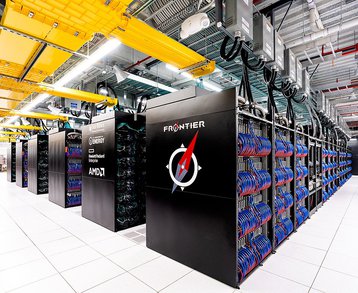
InfiniBand is the interconnect system with the largest share on the list, with 189 of the Top500 using InfiniBand NDR200. But in terms of performance, Slingshot 11, HPE’s latest and greatest interconnect, held a 48.1 percent performance share, compared to just 28.8 percent from Infiniband NDR200.
And Ethernet shows no sign of slowing, either, with recent research from Dell’Oro Group projecting Ethernet to dominate the data center-scale fabric space in the coming years, helping to drive nearly $80 billion in data center switch sales over the next half-decade as operators scramble for an open alternative to InfiniBand.
The latest system to take up what Mike Vildibill and the HPE team describe as “Ethernet plus” or “Ethernet with a twist,” was Isambard-AI, the fastest supercomputer in the UK. Inaugurated in summer 2025, it shot straight to 11th on the Top500 in June, with Slingshot providing 25.6Tbps of bi-directional bandwidth across 64 ports, each capable of 200G.
The HPE VP explains that the trick to Slingshot’s success is getting the technology to “act like a proprietary interconnect on the inside and Ethernet on the edges.
“We try to continue the legacy of what Cray did after being acquired by HPE,” Vildibill says, referring to Cray Research, the supercomputing pioneer that HPE purchased in 2019.
Vildibill continues: “They felt they could implement an interconnect that was Ethernet compatible and compliant at the edges while still doing some of the highly specialized work inside the fabric, or the secret sauce. They pulled it off, and we want to continue that.”
Making strides
With Ethernet projected to dominate then, what lies in store for the future? Cooperation and scale, if industry movements are to be believed.
First up, there’s the ESUN, the Open Compute Project’s new networking-focused working group set to explore Ethernet for AI scale-up. HPE joins the likes of AMD, Meta, and Microsoft in a project set to examine Ethernet-based network switches, with the view to potentially build open, standards-based Ethernet switching for AI workloads.
But most significant of all, perhaps, is the Ultra Ethernet Consortium (UEC), which is looking to take Ethernet networking to the next level. Their 1.0 specification brings that coveted RDMA support from InfiniBand to Ethernet, providing low-latency transport for high-throughput environments, while ensuring the interoperability component that has made Ethernet so successful. And it’s a project HPE is throwing its weight behind.
“The UEC is moving to define what is essentially Ethernet plus, as an open industry standard. The industry wants to build [and] do exactly what we've done with Slingshot,” Vildibill explains. “Not only do we support the industry move, we are a founding member of UEC. We've contributed a ton of intellectual property based on Slingshot, and we very much welcome an industry standardization on something that is closer to Slingshot than Ethernet is today.”
Despite being less than a year old, Vildibill tells DCD that as much as 70 percent of the UEC transport specification comes from Slingshot.
“We’re not competing against UEC, we’re embracing it, because it furthers what we're trying to do as well, which is to take Ethernet everywhere.”
Forged at scale
What sets Slingshot apart isn't just its technical specifications; it's how those capabilities were battle-tested. Unlike most networking products that start small and scale up, HPE's approach was, as Vildibill admits, doing things the hard way.
“Cray developed a new interconnect, and their first deployments that they had designed for, which HPE delivered after the acquisition of Cray, were the world's largest systems, bigger than ever built before,” Vildibill says. “We were finding problems that no one had ever encountered.”
At extreme scale, even the smallest issues become critical, as the VP explains: “When you're running something on 100,000 nodes, and you have a failure rate of one in 10 million, they're going to hit that within about 10 seconds.”
This forced the team to eliminate edge cases and bugs that would be negligible at smaller scales but became showstoppers when amplified across hundreds of thousands of nodes.
The result of this extreme vetting? World-beating systems that make use of a product refined at the highest end first.
“Their reliability, resiliency, error rate, bug rate, are phenomenally low because these things, if we've got them not happening at scale, then they're very rarely, if ever, happening at small scale,” Vildibill concludes.



Comments