
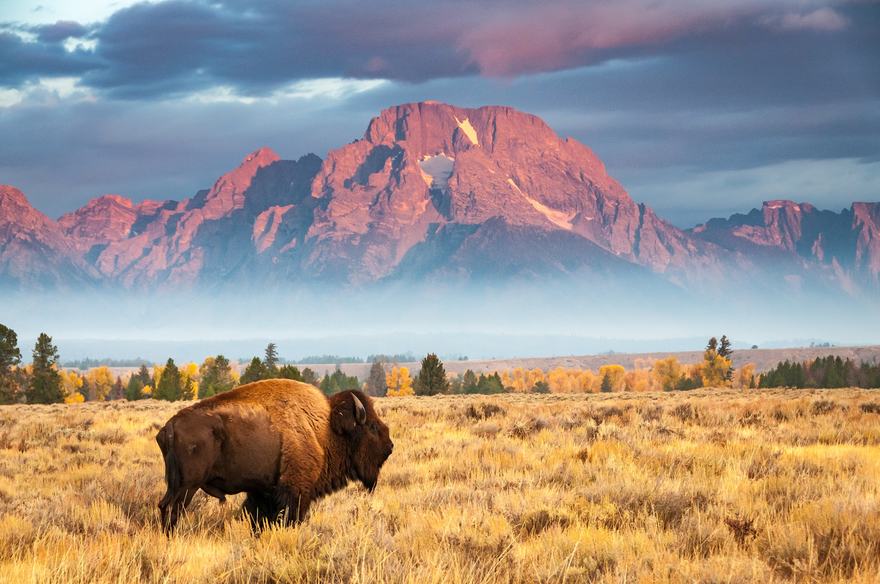
Wyoming Governor Mark Gordon describes himself as a cautious AI user.
“I do use it,” he says, when DCD asks whether he turns to ChatGPT or similar services to help him with the day-to-day business of running the Cowboy State. “I would say I’m cautious about it.
“What we do need to do, particularly as we build our education system, is make sure people understand that the partnership between artificial and human intelligence is what’s key, not replacing human intelligence. But I think there’s absolutely a place for AI in our daily lives.”
Republican Gordon has been governor in Wyoming since 2018, and as he approaches the end of his second term - and his time in office - his state stands ready to welcome the digital infrastructure providers enabling the AI revolution.
And though Wyoming does not currently have a massive data center market, Gordon says all the ingredients are in place to change that.
Cowboy country
Though rarely mentioned in the same breath as Virginia, Texas, or any of the other major US data center markets, Wyoming has many characteristics that make it a desirable location for developers, particularly those looking to build AI data centers.
It is the tenth-largest state in the US by area, spanning 97,813 square miles (253,335 square km). And though much of this land is mountainous and wooded, rather than the flat plains favored by data center firms, there is plenty of space, given that Wyoming is home to just 587,618 people, making it the least populous of all the US states.
In terms of data centers, it has 21 facilities, according to Data Center Map. Most of these are small in capacity, and clustered around Cheyenne, the state capital.

Issue 60 - Quantum of promise
Building the chips to power quantum computers
But Wyoming is starting to grab the attention of the hyperscalers. Microsoft is building a data center in Cheyenne, which could come online later this year. Meta is developing a major campus on a 945-acre site outside the city, and Crusoe recently received planning permission for Project Jade, a 1.8GW campus planned in Laramie County, near the border with Colorado.
Related Digital is spending $1.2 billion on a data center in Cheyenne that will host AI infrastructure for neocloud CoreWeave, and state-based developer Prometheus Hyperscale is planning to build its flagship campus at Evanston, offering 1GW of space.
Gordon says data centers are becoming part of the evolution of Wyoming’s economy, which has traditionally relied on revenues from fossil fuels (more on which later) and agriculture. He says people in the state are becoming more open-minded to developments from the likes of Microsoft and Meta.
“There was some initial scepticism about data centers because they didn’t seem to employ that many people,” he says. “But I think most have now come to the conclusion that not only do these data centers provide great, high-paying jobs, they don't put a tremendous burden on our communities, and can bring enormous amounts of economic activity.”
Nonetheless, Gordon has used speeches and interviews to criticize the people he calls “Club No,” those in state politics and beyond who oppose innovation, technology, and energy projects in Wyoming. “We do have an element who are going to fold their arms and say no to anything,” he says. “But I think most people realize how important this kind of economic development is.”
Gordon says he’s had a lot of conversations with hyperscalers, as well as other players in the market looking to build “data centers with smaller footprints.” He points out that connectivity in the state is strong, with many of the major fiber networks running across the US passing through Wyoming, making it “easy to get tied into fiber in a big way.”
Energy abundance
Governor Gordon is also in a position that would make most other state governors extremely envious: Wyoming has far more power than it needs.
The state generates some 46TWh of electricity annually, according to US Energy Information Administration (EIA) figures, making it the fourth-largest net producer of energy in the country. Crucially, its low population means this is 12 times more than it uses, with much of this energy currently shipped off to other states via transmission lines. Large developments, such as those proposed by Crusoe (it eventually wants to scale its data center in Wyoming to 10GW) could provide power companies with customers on their doorstep.
“Ever since I was growing up in Wyoming, we’ve been searching for the elusive way to make value-add from our raw commodities,” Gordon says. “This is a way to convert the energy we send into the grid for places elsewhere into something that can be used here in a way that is sustainable, durable, and valuable. We need to make hay while the sun is shining.”
Wyoming’s energy surplus is perhaps slightly more problematic for data center firms concerned about their ESG targets. Most of it, some 72 percent, comes from fossil fuels, with coal accounting for 59 percent of this, per the EIA. The state sits atop a third of America’s coal reserves, and has led the country in coal production since the 1980s.
Wind accounts for a growing proportion of Wyoming’s energy mix, providing 24 percent of the state’s power. It is also set to get a new nuclear plant, with Bill Gates-backed TerraPower having been given the go-ahead to build its sodium-cooled nuclear reactor outside the town of Kemmerer. Permission to build the reactor was granted in March, and it could come online by 2030.

Gordon is an increasingly rare figure in Donald Trump’s America - a prominent Republican who does not deny climate change is real, albeit one who continues to champion coal, the most polluting of fossil fuels. He will step down in November, having served two terms as Wyoming governor.
During that time, he has faced criticism for pursuing an “all of the above” approach to power, embracing renewables alongside the state’s coal and gas cash cows, and has repeatedly stated that Wyoming can become “carbon negative” by embracing emerging carbon capture technology, where CO2 is removed from industrial processes and stored away, usually underground, before it can do damage to the planet.
Carbon capture is not a universally popular technology itself, with critics questioning whether it is economically viable and whether it is even an efficient way of controlling emissions. DCD published an in-depth feature on carbon capture and storage in December 2024. Trump is, unsurprisingly, not a fan, and in January the Department of Energy reportedly redirected $500 million in funding earmarked for carbon capture development to instead help revive old and shuttered coal plants.
According to Gordon, Wyoming can court the hyperscalers and still cut its carbon emissions, though he strikes a slightly circumspect tone on whether he still believes in a carbon-negative future for the state.
“I do think that there’s the potential for [carbon negative] to happen,” he says. “I will be the first to admit that the politics have changed dramatically, because in the Biden era we were pushing hard to say that shutting off coal was not going to be a wise thing to do, and that we could both use coal and do a good job of sequestering carbon. That’s still a global concern.
“It’s going to be slow, and there are going to be costs associated with that process, but there are lots of opportunities there too. The current administration doesn’t like it, we get that, but we are still very excited about what [carbon capture] could do.”






Comments