
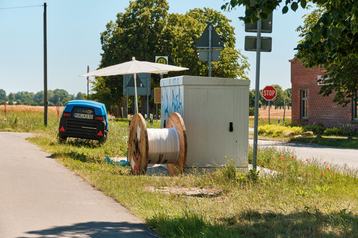
Inline amplifiers (ILAs) are visually non-descript enclosures situated in non-descript locations along a fiber deployment route but are tasked with the very descript job of powering data traffic along thousands of miles of those routes, and are very much becoming an important cog in supporting explosive AI-fueled data traffic.
Joe Reele, VP for solutions architects at Schneider Electric, told an audience during a panel at the recent Connect | New York event put on by DCD that these ILAs are becoming critical infrastructure.
“The ILA hut is a really critical component to the to the whole ecosystem of data centers nowadays,” Reele said of those locations during the appropriately titled “Breaking the bottleneck – Can US connectivity keep pace with growth?” panel.
To bolster that point, Reele said ILA huts currently support up to 1.7 kilowatts (kW) of rack density.
“You know what it does? It just amplifies the light,” Reele said of these locations. “But if you think about from going to the autonomous age, and we're talking about last mile, we're talking about robots, we're talking about drones and all these other kinds of things, do you think that the ILA hut becomes a multipurpose environment? Holy cow! And if it becomes a multipurpose environment, and to have this one-point-something to two-point-something kilowatt, direct density, what am I going to do with that in real compute terms? Not a whole lot, right? So now what happens?”
Reele continued that with “a little bit more power in these places,” they can “start to do some other things other than just pump up the light.”
“I mean, it's cool to pump up the light. Who doesn't want to pump up the light? But, there's a lot of other things that could be going on in those facilities that would help, maybe, unleash or unlock some of the bottlenecks and provide for some of this efficiency, the drones and the other thing to actually come to life,” Reele said. “Everybody's going to talk about the megawatt rack all day long, but do you want to know something? Where the work really happens isn’t in the megawatt rack. There's a bell curve, and things are in the middle, … and I think the ILA hub and the network from … all these great panelists, these are the people that are going to unlock some of that stuff, along with people that can help with power and cooling and that kind of thing.”
Reele’s ILA enthusiasm comes as telecom technology executives continue to debate the physical need for distributed compute resources.
AT&T CTO Igal Elbaz tackled this notion during a recent investor conference, where he downplayed the need to rush compute resources to far Edge locations, an architectural construct that is tied toward supporting latency-sensitive applications and is part of the surge in data center investments.
“I think the proliferation of compute and high-performing compute across the nation, in all metros, is just happening, with the software layer on top of this, with the tools that developers need,” Elbaz said of this surge during the recent NSR/BCG Global Connectivity Leaders Conference. “I am not sure that there's much value in extending that compute all the way to the far Edge just to save another millisecond of latency, or two milliseconds of latency. I think the US perspective on this is a little bit different.”
Elbaz said that from AT&T’s perspective, “we want to take advantage of our nationwide, modern wireless network, our deep fiber build, and being able to create that deterministic experience between whatever use cases comes and help them to intelligently connect to the right model that they use, the context, or the infrastructure that they need, because that's going to be heavily distributed across the US I think the US is a little bit different from other countries and our perspective just because of how deep our compute is being built.”
What’s the ROI for ILA?
Adam Noll, founder of analyst firm Edgeology, also noted during the Connect | New York panel discussion that finances remain an ILA challenge and that deployment models need to take advantage of any chance to “open up the ground.”
“The investor doesn’t understand the return and they want to see a return quicker on the dollar,” Noll said. “If you’re going to put in four conduits, put in 12, put in multiducts. You’re going to want to grow that solution out so that it’s expandable in the future. It’s probably not going to be enough still, but at least you’re trying to architect a network that can grow because long-haul should never be built the same again. You’re never going to know where that sub-market or that off-grid network can appear, so if you're not able to create that off channel, that network, and didn't add more capacity at any given place, then you're not solving the bigger problem.”
This angle echoed that of Jeff Mundt, senior director for optical transport planning at Verizon, who during the recent OFC event touched on the real-world challenge operators are facing when it comes to ILA investments.
Mundt explained that many current inline amplifiers are placed in those previously discussed “little eight-by-24 hut by the side of the railroad tracks” tying together fiber deployments that began decades ago. Mundt noted that while Verizon is indeed interested in multirail technology, the carrier has real-world “asks” of the vendor community tied to the size of such platforms.
“There are some practical questions here of how many lines or rails per rack can I put in, and what's the power and cooling that that's going to be required?” Mundt asked. “And a practical question that we're facing is, if I'm looking at a new fiber build right now, how much land do I buy at all of these ILA (inline amplifier) sites? Am I building and or buying an acre? My real estate team needs to go acquire an acre, because I can plan on putting two shelters and two generators there, or am I going to have to have 10 shelters there for all of these ILAs?”
This density potential has become a central talking point from vendors, with Nokia claiming its multirail platform has a density advantage over rivals.
“This will be the most dense solution in industry,” Rob Shore, head of optical network solutions marketing at Nokia, said during an OFC presentation. “You've probably heard some of our competitors out there talking about their version of this solution. They're getting 128 ILAs (inline amplifiers) per rack. We're getting 160 ILAs per rack. … When this comes out at the end of the year, this will be the highest density solution, about 25 percent more dense than any other solution that will exist in that time frame.”
For Mundt, the backing of those claims is a significant financial and logistical question.
“It's a very simple math: how many rails can I get into a rack? How many racks can fit into one of these shelters? Can I power it? Can I cool that? How many shelters do I need to set on ground for that?” Mundt said. “Am I buying one acre? Am I buying five acres? Am I buying 10 acres? And how much power do I need to go get the power company to deliver to the middle of a cornfield in the middle of nowhere, which is where ILAs typically land. So that's a big question for us.”


Comments