
Thirty-five years is a long time in computing. Since 1990, hardware performance has grown exponentially, with increasingly complex chips powering the PC and mobile revolutions in consumer devices, and the cloud and AI booms in the data center.
At the heart of many of these advances has been British company Arm, which emerged from humble beginnings in a barn in the Cambridgeshire village of Swaffham Bulbeck to become one of the dominant players in silicon design.
Arm’s low-power, high-efficiency chip architecture is at the heart of millions of mobile devices, such as the iPhone. Recently, the firm has been making inroads in the data center by providing blueprints for the hyperscalers to build their own chips.
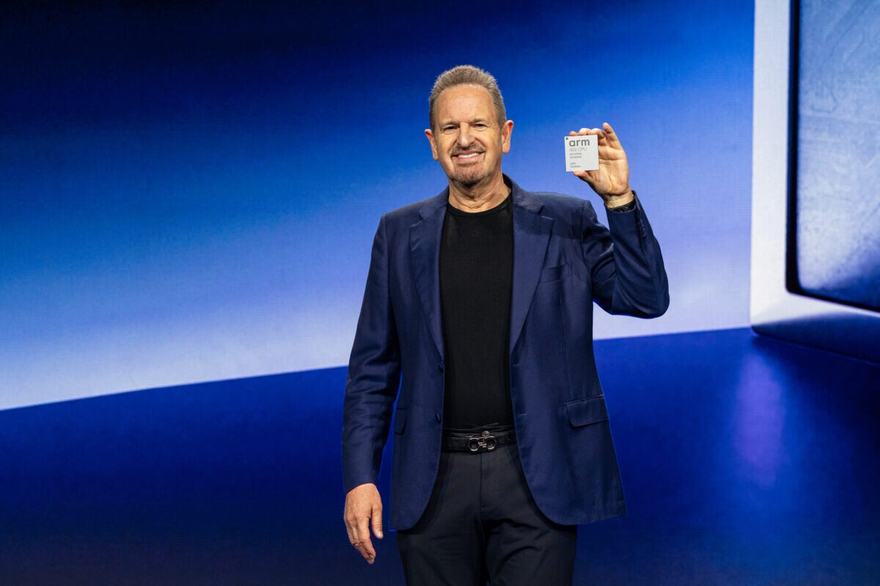
Key to Arm’s success has been its vendor neutrality. With none of its own products on the market, it has been able to license designs to all without fear or favor, earning it the nickname of the “Switzerland of chip design.” But now, Switzerland has decided neutrality is not all it’s cracked up to be, with Arm having announced its first foray into silicon production, the Arm AGI CPU, developed in partnership with Meta and designed for data centers.
The move represents a big shift for the company, and one that could have a profound impact on its future.
The AGI CPU moment
Announced in March, the AGI CPU comprises up to 136 Arm Neoverse V3 cores running up to 3.7GHz across two dies.
Built on TSMC’s 3nm process node, it is said to be capable of delivering more than double the performance per rack when compared with platforms based on Intel’s x86 architecture in certain configurations. This figure, however, is based on internal benchmarks rather than performance in the wild.

The AI Hardware Supplement
Inside the AI server
Arm said it has validated two different Open Compute Project (OCP) rack designs – a 36kW air-cooled system with 30 compute blades, totaling 8,160 cores per rack, and a 200kW liquid-cooled server capable of housing 336 Arm AGI CPUs for more than 45,000 cores.
“This is effectively what cloud providers have been building for a couple of years now, but made available to the general market,” Eddie Ramirez, vice president in Arm’s cloud AI business unit, tells DCD.
“This space is still dominated by players on the x86 architecture. We’ve had a lot of success in the cloud, but mainly with companies that have funds to invest in full silicon teams. To build a chip like this, you need access to north of $500 million in funding, and that’s not realistic for a large part of the market.
“We felt we needed to unlock that part of the market if we wanted to access it, so we needed a different product strategy.”
Meta, a company that definitely has pockets deep enough to build its own silicon – and is doing so alongside Broadcom – will be the first company to deploy the chip. “Meta is perhaps the last hyperscaler that hadn’t adopted Arm in a significant way,” Ramirez says. “They wanted to adopt Arm and do it quickly, and came to us to ask if we could build them something.
“The other good thing about working with Meta is that they said from the beginning they didn’t want this to be a Meta custom chip. They’ve been the great steward and founder of OCP, and they wanted to ensure this chip that was designed around their needs could also be a general-purpose CPU for the market.”
Indeed, Paul Saab, software engineer at Meta who has been involved in the AGI CPU project, told delegates at OCP’s 2026 EMEA Summit, held in Barcelona in April, that the company believes adopting common standards and components will be key to realizing AI’s potential.
“As AI infrastructure scales, standardization across the stack becomes increasingly important to enable interoperability and efficiency,” Saab said. “Our collaboration with Arm reflects a shared focus on advancing open platforms that can support large-scale AI workloads.”
Arm has name-checked a host of other partners that it hopes will be adopting the AGI CPU at some point. AI cloud Verda is perhaps best illustrative of the target customer Ramirez describes. Formerly known as DataCrunch, it currently operates AI data centers in Finland and Iceland, but DCD understands it has big plans to expand into other markets. The company will be deploying the AGI CPU in its data halls, but hasn’t put a timescale on when this might happen.
Ruben Bryon, founder and CEO of Verda, said: “By pairing Arm AGI CPU with our Nvidia GB300 and upcoming VR200 fleet, we aim to deliver a fully Arm-native stack from orchestration to inference, giving customers the density and efficiency that agentic AI demands at scale.”
Ramirez identifies the interoperability between the AGI CPU and Nvidia’s hardware as a key reason the Arm AGI chip could succeed.
“We have a program called System Ready, which was initially an Arm standard where we invited companies to collaborate with us on how chips interact with software,” he says. “We built a set of standards so these different Arm chips look the same to the software, and Nvidia is part of that.
“So the AGI CPU, Nvidia’s Grace processor, and the GB300 are all System Ready compliant, and we’ve donated the specs under that program to OCP. We want multiple Arm chips on the market and do as much as we can to make it easy to adopt all those chips.”
Arm’d and dangerous?
Arm’s leap into chip production could be well-timed, says Stephen Sopko, an analyst with HyperFRAME Research covering the semiconductor sector.
The CPU market is starting to boom, with Intel and its surging share price demonstrating the growing appetite among data center operators to buy more processors to support AI workloads. This will be particularly important as the AI market matures and buyers look to the systems required for inference, rather than just training.
“Agentic AI is driving the ratio of CPUs to GPUs down,” says Sopko. “Whereas before you would get one CPU to eight GPUs, that’s now down to one to four, and [AMD CEO] Dr. Lisa Su has been saying we could see parity between CPUs and GPUs. That’s something that, even a couple of years ago, would have been impossible to imagine.”
Indeed, Dr. Su told investors on the company’s Q1 2026 earnings call that she foresees a scenario where “if you get lots and lots of agents, then you could have more CPUs than GPUs.” CPUs are required to orchestrate AI workloads, while the heavy computational work is handled by GPUs. As such, the theory goes, the more AI agents that are operating, the more CPUs are needed.
Whether agentic AI will take off in the way many predict remains open to debate, but as more and more companies experiment with agents, there is certainly demand for CPUs in the near-term. “Arm has looked at what Intel is doing, and what AMD has been doing, and thinks that it is entering the market at a good moment because of this CPU renaissance,” Sopko says.
What Arm’s existing customers make of the chip designer’s change of direction is not clear, though Ramirez points to supportive statements supplied by many of its key customers for the launch of the AGI CPU as evidence that its licensing business will not be negatively impacted. “We did have discussions with lots of partners letting them know that this was part of our plan,” he says. “Having more Arm in the ecosystem benefits everyone.”
HyperFRAME’s Sopko believes the risk to Arm’s core IP business is limited. “Everyone wants that to be the story,” he says. “But I think there’s so much demand for semiconductors that if you’re Arm, with the legacy and brand they have, there’s space for them to release their own CPU. Theoretically, they are competing with their customers, but in reality, demand is so prevalent that there is plenty of room for them in the market.”
He believes the bigger risk to the company is finding production capacity with TSMC. “They’re relying on the TSMC 3nm process that is already extremely oversubscribed - people are lining up to use those capabilities,” he says. “I’m sure Meta and the other launch partners will consume chips as fast as they can make them, but availability of silicon could be a challenge, and that’s really the only cloud I see on the horizon.”
Sopko adds that moving “from ideas to physical products” changes Arm’s risk profile, but notes: “At the launch, Rene Haas [Arm CEO] made a real point of giving credit to their investors for allowing Arm to absorb that risk. They are so dominant in some parts of the market, and I think they just saw this as an opportunity to drive additional adoption.”
Arm’s Ramirez admits that the company is taking a risk by moving into chip production, but believes it will pay off.
“[Chip making] is a completely different business and requires a lot of investment,” he says. “We started that process a couple of years ago, increasing our staff and hiring folks with experience delivering silicon. There’s more than just designing the chip, you have to design the firmware and the platform that enables you to deliver the chip.
“When you consider all that, it’s a sizeable investment that we’ve made, but we’re super excited because with the growth of AI, it feels like the investment will be well worth it and that we can take advantage of all the new data centers being built.”






Comments